... naked German hikers, according to the authorities in Appenzell.
It would seem that this rather pretty part of German-speaking Switzerland has been chosen by naturist hikers as a good place to go on holiday, and the locals aren't happy. I suppose that I can see their point.
Appenzell is a fairly conservative place. Women weren't entitled to vote in cantonal elections until 1990, and the two Appenzell half-cantons are probably amongst the least industrialised in the entire country (they do make very good cheese though).
I visited Appenzell myself some years ago and, halfway up the side of a mountain, came across a monument to 500 brave men of Appenzell, who had defeated an army of 5000 Austrians. Perhaps the fact that the Austrians were attacking up the side of an exposed mountain, towards a group of archers hiding in trees might have been a contributory factor, but the locals are proud of the victory anyway.
The good news for anyone planning to hike naked in Appenzell is that the locals have laid down their bows. The bad news is that they are instituting a SFr200 (about £122) fine for anyone caught hiking au naturel. My advice is to make sure that you wear thick socks - you get terrible blisters otherwise. Oh yes, and don't forget the sun cream, the UV index is higher at altitude...
Friday, January 30, 2009


Thursday, January 29, 2009
Starbucks annoy me, I boycott them, and see what happens...
The BBC reports that Starbucks are cutting 6,700 jobs worldwide, with the closure of 300 stores. This may have something to do with the announcement that quarterly profits were down 69%, although I'd like to think that my decision to give up my regular vanilla latte was a contribution.
Frankly, I'm surprised that it has taken this long, given the cost of their product. However, it is a sign that people are reining in their spending in anticipation of a long, hard recession. If that money is used to buy other things, then all is good. If it is used to pay off debt, we could be mired in gloom for some time.
Unfortunately for the Government, I'm more inclined to the cautious view and, whilst I tend to shun debt, the idea of building up my savings, if only in a small way, is an appealing one. Forget the miserable interest rates, the idea of having reserves is reassuring.
Frankly, I'm surprised that it has taken this long, given the cost of their product. However, it is a sign that people are reining in their spending in anticipation of a long, hard recession. If that money is used to buy other things, then all is good. If it is used to pay off debt, we could be mired in gloom for some time.
Unfortunately for the Government, I'm more inclined to the cautious view and, whilst I tend to shun debt, the idea of building up my savings, if only in a small way, is an appealing one. Forget the miserable interest rates, the idea of having reserves is reassuring.
Wednesday, January 28, 2009
Isn't it funny how things work out? When a pay deal goes from bad to good(ish)...
In August, I reported on the latest travails of my employers, noting their particularly ungenerous pay offer. It is a measure of how things have changed in just five months that an offer which implied an 8% pay cut in real terms over three years now looks like being a reasonable reflection of inflation in the economy. Indeed, with more than a million jobs likely to be lost over the next year or so, if the experts are to be believed, it looks like a pretty good deal.
Interestingly, my union seem to have gone quiet in terms of protesting about the pay deal, focusing their fire on the proposed office closures and the difficulties likely to be caused for those staff in comparatively remote areas when their offices are closed. I would suggest that this is a fairly pragmatic line to take. Frankly, we civil servants aren't popular at the best of times, tax officials even less so, and the uproar if we got an above inflation pay rise would be great.
Meanwhile, reorganisation continues apace, and jobs continue to be shed, slowly but surely, as we head towards the new, leaner, more efficient organisation that is our target. I was talking to a senior figure in the accountancy world over dinner last week, and he is of the view that we're not doing very well. The ability to get information, to find the right person to talk to about a specific problem, the lack of interconnectedness, all of these things worried him. Yet he acknowledged that the training we provide to our technical staff remains at a high level, and that they are still worth poaching in terms of the skill sets they offer.
I remain concerned that we are reorganising with a headcount figure in mind, rather than a structure which optimises our ability to close the tax gap, improve compliance and serve the public in a way that fulfils their varied needs. There is a sense that things are done because something needs to be, rather than taking a step back and evaluating properly the impact of a particular change. However, the pressure to cut costs, move work away from London and the South East, and introduce greater use of technology is great, and comes from the Government, and a degree of confusion is inevitable.
Let nobody think that the public sector isn't taking its share of pain in terms of this economic crisis. The difference is that, for many of us, we were already suffering before everyone else did. We may not be fashionable, but you might be a lot worse off when we're gone...
Interestingly, my union seem to have gone quiet in terms of protesting about the pay deal, focusing their fire on the proposed office closures and the difficulties likely to be caused for those staff in comparatively remote areas when their offices are closed. I would suggest that this is a fairly pragmatic line to take. Frankly, we civil servants aren't popular at the best of times, tax officials even less so, and the uproar if we got an above inflation pay rise would be great.
Meanwhile, reorganisation continues apace, and jobs continue to be shed, slowly but surely, as we head towards the new, leaner, more efficient organisation that is our target. I was talking to a senior figure in the accountancy world over dinner last week, and he is of the view that we're not doing very well. The ability to get information, to find the right person to talk to about a specific problem, the lack of interconnectedness, all of these things worried him. Yet he acknowledged that the training we provide to our technical staff remains at a high level, and that they are still worth poaching in terms of the skill sets they offer.
I remain concerned that we are reorganising with a headcount figure in mind, rather than a structure which optimises our ability to close the tax gap, improve compliance and serve the public in a way that fulfils their varied needs. There is a sense that things are done because something needs to be, rather than taking a step back and evaluating properly the impact of a particular change. However, the pressure to cut costs, move work away from London and the South East, and introduce greater use of technology is great, and comes from the Government, and a degree of confusion is inevitable.
Let nobody think that the public sector isn't taking its share of pain in terms of this economic crisis. The difference is that, for many of us, we were already suffering before everyone else did. We may not be fashionable, but you might be a lot worse off when we're gone...
Someone has been too clever by half...
Yesterday, I blogged about 'Progressive London' aka 'Get Ken elected in 2012'. I noted that the administration he had led prior to last year's election had become, how can I put this, morally and ethically ambivalent at best, noting Lee Jasper in particular.
Frankly, I've tended to the view that Mr Jasper and, in particular, his approach towards plurality and inclusion is decidedly sub-optimal. You can be included if you agree with him but not otherwise, and plurality is a one way street whereby his perspective should be considered when he is out of office, and yours can be disregarded when he is in office. However, that is a personal view, and anyone has a right to hold a view to the contrary.
There was, however, a quite educational exchange of comments, anonymous naturally, where the author first accused me of racism and then, when I noted my mixed race status, accused me of suffering from self-hate.
I usually enjoy these anonymous comments because, unless I happen to agree with them, they give me an opportunity to abuse the author on grounds of cowardice. Spleen venting is always amusing...
However, there was an interesting twist. I had referred to a GLA hustings in 2000, where Mr Jasper's behaviour was, to my mind, indicative of an utter disrespect for the democratic process and for the right of legitimate political movements to make the case for their views. I named the constituency but not the location. Curiously, my anonymous commenter knew where the hustings had taken place, which might lead one to reasonably assume that he, or she, was there and, might I suggest, a participant in the orchestrated abuse.
I made that point, and the comments stopped. Curious, eh...
Frankly, I've tended to the view that Mr Jasper and, in particular, his approach towards plurality and inclusion is decidedly sub-optimal. You can be included if you agree with him but not otherwise, and plurality is a one way street whereby his perspective should be considered when he is out of office, and yours can be disregarded when he is in office. However, that is a personal view, and anyone has a right to hold a view to the contrary.
There was, however, a quite educational exchange of comments, anonymous naturally, where the author first accused me of racism and then, when I noted my mixed race status, accused me of suffering from self-hate.
I usually enjoy these anonymous comments because, unless I happen to agree with them, they give me an opportunity to abuse the author on grounds of cowardice. Spleen venting is always amusing...
However, there was an interesting twist. I had referred to a GLA hustings in 2000, where Mr Jasper's behaviour was, to my mind, indicative of an utter disrespect for the democratic process and for the right of legitimate political movements to make the case for their views. I named the constituency but not the location. Curiously, my anonymous commenter knew where the hustings had taken place, which might lead one to reasonably assume that he, or she, was there and, might I suggest, a participant in the orchestrated abuse.
I made that point, and the comments stopped. Curious, eh...
Tuesday, January 27, 2009
Progressive London - just another Labour front...
Mark Pack has already noted that Progressive London is not all that it seems, or at least that not all of those involved are singing from the same hymnsheet, so to speak.
I am not in the least surprised that Dawn Butler doesn't get it. Anyone willing to claim more than £21,000 as a second home allowance when they represent a constituency within 24 minutes of Westminster, who complains about unfair coverage in her local newspaper and who appears to have given up representing those constituents being transferred into Brent North, is hardly likely to be backward in seeking endorsement of her Party above a wider cause.
However, I thought that I should see what 'Progressive London' is all about. After all, I am a Londoner, born and bred, and I want the city to be successful. So imagine my surprise when, amongst the articles posted are a series of pieces from the Socialist Economic Bulletin, penned by one Ken Livingstone, and which make no reference, direct or otherwise, to London.
The Conference was opened by one Ken Livingstone, and one might almost suspect that the organisation is simply a front for a 're-elect Ken' campaign for 2012.
In fact, why beat about the bush, it is a front for Ken, and anyone who has any experience or knowledge of how the old hard left worked, will recognise it for what it is, a way to keep Ken in the spotlight. Given that Citizen Ken led an administration which became more and more ethically bankrupt as it felt more secure - Lee Jasper, anyone? - I for one don't want to see him back.
I'm not attacking Susan Kramer or Mike Tuffrey, after all, it was certainly worth checking the lie of the land. And whilst I do wonder why Lembit has gotten himself involved - Montgomery must be in, oh, zone 127 - he does live in London midweek and it's nice to see him take an interest. But enough is enough. We have a fairly appalling relationship with London Labour - with a few honourable exceptions - and I see no advantage in lending them the credibility that comes with our involvement.
After all, they'll almost certainly shaft us if their ploy works...
I am not in the least surprised that Dawn Butler doesn't get it. Anyone willing to claim more than £21,000 as a second home allowance when they represent a constituency within 24 minutes of Westminster, who complains about unfair coverage in her local newspaper and who appears to have given up representing those constituents being transferred into Brent North, is hardly likely to be backward in seeking endorsement of her Party above a wider cause.
However, I thought that I should see what 'Progressive London' is all about. After all, I am a Londoner, born and bred, and I want the city to be successful. So imagine my surprise when, amongst the articles posted are a series of pieces from the Socialist Economic Bulletin, penned by one Ken Livingstone, and which make no reference, direct or otherwise, to London.
The Conference was opened by one Ken Livingstone, and one might almost suspect that the organisation is simply a front for a 're-elect Ken' campaign for 2012.
In fact, why beat about the bush, it is a front for Ken, and anyone who has any experience or knowledge of how the old hard left worked, will recognise it for what it is, a way to keep Ken in the spotlight. Given that Citizen Ken led an administration which became more and more ethically bankrupt as it felt more secure - Lee Jasper, anyone? - I for one don't want to see him back.
I'm not attacking Susan Kramer or Mike Tuffrey, after all, it was certainly worth checking the lie of the land. And whilst I do wonder why Lembit has gotten himself involved - Montgomery must be in, oh, zone 127 - he does live in London midweek and it's nice to see him take an interest. But enough is enough. We have a fairly appalling relationship with London Labour - with a few honourable exceptions - and I see no advantage in lending them the credibility that comes with our involvement.
After all, they'll almost certainly shaft us if their ploy works...
Lords reform in an age of scandal - not as easy as it looks...
The publication of allegations of wrongdoing against four Labour Peers by the Sunday Times has dealt another blow to the current arrangements in the House of Lords. Lord Taylor of Blackburn, in particular, has been particularly foolish, and the recording of parts of the conversation he had with the undercover journalists appears to be pretty damning.
Much attention has been drawn to the current lack of effective sanction against those who break the rules, and there have been many who have been quick to condemn the allowances system that applies at present. On first glance, it looks pretty generous. A daily attendance allowance, supplemented by additional payments for those who reside outside London, amounts to approximately £330 per day. There are additional allowances for secretarial support, as well as reimbursement of travel costs.
And there's the rub. To get paid, you have to turn up. Given the age profile of the Lords, that's less easy than it sounds, and it also needs to be borne in mind that the House only sits for about 160 days each year, less if there is a General Election. Ill health means that you lose your income and, for those whose primary source of income is their activity in the Lords, an accident or surgery can be very expensive indeed.
Whilst some Peers are assiduous in their attendance, holding down frontbench roles, serving on Select Committees, or on one of the various committees that manage business in the Lords, there are many who turn up infrequently, if at all. I notice that journalists have referred to Jeffrey Archer (Lord Archer of Weston-super-Mare) as a convicted criminal who still sits in the Lords, yet he has not attended for some time. Some of the Peers are in their nineties, and given that Life Peers cannot renounce their peerages, they are 'on the books' until death.
So, what do you do to reform the Lords, if the Government is so unwilling to do anything to change the way people get there? Salaries for Peers might be attractive to some, but what level of remuneration is appropriate? How do you link it to attendance? Indeed, what can one expect in return?
There are those who will suggest that Peers be barred from earning from sources other than the Lords. Frankly, this is a non-runner. Too many Peers have established income from their activities established long before they were elevated to the Lords. Captains of industry, bankers, local councillors, lawyers and even the bishops are often there because of those activities. Some of them attend less frequently than they might for the very reason that it permits them to engage in those other activities. And, of course, if they don't turn up at the Lords, they don't get paid.
Indeed, if you have a job or profession that pays £70,000 per year or more, you would be guaranteed to be worse off if you then accepted a peerage. If you want the best and the brightest to contribute to public life by means of scrutiny of legislation, or by amending poor legislation, then either you provide them with an incentive, or you leave them with the scope to obtain supplementary income.
A more limited reform would be to ban Peers from being lobbyists or Parliamentary advisors. Ironically, this is pretty much banned already, and Peers are expected to declare their interest if they speak or raise questions. This convention could be toughened up though, with meaningful sanctions for those who breach it. The inability of the Lords to punish miscreants is a serious failing, and the options of suspension, with its financial implications, or outright expulsion should be considered.
Given that most Peers will be perfectly happy to see the book thrown at any Peer found guilty of taking cash for amendments, such legislation would almost certainly be welcomed.
We must be careful not to over-react. If we place too many restrictions on Peers, we risk restricting new appointments to those with sufficient financial resource to take the hit of reduced income, the retired and, ironically, the poor. As an example, an Executive Officer in the Civil Service would probably be better off as a Peer if they attended half of the sitting days. On the other hand, if we want the best and the brightest, and there really are some astonishingly knowledgable people in the Lords, we need to provide some flexibility.
Of course, the best solution is an elected second chamber, but does anyone see that sort of reform coming in the next ten years?...
Much attention has been drawn to the current lack of effective sanction against those who break the rules, and there have been many who have been quick to condemn the allowances system that applies at present. On first glance, it looks pretty generous. A daily attendance allowance, supplemented by additional payments for those who reside outside London, amounts to approximately £330 per day. There are additional allowances for secretarial support, as well as reimbursement of travel costs.
And there's the rub. To get paid, you have to turn up. Given the age profile of the Lords, that's less easy than it sounds, and it also needs to be borne in mind that the House only sits for about 160 days each year, less if there is a General Election. Ill health means that you lose your income and, for those whose primary source of income is their activity in the Lords, an accident or surgery can be very expensive indeed.
Whilst some Peers are assiduous in their attendance, holding down frontbench roles, serving on Select Committees, or on one of the various committees that manage business in the Lords, there are many who turn up infrequently, if at all. I notice that journalists have referred to Jeffrey Archer (Lord Archer of Weston-super-Mare) as a convicted criminal who still sits in the Lords, yet he has not attended for some time. Some of the Peers are in their nineties, and given that Life Peers cannot renounce their peerages, they are 'on the books' until death.
So, what do you do to reform the Lords, if the Government is so unwilling to do anything to change the way people get there? Salaries for Peers might be attractive to some, but what level of remuneration is appropriate? How do you link it to attendance? Indeed, what can one expect in return?
There are those who will suggest that Peers be barred from earning from sources other than the Lords. Frankly, this is a non-runner. Too many Peers have established income from their activities established long before they were elevated to the Lords. Captains of industry, bankers, local councillors, lawyers and even the bishops are often there because of those activities. Some of them attend less frequently than they might for the very reason that it permits them to engage in those other activities. And, of course, if they don't turn up at the Lords, they don't get paid.
Indeed, if you have a job or profession that pays £70,000 per year or more, you would be guaranteed to be worse off if you then accepted a peerage. If you want the best and the brightest to contribute to public life by means of scrutiny of legislation, or by amending poor legislation, then either you provide them with an incentive, or you leave them with the scope to obtain supplementary income.
A more limited reform would be to ban Peers from being lobbyists or Parliamentary advisors. Ironically, this is pretty much banned already, and Peers are expected to declare their interest if they speak or raise questions. This convention could be toughened up though, with meaningful sanctions for those who breach it. The inability of the Lords to punish miscreants is a serious failing, and the options of suspension, with its financial implications, or outright expulsion should be considered.
Given that most Peers will be perfectly happy to see the book thrown at any Peer found guilty of taking cash for amendments, such legislation would almost certainly be welcomed.
We must be careful not to over-react. If we place too many restrictions on Peers, we risk restricting new appointments to those with sufficient financial resource to take the hit of reduced income, the retired and, ironically, the poor. As an example, an Executive Officer in the Civil Service would probably be better off as a Peer if they attended half of the sitting days. On the other hand, if we want the best and the brightest, and there really are some astonishingly knowledgable people in the Lords, we need to provide some flexibility.
Of course, the best solution is an elected second chamber, but does anyone see that sort of reform coming in the next ten years?...
What do you mean, you haven't filed your tax return?
 Yes, it's that time of year once again, when thousands of people around the country suddenly realise, "Oh dear (or something similar), I've forgotten to deal with my tax return. I'd better get it done.".
Only this year, there's a difference. In years past, you could download the return form, fill it out quickly, and deliver it by hand. I remember when self assessment was new, my then office opened over the weekend to deal with the late rush. Taxpayers were queuing down a flight of stairs to hand over their return and a cheque to settle their liabilities. As the office's Customer Service Manager, my job was to keep things moving along and deal with those who felt that queuing was beneath them. It turned out that they were wrong...
Unfortunately, such an option isn't open to you this year, as the deadline for filing paper returns was 31 October. Your only option is to file online, although you'll need an activation code if you haven't already got one. Oh yes, and it's almost certainly too late to get one in time.
So, a penalty of £100 beckons, unless you take my advice. In fact, the penalty is £100 or the amount of tax unpaid at 31 January so, if you make sure that you pay your tax in time, and I recommend today, any penalty will be reduced to nil once the tax return is filed.
You know what to do. Besides, the Government needs your money...
Monday, January 26, 2009
A picture may not be worth a thousand words...
Yesterday, Ros and I could be found in Newport, where we were scheduled to meet up with Ed Townsend, the Deputy Leader of Newport Council and our PPC in Newport East. Ed has been building up support over recent years, and got within 900 votes of winning the Welsh Assembly seat in the 2007 election. Now he has his sights on the Parliamentary seat, and we were there to take photographs and do a little light delivering.
We were first taken to the M4 near Severn Tunnel Junction station where, from an overhead bridge, we had a clear view of the toll plaza. This pinch point acts to cause congestion, especially as there is a restricted range of payment options. If you don't have enough money to pay the toll, you are obliged to exit the motorway, and are escorted off. To make matters more entertaining, there is a 50 mph speed limit on the motorway as it approaches the toll boothes, and much money is generated by use of speed cameras.
Entertainingly, there was a speed camera vehicle on the bridge whilst we were there, with loud music blaring from it, illegally parked on the footway. Given that it's all automated, I suspect that the officer in the back of the van probably acts merely as a guard.
Photographs were orchestrated by Veronica German, Mike's wife and our leader on Torfaen Council, as combinations of Ros, Mike, Ed and local campaigner, Linda Guppy, were pictured looking at the toll boothes or talking to each other. I took the opportunity to get some shots for Ros's Facebook group and for the website.
Next, we visited a post office which had been saved. Yes, saved. I was intrigued to discover that the Post Office appear to limit the ability of a postmaster or postmistress to campaign to save their facility. Apparently, they had known that they were earmarked for closure, but were sworn to secrecy for nearly three months. I find that level of cynicism quite remarkable, but am not terribly surprised. More photographs were taken, and then it was time to do some leaflet delivery.
Beechwood ward is bounded by the M4 to the north and Beechwood Park to the west, and I was tasked with delivering the two boundary roads (not the M4, the one parallel to it...). Luckily, it was mostly downhill, although I felt as though I'd done a round on the step machine by the time I'd finished. At least the sun was still shining...
And then it was time to head back to London. We had the company of some Arsenal fans heading back from their cup game at Cardiff City, and their chanting on arrival at Paddington was amplified by the great curved train shed. They're surprisingly melodic...
We were first taken to the M4 near Severn Tunnel Junction station where, from an overhead bridge, we had a clear view of the toll plaza. This pinch point acts to cause congestion, especially as there is a restricted range of payment options. If you don't have enough money to pay the toll, you are obliged to exit the motorway, and are escorted off. To make matters more entertaining, there is a 50 mph speed limit on the motorway as it approaches the toll boothes, and much money is generated by use of speed cameras.
Entertainingly, there was a speed camera vehicle on the bridge whilst we were there, with loud music blaring from it, illegally parked on the footway. Given that it's all automated, I suspect that the officer in the back of the van probably acts merely as a guard.
Photographs were orchestrated by Veronica German, Mike's wife and our leader on Torfaen Council, as combinations of Ros, Mike, Ed and local campaigner, Linda Guppy, were pictured looking at the toll boothes or talking to each other. I took the opportunity to get some shots for Ros's Facebook group and for the website.
Next, we visited a post office which had been saved. Yes, saved. I was intrigued to discover that the Post Office appear to limit the ability of a postmaster or postmistress to campaign to save their facility. Apparently, they had known that they were earmarked for closure, but were sworn to secrecy for nearly three months. I find that level of cynicism quite remarkable, but am not terribly surprised. More photographs were taken, and then it was time to do some leaflet delivery.
Beechwood ward is bounded by the M4 to the north and Beechwood Park to the west, and I was tasked with delivering the two boundary roads (not the M4, the one parallel to it...). Luckily, it was mostly downhill, although I felt as though I'd done a round on the step machine by the time I'd finished. At least the sun was still shining...
And then it was time to head back to London. We had the company of some Arsenal fans heading back from their cup game at Cardiff City, and their chanting on arrival at Paddington was amplified by the great curved train shed. They're surprisingly melodic...
Sunday, January 25, 2009
Tea and gentility on the Welsh border
In Abergavenny, we attended an open house at the home of Alan Butt Philip, the number 1 candidate on the Welsh Liberal Democrats list for the European Parliament elections in June.
The comparatively low number of seats in Wales, the dominance of Labour and the existence of four credible alternatives have all combined to make winning a seat difficult for Liberal Democrats here. However, the drop in Labour support over the past five years has led to support for whichever opponent has established itself as the credible alternative, and Labour's hammerlock over the politics of South Wales is slowly being loosened. This is our opportunity to win that elusive seat in the European Parliament.
Jo drove us back to Cardiff Bay, where we grabbed dinner in a Turkish restaurant on the waterfront, before returning to our base in one of the new developments in the area. Of that, more later...
The comparatively low number of seats in Wales, the dominance of Labour and the existence of four credible alternatives have all combined to make winning a seat difficult for Liberal Democrats here. However, the drop in Labour support over the past five years has led to support for whichever opponent has established itself as the credible alternative, and Labour's hammerlock over the politics of South Wales is slowly being loosened. This is our opportunity to win that elusive seat in the European Parliament.
Jo drove us back to Cardiff Bay, where we grabbed dinner in a Turkish restaurant on the waterfront, before returning to our base in one of the new developments in the area. Of that, more later...
Saturday, January 24, 2009
To Merthyr... and beyond!
We grabbed a quick cup of tea with Amy Kitcher, the PPC there, and her husband Kevin, before hitting the streets of Merthyr. Ros went off to meet local shopkeepers with Amy and Cllr Bob Griffin, whilst I went off with Kevin, Dominic and others to deliver leaflets.
Whilst Merthyr has a reputation for being a bit grim, and I acknowledge that some of the economic and social statistics are depressing, to say the least, yet it is surrounded by some incredible scenery. If only the Labour council weren't so deluded...
I was astonished to find that the local development plan presumes that 4,000 new homes will be built in Merthyr in the period to 2022. What they will do for work is something of a mystery, and there are suspicions that it is an excuse to permit open cast coal mining - after all, land will need to be levelled and foundations dug... 45% of households in Merthyr are without paid employment already so why not develop employment opportunities instead?
Indeed, local Liberal Democrats have published their critique of the plans at www.merthyrlibdems.co.uk. Alas, Labour in Merthyr have been in power so long that they have developed a sense of invulnerability, and won't listen to other voices.
Like a welcome parcel, we were then passed on to Jo Foster, Chief Executive of the Welsh Liberal Democrats, who whisked us off to Abergavenny, Y Fenni in Welsh...
Whilst Merthyr has a reputation for being a bit grim, and I acknowledge that some of the economic and social statistics are depressing, to say the least, yet it is surrounded by some incredible scenery. If only the Labour council weren't so deluded...
I was astonished to find that the local development plan presumes that 4,000 new homes will be built in Merthyr in the period to 2022. What they will do for work is something of a mystery, and there are suspicions that it is an excuse to permit open cast coal mining - after all, land will need to be levelled and foundations dug... 45% of households in Merthyr are without paid employment already so why not develop employment opportunities instead?
Indeed, local Liberal Democrats have published their critique of the plans at www.merthyrlibdems.co.uk. Alas, Labour in Merthyr have been in power so long that they have developed a sense of invulnerability, and won't listen to other voices.
Like a welcome parcel, we were then passed on to Jo Foster, Chief Executive of the Welsh Liberal Democrats, who whisked us off to Abergavenny, Y Fenni in Welsh...
There'll be a leaflet on the hillside...
I've been having a bit of a stroll today, enjoying the sunshine and the crisp winter air. Strangely enough, I've had some bits of paper to read and, best of all, share, with some complete strangers.
My day started in Cardiff Central, with a breakfast meeting with some Cardiff students. Luckily, students are sensible souls, so we met at 10 a.m. I was chatting away when in walked a memory of my days in Brent. Elizabeth Clark was an activist in Brent and now lives in Cardiff, where she was recently elected to the city council. We talked briefly of past memories before she had to leave for a ward surgery.
Fortified by a bacon sandwich and a capucchino, it was time to deliver some leaflets. Off to Penarth with Cardiff South & Penarth PPC, Dominic Hannigan, where Ros and I met up with Rodney Berman and Jenny Willott, whose generosity in supporting the campaign in a neighbouring seat is great to see.
We grabbed lunch in a local pub before Dominic drove us to Pentrebach to meet with key campaigners in the Merthyr Tydfil & Rhymney constituency...
My day started in Cardiff Central, with a breakfast meeting with some Cardiff students. Luckily, students are sensible souls, so we met at 10 a.m. I was chatting away when in walked a memory of my days in Brent. Elizabeth Clark was an activist in Brent and now lives in Cardiff, where she was recently elected to the city council. We talked briefly of past memories before she had to leave for a ward surgery.
Fortified by a bacon sandwich and a capucchino, it was time to deliver some leaflets. Off to Penarth with Cardiff South & Penarth PPC, Dominic Hannigan, where Ros and I met up with Rodney Berman and Jenny Willott, whose generosity in supporting the campaign in a neighbouring seat is great to see.
We grabbed lunch in a local pub before Dominic drove us to Pentrebach to meet with key campaigners in the Merthyr Tydfil & Rhymney constituency...
Friday, January 23, 2009
A visit to Freedom Central
Not just a collaborative blog, Freedom Central is the new headquarters of the Welsh Liberal Democrats, and I have now visited it. They make a very nice cup of tea (thanks, Rachel!) and have a nice view out of the windows. It's pretty hi-tech, so I'm sure it will be a great success.
Yes, Liberal Bureaucracy is brought to you live from Wales, where I'm accompanying Ros on her first weekend trip as Party President. We caught a mid-afternoon train from Paddington, which arrived at Cardiff Central on time (amazing, given that we were on First Great Western...). We were met by Dominic Hannigan, our PPC for Cardiff South & Penarth, who whisked us off to HQ for a look round and light refreshment.
Ian Walton, an old friend, was in the middle of announcing the election results for the Welsh version of Liberal Youth, and we exchanged a few stories about youth wing elections - I'm the Returning Officer for Liberal Youth in England.
We then retired for a breather in our base for the weekend, before attending a pizza and politics event in Cardiff Central at the home of Cllr David Rees, something of a local legend.
Tomorrow, we're in Cardiff South & Penarth, Merthyr Tydfil & Rhymney and Abergavenny (where the cheese comes from). Should be fun!
Yes, Liberal Bureaucracy is brought to you live from Wales, where I'm accompanying Ros on her first weekend trip as Party President. We caught a mid-afternoon train from Paddington, which arrived at Cardiff Central on time (amazing, given that we were on First Great Western...). We were met by Dominic Hannigan, our PPC for Cardiff South & Penarth, who whisked us off to HQ for a look round and light refreshment.
Ian Walton, an old friend, was in the middle of announcing the election results for the Welsh version of Liberal Youth, and we exchanged a few stories about youth wing elections - I'm the Returning Officer for Liberal Youth in England.
We then retired for a breather in our base for the weekend, before attending a pizza and politics event in Cardiff Central at the home of Cllr David Rees, something of a local legend.
Tomorrow, we're in Cardiff South & Penarth, Merthyr Tydfil & Rhymney and Abergavenny (where the cheese comes from). Should be fun!
A posting of no interest whatsoever...
It has been brought to my attention that the rate of interest paid on income and corporation tax overpaid is about to drop.
To make life simple, there is an automatic link between the base rate and the rates of interest paid and charged, and with the recent rapid drop in the base rate, it's gotten to the point where it was hardly worth calculating the interest. However, with the base rate at 1.5%, the interest rate for overpayments should be almost negative, i.e. you get charged for the privilege of being owed money.
And so, as of 27 January, the interest rate for tax overpaid will drop to zero.
There is a silver lining though. If you owe HM Revenue & Customs money, we're only charging 3.5%. Why do I think that the Government is going to drop down the list of priority debtors?...
To make life simple, there is an automatic link between the base rate and the rates of interest paid and charged, and with the recent rapid drop in the base rate, it's gotten to the point where it was hardly worth calculating the interest. However, with the base rate at 1.5%, the interest rate for overpayments should be almost negative, i.e. you get charged for the privilege of being owed money.
And so, as of 27 January, the interest rate for tax overpaid will drop to zero.
There is a silver lining though. If you owe HM Revenue & Customs money, we're only charging 3.5%. Why do I think that the Government is going to drop down the list of priority debtors?...
The Borders, Citizenship and Immigration Bill - another curate's egg from Labour
According to the website of the UK Borders Agency,
"The Borders, Citizenship and Immigration Bill will lay down a radical new approach to British citizenship that will require all migrants to speak English and obey the law if they want to gain citizenship and stay permanently in Britain - while speeding up the path to citizenship for those who contribute to the community by being active citizens.'
I have to say that, whenever I see language like that, I am immediately wary and, given the form of this Government in terms of talking tough and then failing to resource the work properly, creating hardship and organisational chaos.
Certainly, the new proposals will appeal to those who feel that immigration to the United Kingdom is too easy, and the talk of restricting access to benefits, and of sending foreign criminals home probably qualifies as 'dog whistle' politics.
I admit to doubts about the proposals that all foreign migrants committing crimes will risk the automatic loss of their right to remain (for those earning prison sentences), or an extension to their qualifying period for citizenship for minor offences. For those migrants from countries that are unsafe, or with whom we are unable to reach agreement over repatriation, a future of semi-permanent detention beckons, and the cost to the public purse will be formidable. Restricted access to benefits, particularly if applied to genuine refugees, will cause great hardship and greater temptation to commit minor crimes to keep body and soul together. If, however, we enable refugees to work, this might be mitigated to some extent.
We've already had plenty of warning of the new points-based system and, whilst it is claimed that it will 'allow the Government to manage immigration which in turn will help contribute to future population projections and control', I am yet to be convinced that, when immigration from other EU countries is unlimited, it will prove to be much more than guesswork. Besides, in an employment market as complex and fluid as we have in the United Kingdom, I suspect there will be plenty of work for lawyers in challenging how the points system operates.
Border and Immigration Minister Phil Woolas is quoted as saying:
"We are clear that newcomers should speak English, work hard, and earn the right to stay here - and only get British citizenship once they have proved their commitment to the country.
"Migration only works if it brings benefits, and these measures will ensure that only those migrants that make a positive impact on their local community will be able to stay in the UK."
Nonsense, of course. Lithuanians, Poles and Bulgarians will be exempt from this, as will French, Portuguese and Greeks. Given that much of our immigration is from EU nations, it's all talk from 'Bruiser Phil'. As a bid to draw voters away from the BNP, it may well do the trick, at least temporarily, but it hardly acts to mark us as reaching for higher moral and ethical standards in public life.
There are some positive elements though. The Bill will strengthen Britain's security by giving frontline staff of the UK Border Agency combined customs and immigration powers, allowing them to be more effective.
The Bill will also place a duty on the UK Border Agency to safeguard the welfare of children in its work; introduce new rules to give automatic British nationality to a child born in the UK where at least one parent is a foreign or Commonwealth member of the British armed forces; and fix the current situation whereby a father could pass on his British nationality to a child born abroad before 1961 while a mother could not. I think that we can all applaud that...
I suspect that the Conservatives will wave this through whilst complaining that it isn't tough enough and the Government are all talk and no action. They're probably right on the second point, but I'm hoping that our Peers and MPs will do what they can to improve the Bill. The notion that we have to be tough on people coming to our shores 'just because' is no excuse for injustice.
"The Borders, Citizenship and Immigration Bill will lay down a radical new approach to British citizenship that will require all migrants to speak English and obey the law if they want to gain citizenship and stay permanently in Britain - while speeding up the path to citizenship for those who contribute to the community by being active citizens.'
I have to say that, whenever I see language like that, I am immediately wary and, given the form of this Government in terms of talking tough and then failing to resource the work properly, creating hardship and organisational chaos.
Certainly, the new proposals will appeal to those who feel that immigration to the United Kingdom is too easy, and the talk of restricting access to benefits, and of sending foreign criminals home probably qualifies as 'dog whistle' politics.
I admit to doubts about the proposals that all foreign migrants committing crimes will risk the automatic loss of their right to remain (for those earning prison sentences), or an extension to their qualifying period for citizenship for minor offences. For those migrants from countries that are unsafe, or with whom we are unable to reach agreement over repatriation, a future of semi-permanent detention beckons, and the cost to the public purse will be formidable. Restricted access to benefits, particularly if applied to genuine refugees, will cause great hardship and greater temptation to commit minor crimes to keep body and soul together. If, however, we enable refugees to work, this might be mitigated to some extent.
We've already had plenty of warning of the new points-based system and, whilst it is claimed that it will 'allow the Government to manage immigration which in turn will help contribute to future population projections and control', I am yet to be convinced that, when immigration from other EU countries is unlimited, it will prove to be much more than guesswork. Besides, in an employment market as complex and fluid as we have in the United Kingdom, I suspect there will be plenty of work for lawyers in challenging how the points system operates.
Border and Immigration Minister Phil Woolas is quoted as saying:
"We are clear that newcomers should speak English, work hard, and earn the right to stay here - and only get British citizenship once they have proved their commitment to the country.
"Migration only works if it brings benefits, and these measures will ensure that only those migrants that make a positive impact on their local community will be able to stay in the UK."
Nonsense, of course. Lithuanians, Poles and Bulgarians will be exempt from this, as will French, Portuguese and Greeks. Given that much of our immigration is from EU nations, it's all talk from 'Bruiser Phil'. As a bid to draw voters away from the BNP, it may well do the trick, at least temporarily, but it hardly acts to mark us as reaching for higher moral and ethical standards in public life.
There are some positive elements though. The Bill will strengthen Britain's security by giving frontline staff of the UK Border Agency combined customs and immigration powers, allowing them to be more effective.
The Bill will also place a duty on the UK Border Agency to safeguard the welfare of children in its work; introduce new rules to give automatic British nationality to a child born in the UK where at least one parent is a foreign or Commonwealth member of the British armed forces; and fix the current situation whereby a father could pass on his British nationality to a child born abroad before 1961 while a mother could not. I think that we can all applaud that...
I suspect that the Conservatives will wave this through whilst complaining that it isn't tough enough and the Government are all talk and no action. They're probably right on the second point, but I'm hoping that our Peers and MPs will do what they can to improve the Bill. The notion that we have to be tough on people coming to our shores 'just because' is no excuse for injustice.
Thursday, January 22, 2009
A society debut - sort of...
So there I am, sitting on a southbound Northern line train, dressed in black and white, my one rebellion against monochrome a pair of cufflinks in a variety of pinks and purples, on my way to a dinner party. At least I am coloured co-ordinated with the line I'm travelling on...
I admit that it isn't a particularly intimate dinner party, although I have no idea who the hosts are, and the list of sponsors is fairly spectacular. I do know what the occasion is - we're celebrating the onset of the Year of the Ox - so am guessing that there is a Chinese element.
So, why am I going? Good question, my friend. Apparently, our glorious Leader, a.k.a. the Cleggster, is in the South West this evening, and in his absence, our Imperial Sereneness, the Party President, is standing in. I'm tagging along. And yes, you guessed it, two blokes called Gordon Brown and David Cameron are turning up as well. I wonder if their skills at small talk are any good...
I'll tell you about it afterwards, assuming that there is an afterwards, that is...
I admit that it isn't a particularly intimate dinner party, although I have no idea who the hosts are, and the list of sponsors is fairly spectacular. I do know what the occasion is - we're celebrating the onset of the Year of the Ox - so am guessing that there is a Chinese element.
So, why am I going? Good question, my friend. Apparently, our glorious Leader, a.k.a. the Cleggster, is in the South West this evening, and in his absence, our Imperial Sereneness, the Party President, is standing in. I'm tagging along. And yes, you guessed it, two blokes called Gordon Brown and David Cameron are turning up as well. I wonder if their skills at small talk are any good...
I'll tell you about it afterwards, assuming that there is an afterwards, that is...
Another political quiz, and how did I make out?
My Political Views
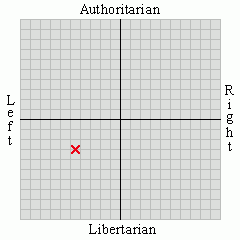
I am a left moderate social libertarian
Left: 4.51, Libertarian: 2.78
Political Spectrum Quiz
So, I remain modestly left-wing and modestly libertarian. In United Kingdom terms, that makes me centrist and socially liberal.
My Foreign Policy Views
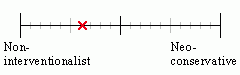
Score: -3.75
Political Spectrum Quiz
My Culture War Stance
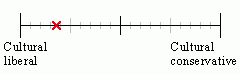
Score: -6.4
Political Spectrum Quiz
I'm not really an interventionist and I'm a cultural liberal. I'm reassured by that, wouldn't want to think that I was becoming a reactionary as I get older...
I am a left moderate social libertarian
Left: 4.51, Libertarian: 2.78
Political Spectrum Quiz
So, I remain modestly left-wing and modestly libertarian. In United Kingdom terms, that makes me centrist and socially liberal.
My Foreign Policy Views
Score: -3.75
Political Spectrum Quiz
My Culture War Stance
Score: -6.4
Political Spectrum Quiz
I'm not really an interventionist and I'm a cultural liberal. I'm reassured by that, wouldn't want to think that I was becoming a reactionary as I get older...
Wednesday, January 21, 2009
Who's afraid of the big Ken Clarke, the big Ken Clarke, the big Ken Clarke?...
Not me, I must confess? In fact, I would suggest that having Ken Clarke back on the Conservative frontbench is probably good for us.
The justification is that the Conservatives need someone with experience to take on Peter Mandelson. Hang on a minute, the noble Lord is... in the Lords, the one place where our suede shoe wearing, jazz loving Europhile can't go. And yes, he'll be up against him on television, but how many of the public actually care about business regulation? Indeed, how many Conservative shadow spokespeople in that role can most people remember?
Let's be honest here, bringing back a sixty-eight year old is hardly intended to be a long-term appointment. The prospects of Ken Clarke serving in the first Cameron cabinet are probably pretty remote, and this is simply a short-term fix intended to distract attention from the fact that there is no policy substance (still!).
He will entertain, in all likelihood, but he is a bruiser, not a strategist. You always sensed that his primary tactic as a minister was to pick a fight, and then get shuffled off to another job, leaving some other poor soul to mend fences afterwards.
From an outside perspective, his well-publicised differences with the Party leadership on the subject of Europe mean that he will be distrusted by the Eurosceptic right and by the more reactionary press (Daily Mail and Daily Telegraph). Every utterance with regard to Europe (and his portfolio is impacted by Europe more than some others) will be analysed for adherence to the 'line', and I frankly doubt his discipline.
I have to say though, he will at least be consistent, unlike his leader. Now, Mr Cameron, your policy on leaving the EPP and forming a more conservative grouping in the European Parliament. How's that going?
The justification is that the Conservatives need someone with experience to take on Peter Mandelson. Hang on a minute, the noble Lord is... in the Lords, the one place where our suede shoe wearing, jazz loving Europhile can't go. And yes, he'll be up against him on television, but how many of the public actually care about business regulation? Indeed, how many Conservative shadow spokespeople in that role can most people remember?
Let's be honest here, bringing back a sixty-eight year old is hardly intended to be a long-term appointment. The prospects of Ken Clarke serving in the first Cameron cabinet are probably pretty remote, and this is simply a short-term fix intended to distract attention from the fact that there is no policy substance (still!).
He will entertain, in all likelihood, but he is a bruiser, not a strategist. You always sensed that his primary tactic as a minister was to pick a fight, and then get shuffled off to another job, leaving some other poor soul to mend fences afterwards.
From an outside perspective, his well-publicised differences with the Party leadership on the subject of Europe mean that he will be distrusted by the Eurosceptic right and by the more reactionary press (Daily Mail and Daily Telegraph). Every utterance with regard to Europe (and his portfolio is impacted by Europe more than some others) will be analysed for adherence to the 'line', and I frankly doubt his discipline.
I have to say though, he will at least be consistent, unlike his leader. Now, Mr Cameron, your policy on leaving the EPP and forming a more conservative grouping in the European Parliament. How's that going?
Cannabis: a gentle warning from your friendly neighbourhood bureaucrat
Of course, I am fully aware that my readers are all thoroughly law abiding souls, but given your catholic tastes in friends and acquaintances, I thought you might like to pass word on…
The change in categorisation of cannabis from class C to B was announced by Home Secretary Jacqui Smith last May, and comes into force on 26 January. It means the penalty on conviction for summary cases, those conducted without a jury trial, will increase.
Offenders currently pay three times the value of the drug or £500 – whichever is greater – and can be imprisoned for up to three months. This will go up to three times the value or £2,000, with a potential prison sentence of six months.
The penalties for conviction on indictment are not affect by the reclassification.
Rules governing compounding, where offenders found with small quantities of the drug may in certain circumstances be offered the chance to pay a settlement instead of facing court proceedings, also differ between class C and class B drugs.
The change in categorisation of cannabis from class C to B was announced by Home Secretary Jacqui Smith last May, and comes into force on 26 January. It means the penalty on conviction for summary cases, those conducted without a jury trial, will increase.
Offenders currently pay three times the value of the drug or £500 – whichever is greater – and can be imprisoned for up to three months. This will go up to three times the value or £2,000, with a potential prison sentence of six months.
The penalties for conviction on indictment are not affect by the reclassification.
Rules governing compounding, where offenders found with small quantities of the drug may in certain circumstances be offered the chance to pay a settlement instead of facing court proceedings, also differ between class C and class B drugs.
A more diverse Parliament: it isn't about shortlists, it's about electoral systems and changing the culture
Whilst the inauguration of Barack Obama has been occupying the attention of most of the world's media, the Speaker's Conference on increasing diversity in Parliament has been hearing evidence. Two of those giving evidence today raised interesting points, and I agree with one as much as I disagree with the other.
I'll start with where I agree. Fay Mansell, from the Women's Institute (a far more radical organisation than one might expect), was of the view that the culture of the House of Commons was much too macho, and dissuaded women from getting involved. Indeed, the House of Lords, a much more civilised place, has women in a range of key roles, and some of the best performers on all benches are women. Ironically, such a situation might not survive the coming of an elected second chamber if the 'first past the post' electoral system is used.
There is no question that the culture of the House of Commons, while improved, is outputting to those who believe that a good argument and a strong case should help you to make policy and persuade others to support it. The quality of debate, the lack of courtesy and the childish sub-public school humour make you despair sometimes. Once again, compare and contrast with the House of Lords.
As a backbench MP, or an opposition one, you probably have less power and influence than a senior councillor on a unitary authority. The councillor will certainly have a budget, unlike MPs, will be able to go home at night, unlike MPs, and attract less abuse. You can understand why women are better represented at council level.
So yes, change the culture, cut out the mindless confrontation, make question sessions real, rather than an opportunity for the rutting stags on the green benches to score petty points, and resource MPs so that they can do their jobs well. That way, you might persuade some of the really talented women on county councils and unitary authorities to take that last step towards parliamentary candidacy.
And now for my area of disagreement. Simon Woolley, of Operation Black Vote, continues to promote all-black shortlists for Parliamentary candidate selection. Curiously, I supported the legislation permitting political parties to seek an exemption from anti-discrimination rules, on the grounds that such a notion fitted very nicely into Labour Party philosophy. If it does, I see no reason why they shouldn't be able to do it. Yes, they'll need to deal with the potential consequences - and Blaenau Gwent is a living reminder of what can go wrong - but they need to be true to what they think is right.
However, it appears that Mr Woolley is oblivious to the question of political philosophy. To ask Liberal Democrats to apply positive discrimination demonstrates that he doesn't 'get' liberal democracy as we see it. We are mostly uncomfortable with the notion that we should favour someone because they are something rather than having the right skills. We believe in merit, and that anyone with the right skills can succeed with work and a dash of charisma.
There are some in our Party who give the impression that, if we discriminate in their favour, all will be well, and we will have our more diverse Parliamentary party. And yet isn't it about the concept rather than the named individual? Our aim should be to create opportunity for everybody, and our 'tool of choice' is proportional representation.
Multi-member constituencies would create greater political diversity, would encourage political parties to cast their net wider for support, for activists and for candidates, and allow for the development of new political parties that fill niches that currently have insufficient oxygen to allow meaningful life. I don't hear Simon Woolley calling for that though...
I'll start with where I agree. Fay Mansell, from the Women's Institute (a far more radical organisation than one might expect), was of the view that the culture of the House of Commons was much too macho, and dissuaded women from getting involved. Indeed, the House of Lords, a much more civilised place, has women in a range of key roles, and some of the best performers on all benches are women. Ironically, such a situation might not survive the coming of an elected second chamber if the 'first past the post' electoral system is used.
There is no question that the culture of the House of Commons, while improved, is outputting to those who believe that a good argument and a strong case should help you to make policy and persuade others to support it. The quality of debate, the lack of courtesy and the childish sub-public school humour make you despair sometimes. Once again, compare and contrast with the House of Lords.
As a backbench MP, or an opposition one, you probably have less power and influence than a senior councillor on a unitary authority. The councillor will certainly have a budget, unlike MPs, will be able to go home at night, unlike MPs, and attract less abuse. You can understand why women are better represented at council level.
So yes, change the culture, cut out the mindless confrontation, make question sessions real, rather than an opportunity for the rutting stags on the green benches to score petty points, and resource MPs so that they can do their jobs well. That way, you might persuade some of the really talented women on county councils and unitary authorities to take that last step towards parliamentary candidacy.
And now for my area of disagreement. Simon Woolley, of Operation Black Vote, continues to promote all-black shortlists for Parliamentary candidate selection. Curiously, I supported the legislation permitting political parties to seek an exemption from anti-discrimination rules, on the grounds that such a notion fitted very nicely into Labour Party philosophy. If it does, I see no reason why they shouldn't be able to do it. Yes, they'll need to deal with the potential consequences - and Blaenau Gwent is a living reminder of what can go wrong - but they need to be true to what they think is right.
However, it appears that Mr Woolley is oblivious to the question of political philosophy. To ask Liberal Democrats to apply positive discrimination demonstrates that he doesn't 'get' liberal democracy as we see it. We are mostly uncomfortable with the notion that we should favour someone because they are something rather than having the right skills. We believe in merit, and that anyone with the right skills can succeed with work and a dash of charisma.
There are some in our Party who give the impression that, if we discriminate in their favour, all will be well, and we will have our more diverse Parliamentary party. And yet isn't it about the concept rather than the named individual? Our aim should be to create opportunity for everybody, and our 'tool of choice' is proportional representation.
Multi-member constituencies would create greater political diversity, would encourage political parties to cast their net wider for support, for activists and for candidates, and allow for the development of new political parties that fill niches that currently have insufficient oxygen to allow meaningful life. I don't hear Simon Woolley calling for that though...
Tuesday, January 20, 2009
The eyes of the world are turned towards Washington DC
And so the big day has arrived, and all of the news coverage is of the inauguration of that nice Senator Obama as President.
The British have always felt more at home with a Democrat in the White House, regardless of the affability or competence of the man himself, and I suspect that this is due to the chasm in ideology between Europe and the US.
Even the British, with our so-called special relationship, find Republicans hard work. The fixation with guns and religion is alien to most of us, given that we've banned handguns and licenced everything else. As for religion, we tend to the view that our faith, or lack thereof, is a private matter, not to be broadcast. Even the evangelical movement here is rooted in the Afro-Caribbean community, and hasn't really penetrated the consciousness of the rest of the population.
We're also more internationalist in our outlook. Whilst Kennedy, Clinton and Obama had travelled widely prior to their election, and not just to fight, many Republican contenders have been less travelled. Our experiences within a common Europe engender a belief in collective action, whereas Republicans tend to the view that, given that they have the capability, they can act alone, at least to some extent.
Bill Clinton was so popular here that, even in the midst of the impeachment hearings, his approval rating was 63%. Regardless of what he did at home, he was felt to be willing to persuade allies to act in concert, rather than browbeat them into acquiescence. His support for the Northern Ireland peace process was invaluable, and the warmth of the welcome given to him when he visited Belfast was utterly genuine.
George W Bush will be irredeemably linked to the invasion of Iraq, an action opposed by the majority of the British people, and the cause of too many resented deaths of young servicemen and women. Regardless of the validity of the invasion, it was felt that the US was ignoring the international framework for conflict resolution, faulty and ineffectual though it has often been.
We also struggle with questions related to the role of government. There is a far greater sense that government has an active role in building a better society, whereas Americans, particularly Republicans tend to be suspicious of 'big government'.
And so we welcome President Obama. He represents politics that we can relate to, but with added charisma and a sense of romance that we aspire to. He looks like a statesman, sounds like one too. The only worry is that we expect too much of him, but he's clever, articulate and appears to be managing our expectations closer to reality.
I wish him well...
The British have always felt more at home with a Democrat in the White House, regardless of the affability or competence of the man himself, and I suspect that this is due to the chasm in ideology between Europe and the US.
Even the British, with our so-called special relationship, find Republicans hard work. The fixation with guns and religion is alien to most of us, given that we've banned handguns and licenced everything else. As for religion, we tend to the view that our faith, or lack thereof, is a private matter, not to be broadcast. Even the evangelical movement here is rooted in the Afro-Caribbean community, and hasn't really penetrated the consciousness of the rest of the population.
We're also more internationalist in our outlook. Whilst Kennedy, Clinton and Obama had travelled widely prior to their election, and not just to fight, many Republican contenders have been less travelled. Our experiences within a common Europe engender a belief in collective action, whereas Republicans tend to the view that, given that they have the capability, they can act alone, at least to some extent.
Bill Clinton was so popular here that, even in the midst of the impeachment hearings, his approval rating was 63%. Regardless of what he did at home, he was felt to be willing to persuade allies to act in concert, rather than browbeat them into acquiescence. His support for the Northern Ireland peace process was invaluable, and the warmth of the welcome given to him when he visited Belfast was utterly genuine.
George W Bush will be irredeemably linked to the invasion of Iraq, an action opposed by the majority of the British people, and the cause of too many resented deaths of young servicemen and women. Regardless of the validity of the invasion, it was felt that the US was ignoring the international framework for conflict resolution, faulty and ineffectual though it has often been.
We also struggle with questions related to the role of government. There is a far greater sense that government has an active role in building a better society, whereas Americans, particularly Republicans tend to be suspicious of 'big government'.
And so we welcome President Obama. He represents politics that we can relate to, but with added charisma and a sense of romance that we aspire to. He looks like a statesman, sounds like one too. The only worry is that we expect too much of him, but he's clever, articulate and appears to be managing our expectations closer to reality.
I wish him well...
Subscribe to:
Posts (Atom)