The musings of a liberal and an internationalist, living in Suffolk's county town. There may be references to parish councils, bureaucracy and travel, amongst other things. And yes, I'm a Liberal Democrat.
Thursday, May 19, 2022
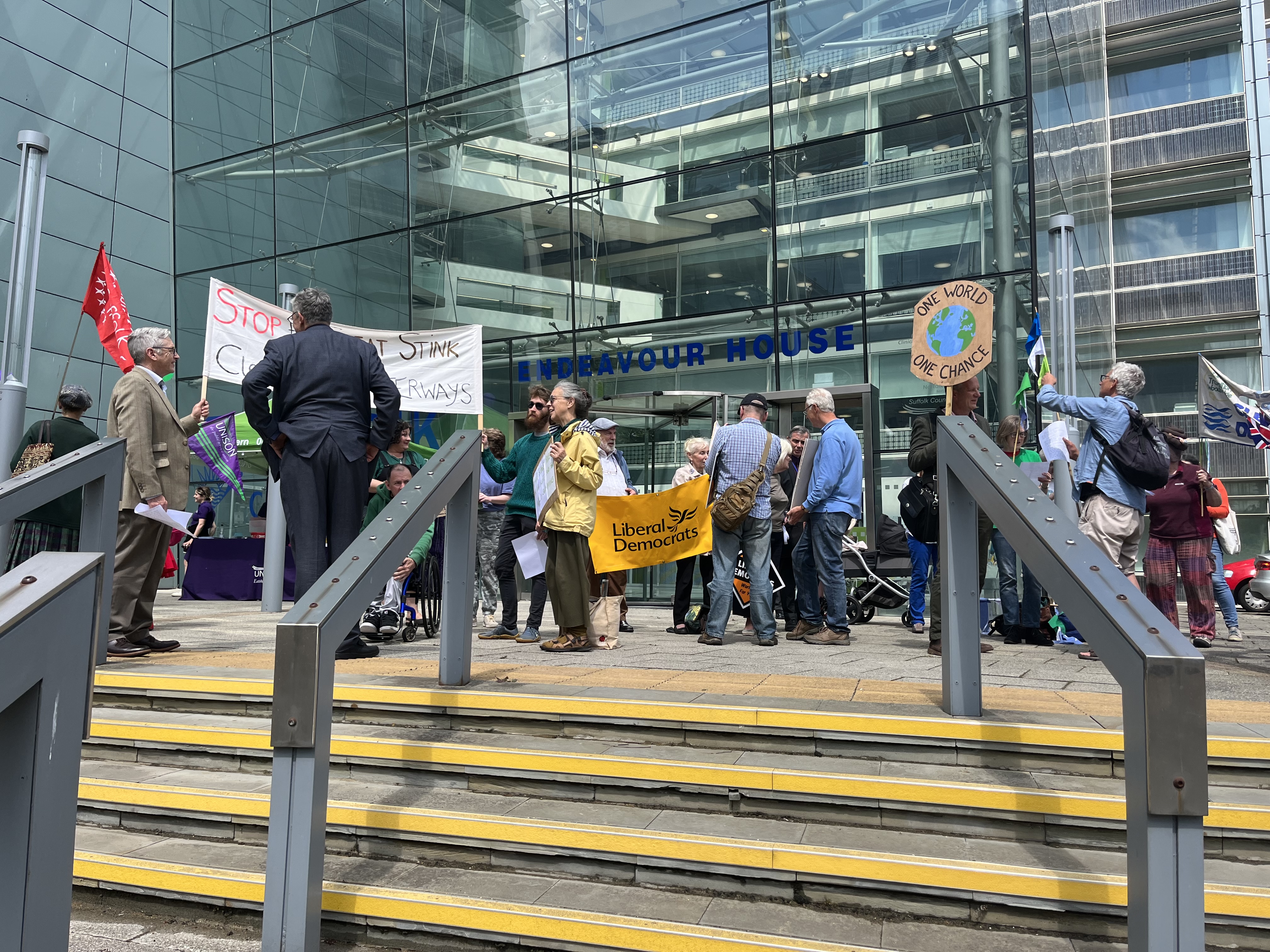
A genteel demonstration in the county town
Sunday, April 03, 2022
Compromise is the hardest thing to do…
Friday, April 09, 2021
Do Liberal Democrats appreciate bureaucrats?
Tuesday, April 06, 2021
Religion and political parties - not entirely a comfortable fit...
It would be fair to describe me as a not particularly devout Catholic. I don't attend Mass, I don't support my local Catholic church. I feel vaguely guilty about that, but see guilt as being part of the basic underpinning of Catholicism and so don't feel so bad about it. And, in truth, I have problems with a faith that discriminates against a majority of its own membership, let alone the rest of the population.
It would also be fair to say that, as a political activist, wishing people a happy (insert religious festival as appropriate) makes me slightly uncomfortable. In the multicultural society we live in, the sheer range of religious festivals to be marked means, that if you want to be seen as properly inclusive, you risk issuing so many messages that they become a bit of a cliché. Are you marking a particular festival because you care, or because you simply feel that you ought to?
Now I do accept that religious observance is still important in our society, albeit less so than once it was. In my own community, the Anglican Church plays a central part in community cohesion that it didn't obviously do in the London suburbs - or perhaps I wasn't looking for it. But I tend to the view that how you live your life and, as importantly, how you are perceived to do so, is more important than overt displays of religious tolerance and inclusion.
I sense, without much of a theological education to rely upon, that most religions have, at their core, similar philosophical positions - that you should help those in need, that you should respect the world around you and the people in it and that you should attempt to uphold what are generally accepted virtues. Do those things, and most people will see that you are at least trying.
But politicians want to be liked which, in a profession which centres on the ability to win organised popularity contests, perhaps shouldn't come as a terrible surprise. That does engender some degree of suspicion as to motive given how little trust is placed in them and so I find myself wondering how much value there is for a non-religious politician to mark religious festivals. Those who practice the particular religion might think it good to be included, whilst others will question the sincerity of the author.
For those who are publicly devout in their faith, I see rather less of a problem. And yes, as Tim Farron has discovered, being devout can bring with it a whole different set of problems, but that goes with the territory of having opinions - you have to be able, and willing, to justify them if challenged. But referring to religion when you are an active adherent feels a bit more justified to me.
Ultimately, it is for individual politicians to judge whether or not to mark religious festivals within their communities and to deal with the consequences of the stance they take. And, as long as political parties don't use it as an opportunity to attack each other, it probably does little harm overall. But, from a personal perspective, I will keep my religious beliefs a predominantly personal matter and respect the rights of others to practice their faith as they see fit...
Sunday, September 20, 2020
Are Liberal Democrats too busy talking to themselves to reach out to the electorate?
I have to admit that I drafted this a month ago for Liberal Democrat Voice, but decided not to publish it at the time - I wasn’t sure that I wanted or needed the grief that would probably come from offering it up to a (probably) larger audience than it would get here. But, the nagging thought in my mind won’t quite go away... so here it is. It isn’t necessarily my final word, nor is it a perfect distillation of my views, although it does seem to reflect the views of our new leader, perhaps unexpectedly.
As we come to the end of a leadership contest which feels as though it has lasted forever - and I admit to not having cast my vote yet - it has occurred to me that we seem to have spent a lot of time lately having leadership contests (or, in the case of Vince’s coronation, non-contest). Tim vs Norman, Vince vs the radicals, Jo vs Ed, Ed vs Layla. Four leadership elections in five years, and a lot of talk about what happens next.
Or not, really.
To win a leadership contest, you have to persuade members to feel good about themselves. That means that we talk about issues that matter to our members. It isn’t, however, necessarily the case that the campaigns talk about issues that matter outside that group, i.e. to the overwhelming majority of the public.
Now, some of you will be thinking that I have an unspoken agenda here. “Don’t talk about minority issues, talk about schools and hospitals, jobs and crime instead.”, might be running through your head. And, perhaps, you may have a point.
I’m proud of our opinions on minority rights, on social reforms that allow everyone (and I do mean everyone) to live their lives in the way they choose, subject to the restraints of law designed to protect us from harm. Our policies on those issues are well thought out, easy to articulate, and will make a real difference to lives. Making sure that we express those views when we’re talking to those who want to hear them, or those directly affected, is exactly what a radical, social reformist political party should do.
But, in spending so much time talking to ourselves over the last five years, we seem to have stopped talking about things that actually affect large numbers of people, many of whom just want to feel that someone is listening to them. Yes, we spent a lot of time talking about Europe - our members would want little else given the reason why so many of them joined. We tended to be unequivocal about how much better being in the European Union was, rather than arguing the case for working together. There was a worrying tendency by some to assume that those on the other side were racist or stupid, or both, rather than being ill-informed by our media, or despairing of the day to day grind of lives that weren’t so fortunate. But whilst we were focussed on that, we stopped expressing ourselves about the other stuff.
How much did we talk about housing, when so many young people are struggling to find a place they can afford? What did we say about the instability of work in an era of zero-hour contracts and the gig economy? What did we say about how the tax system and the finance sector distort our economy and encourage short-term investment strategies? Was it anything more than sound bites designed to attract a moment’s attention?
Can you remember? I can’t. And, perhaps, that’s the problem.
It seems to me that, where we’ve been successful over a long period, it’s because we talk to people about the things that matter, we offer solutions that resonate, and we have a passion to serve those communities. It isn’t where we take a purist approach, insisting that people sign up to the overwhelming majority of our policies. Hell, I don’t sign up to all of our policies, and I’ve been a member of the Party and its predecessor for thirty-six years.
So, whoever wins when the votes are counted, we need to talk to people where they metaphorically live. No, that doesn’t mean pandering to them, even if it’s tempting. It means addressing the things that, if fixed, would make their lives genuinely better, making the case for the changes we think will work, and being patient.
Being a Liberal Democrat isn’t easy. If it was, everybody would be one. We aren’t going to go from 6% to glorious victory in one electoral cycle, or even two or three. But, if we have any aspiration to do so, we need to start talking to them, not just us.
Wednesday, October 04, 2017
Mid Suffolk: the Boundary Commission proposes an unexpected outcome...
Thursday, September 01, 2016
Brexit: why I worry about what comes next...
Friday, January 01, 2016
Simon Danczuk: a knave, or just another victim of a capricious media?
The front page news in the Sun that Simon Danczuk, the Labour MP for Rochdale, was caught sending text messages of an unwise nature to a seventeen-year-old who had applied for a job in his office is just the latest in a series of bewildering events in the life of a man easily described as controversial.
The Labour Party has, in suspending his membership, done the only thing that it can do, given the way an unsympathetic media treat such matters. After all, to be seen to dither on what appears to be an open and shut case leads to day after day of hostile coverage, as Liberal Democrats have learned in recent times. It merely allows 'senior figures' to comment, often unhelpfully, for or against the accused and, given that most such people rarely know how their organisations' disciplinary processes work, they mostly act to make matters worse rather than better.Friday, July 17, 2015
MP pay - is it really too difficult to read the whole story before engaging outrage mode?
In my day job, I spend my time examining all of the available data in order to define any areas of doubt and uncertainty and then, having done so, work out a fair and rational way of dealing with them. It is surprisingly enjoyable, especially as you learn more about human nature and about how people organise, and rationalise, their lives. You get to meet interesting people and get a sense of their worlds.Wednesday, July 15, 2015
I wonder if the Daily Telegraph's editorial team have bothered to read the Conservative Party's membership rules...
Telegraph providing step by step guide on how to vote for Corbyn in order to help "doom" LAB.
http://t.co/AJNWGAzdKM pic.twitter.com/Ii6XHxRtV5
— Mike Smithson (@MSmithsonPB) July 15, 2015
The Party is a political Party for the Nation, open to all who share its objects and values and who undertake to be bound by this Constitution. The Party shall consist of its Members. Membership of the Conservative Party is not compatible with Membership of or association with any other registered political party.
Saturday, June 20, 2015
Bosmere Liberal Democrats - thinking about what matters to us
Thursday, June 18, 2015
It's been a slightly unusual day on Planet Bureaucrat...
| A few seconds of unexpected fame... |
Monday, May 25, 2015
The adventure is over, for the time being. Now, the hard work begins...
Saturday, May 09, 2015
@ALDEParty Council - the urgency resolutions working group
After a hearty breakfast, I arrived at the Council venue and took a seat. Vedrana Gujic, President of LYMEC (ALDE's youth wing), opened the meeting and we were under way. Resolutions on Greece and the Eurozone, protecting the European Single Market, mineral waste dumping in Norwegian fjords and the release of political prisoners in Russia, Belarus and Azerbaijan were pretty uncontentious. However, there was some debate on whether or not to push for visa-free access to the European Union for Ukrainians. Personally, I tend to the view that moving on this demonstrates to the people of Ukraine that we believe them, and want them, to be part of the European family, and is a good thing.
Friday, May 08, 2015
Alright, it's virtually all over. It's been horrible. We're not dead though.
Sunday, April 19, 2015
Creeting St Peter - @jemnicole1 has a leaflet put through our door...
So, hardly a temptation to vote Conservative. I wonder if the Greens have anything better to offer...
Friday, February 13, 2015
190 new homes in Stowupland - a challenge for honesty in politics?
Wednesday, February 11, 2015
@AamAadmiParty - now that's what I call a landslide...
Thursday, January 29, 2015
Hope? Yes by all means, but don't get carried away...
Monday, January 26, 2015
How faithful do you have to be to a party's policies to be a member?
After all, if a political party is to be a group of purists, how does it change and develop policy? Are those seeking change to be cast into the outer darkness if they are challenging a point of principle to be worshipped as though a holy relic?
Political parties do not, in my experience, spend a lot of time investigating potential new members for ideological purity, nor do they spend a lot of time debating ideas - there is too much campaigning to be done for that - but one would be reasonable in assuming that new members agree broadly with your message and, most importantly, with more of it than with any of the other choices out there.
So, how much of your party's policy should be supported in order to remain a member? 70%? 80%? 99%? And what is essential? After all, there are key Labour Party figures that believe in allowing the market into public services, Conservatives who support European integration (up to a certain point) and Liberal Democrats who are sceptical about Europe.
Yes, lobby individual representatives if you don't agree with them. Tell them why, remaining courteous. But if it's an offence to disagree with things that matter to you, do bear in mind that, one day, it might be you facing the mob. And please don't come to me for sympathy - it will be in short supply...


