Showing posts with label Liberal Democrats. Show all posts

Sunday, December 14, 2025

A dawning realisation that I don’t really fit, but that’s fine

Occasionally, someone revisits the idea that the Liberal Democrats consist of a number of tribes, and writes (usually quite thoughtfully) about how the interaction between the various groups impacts the way that the Party operates. And, as a long-term member whose history includes a variety of roles at every level of the voluntary party, I naturally read them with a degree of informed interest.

This year, the version that caught my attention was from James Baillie. James is a relative newcomer (admittedly, dinosaurs are relative newcomers compared to me these days) but his background as a historian offers a interesting perspective and his use of data opens up sources of evidence that underpin his logic. He identifies six groups;

  • Orange Bookers
  • Social Conservatives
  • HQ Loyalists
  • Moderates & Parochialists
  • Social Liberals
  • Radical Liberals
which feels about right, at least to this observer, although I might have used slightly different language.

And that’s kind of where my problem lies. I don’t sit easily with any of these groups and, in truth, nobody has ever come up with a grouping which I might recognise myself as sitting within.

It is, if you like, the blessing, and the curse, of being a bureaucrat in a political organisation and, despite my occasional attempts to “be something else”, that is my default role - my liberalism is best expressed by maintaining the societal and constitutional guardrails that protect a liberal society and allow others to shape that society. You might reasonably argue that this is an inherently conservative view of the world, and it probably is, but my motivation is to defend freedom by operating the systems that protect individuals from the overmighty state/party hierarchy (delete as appropriate). Rules matter, if you like.

And, in an environment where being part of a group matters more, as various groups within the Party organise and promote slates of candidates for its internal elections, I do feel, just a little bit, that I am something of an anachronism in not having an obviously political agenda or a desire for advancement.

That wasn’t why I didn’t run for election this year. I’m not a policy wonk, which rules out Federal Policy Committee, and I’ve not really got an obvious skillset which makes Federal Conference Committee a serious option. My professional life rules out the Federal Board (and realistically I’m not going to win anyway). I’ve been a member of Federal Council (and what a mistake that was) and Federal International Relations Committee, but feel that, for the time being, I’ve served long enough.

And you know, that's fine. Let someone else have a go and, if the time is right, I can find something that suits me and the Party at some point in the future...

Saturday, October 18, 2025

Time to bask in the glow of achievement... for now, at least...

I have been gloriously re-appointed as Suffolk's member of the National Assembly of the National Association of Local Councils (NALC), representing our county on the national stage in the town and parish council sector, and I ought to thank my fellow colleagues on the Board of the Suffolk Association of Local Councils for giving me the chance for what may be one last go-around in the role.

I do have another set of roles to decide upon, which offers some interesting questions. NALC elects its officers and committees for a two-year term, something that I will not be able to complete, as my eligibility comes to an end in May 2027 unless something extraordinary happens - a new Ipswich Town Council may have elections then, but I'd have to run (and win) in a town where Liberal Democrats are not often elected.

It would be foolish of me to count upon such happenstance...

On the other hand, I appear to have the respect of my colleagues on the National Assembly (which never ceases to surprise me), and I think that I add value as the current Chair of the Smaller Councils Committee and Co-Chair of the Micro Councils Network (we may be small, but we're often perfectly formed...).

I have a fortnight to make up my mind.

As encouragement perhaps, I find myself in the rather unusual role of panel member for a discussion of Local Government Reform at the Liberal Democrat East of England Regional Conference in Colchester on 15 November. Unusual, mostly because I really wouldn't consider myself to be an expert. Luckily, I'll be in the company of Chelmsford City Council Leader, Stephen Robinson, and NALC's Head of Policy and Communications, Justin Griggs, who both know more than I do and can look and sound intelligent whilst I try not to panic.

As I write this, it dawns on me that there isn't a woman on the panel - note to self to have a word with the Regional Conference Chair on this point.

I also ought to think about what I want to say, and an opportunity to do that is offering itself in just over a fortnight.

In the meantime, there's stuff to do, and I really ought to get on...


Friday, August 29, 2025

Party Presidency: the field begins to emerge

So, the starting gun has been fired, and the process of gathering nominations is underway in earnest. As far as I can tell, we have three candidates plus a potential fourth, so it's probably fair to start considering them in terms of potential pluses and minuses.

Josh Babarinde

An MP is not necessarily the best person to be Party President. They have a responsibility to their constituency electorate, although there's nothing to say that they can't juggle the two competing roles. There will be those who wonder why Josh is doing it, given that of the four MPs who have held the role, two went on to be Leader, a third lost contests for the leadership before and during his Presidency and the fourth was Robert Maclennan, who had already been Leader of the SDP.

There will also be questions about his ability to navigate the internal workings of the Party, given that I'm not aware that he has served on any Party committees and his local government experience is limited to two years on Eastbourne Borough Council. That's not to say that he hasn't got the skills required, but that I haven't seen them displayed.

On the plus side, he has a strong personality, is likely to be good in the media and is a proven campaigner, as his campaign for the Presidency has already demonstrated.

Prue Bray

Prue, on the other hand, I've known for a long time, given that we both operate with the field of candidate selection. She certainly knows her way around the Party, having served on a wide range of Party bodies over the years. She can certainly campaign, and I don't doubt her liberalism.

The questions here relate to both her media skills and her ability to influence the direction of the party and to be taken seriously by the Leader and his entourage. Whilst I have to accept that Mark Pack has clearly been effective as President, is he an exception, or merely the first of many non-Parliamentarians to fill the post?


Natalie Bird

I can't find a picture of her that I am happy to use, which perhaps suggests one of the core challenges to her candidacy. She has apparently announced in a private Facebook group that she is running but, until today's piece in Liberal Democrat Voice, there appeared to be no trace of a public campaign for the post.

She will doubtless be seen as a single issue candidate, acting as a champion of those who might be considered transphobes, and her first formal statement is rather policy heavy, not something that Presidents have traditionally sought to lead on. Her liberalism is not mine, and my only experience of hearing her speak was not entirely convincing, regardless of my views on the content.

I also suspect that name recognition will be a problem, given that most of those who will have heard of her at all will associate her with her legal action against the Party.

Finally, there is a rumour that S R Forster is thinking about running for the position, according to an old friend who runs a private Facebook group on internal party elections. I'll be honest, I have no idea who that is, why they want to run or what their key priorities are. That does not suggest a winning campaign, but maybe more will emerge from her or anyone else who suddenly decides to announce their candidacy.

We'll find out how many candidates can persuade two hundred fellow members from at least twenty Local Parties or SAOs to nominate them, I guess...

Sunday, November 24, 2024

A cautious dip into the Regional politics of the Liberal Democrats

You might think that I'd have learnt better, having served as Regional Secretary and then Regional Conference Chair in London, and then as Regional Secretary in the East of England, but I find myself hoping for a somewhat gentler return to the fray as a member of the East of England's Regional Candidates Committee.

Now, that said, there is the small matter of an election to win first, with six candidates for four places. My odds are perhaps improved by the slightly puzzling failure of two of my opponents to submit a manifesto, and the high probability that another will be directly elected to be the Regional Candidates Chair, but I take nothing for granted, even though I'm the only candidate who is running for just the one position.

So, why am I doing it?

I've always been fairly outspoken about the way we select our Parliamentary candidates but also about the importance of preparation by candidates. As I've written in the past, we can create all the pathways we like, but you can't just rock up at the last minute and expect to beat opponents who have been "working the patch" for months and even years. I've seen more of that than I'd like.

As Liberal Democrats, we rely heavily on a good ground war, and any successful Parliamentary candidate needs a strong relationship with the members of the Local Party who, by definition, will do a lot of the heavy lifting of leaflet delivery, canvassing and building the team that will organise, fundraise and all of the other essential stuff that is needed to win. And, no matter how charismatic you think you might be, familiarity matters.

As a member of a Regional Candidates Committee, my hope would be to work on a plan which would allow Local Parties to move as quickly as they'd like, and offer potential candidates the time and scope to effectively pitch for a job. What matters is knowledge and information, and if being a Parliamentary candidate is to be treated as being a bit like a career, you need to give people the tools they need to plan that "career".

That means getting as many potential candidates through the development process as early as possible, so that they can then focus on a seat or seats that they believe they could win selection for, keeping them informed of opportunities as far out as possible and then letting them do what they think needs to be done to be successful.

Meanwhile, a audit of Returning Officers, some refresher training if there are significant rule changes and a call for new RO "blood" will enable the Regional Party to be ready to respond to the needs of the Regional and National Campaign Teams.

I acknowledge that this sounds a bit like a pitch for the job of Regional Candidates Chair. So, why didn't I run for the post? Well, I have plenty of time for the incumbent (who is running for re-election anyway) and not enough time of my own to allow me to lead in the way I would see fit. I am, apparently, a busy person with everything I'm doing in the Town and Parish Council sector, and besides, it feels a bit presumptuous to turn up and run for a serious position. Besides, I'm not convinced that the powers that be who currently run English Candidates Committee would be wildly keen on having me back - I was something of a "wild child" in those days (relative to the membership of the Committee, that is). Ironically, more than a decade away has seen me mellow... a bit...

Saturday, September 21, 2024

A manifesto for Suffolk - talking about an evolution?

Whilst in Brighton, I found myself volunteering to help with the Suffolk County Co-ordinating Committee, a sinister group of Liberal Democrats working to elect more Liberal Democrats across Suffolk.

Now, in fairness, I've been there before, and it wasn't exactly the most exciting thing that I've ever done. But all good people should rally around the flag, and I've become a bit better at political strategy (you'd like to think so after all these years, wouldn't you?). Besides, you really can't just stand back and leave others to do the hard yards.

And so, I've spent part of an evening talked about a manifesto for next year's County Council elections. Unsurprisingly, you won't find any details here, because the drafting process is still at an early stage, and it's not going to be imposed upon our campaigners and activists without some consultation.

That said, there will be some obvious key elements. The Party nationally has outlined some key priorities, and you'd reasonably expect us to major on those in Suffolk, plus there are a number of challenges that face shire counties across the piece, especially that of finance.

It's going to be an interesting set of elections in Suffolk. Labour, who have generally been weak outside of the key towns, will now doubtless feel obliged to fight rural divisions, whilst the Greens will be ambitious to expand their influence beyond Mid Suffolk and the Waveney Valley and Reform will be something of a joker given their current lack of organisation and structure. The Conservatives have it all to lose, but in an atomised electorate, seats may well be won with relatively low percentages of the vote.

Our task, if you like, will be to find the space to make our presence felt amongst the hubbub of competing voices. How ready we are for the challenge is something that I hope to find out, having rather kept out of local Liberal Democrat politics in recent years.

Tuesday, September 17, 2024

Suitably inspired, I return to Suffolk

Conference over, I’ve taken a rather leisurely route back to Suffolk, having first diverted to a quirky hotel bar to spend a few hours with the Awkward Squad, decompressing after the Leader’s Speech.

It is for others to comment on the content of Ed Davey’s speech, but the warm-up, with seventy-one MPs sweeping onto the stage (and beyond) was a powerful reminder of what the Party achieved on 4 July. And the sense of joy after so many years of pain and disappointment was quite cathartic. You might almost feel inspired to deliver the odd leaflet or two. I might even do that at some point.

But I am reminded that my particular “skill” is bureaucracy - dealing with the process stuff that, if not done, restricts the resources available to campaign and, hopefully win. If you like, helping to remove the obstacles to progress.

And whilst I don’t have many official roles, I am modestly good at connecting people to other people who might be able to help them. For example, a conversation with an old friend from Liberal Democrats Abroad, and a conveniently timed Slack message from the Chair of Federal Council, has offered an opportunity to seek improvements to the Party’s technology that might help to connect Local Parties to Liberal Democrat voters and supporters overseas and allow greater involvement in candidate selections, for example.

Often, the challenge when trying to do something is as much about knowing who to talk to and how to reach them and, if I can help with the connections, it seems obvious that I should.

So, my hope is to try and be a little more engaged locally, be a bit more activist in my wider efforts and give a little more back to a Party which has, over very nearly forty years, given me rather more than I might have expected. Because, in the quest to build a better country, we all ought to be willing to make our own small contribution, even if it is an indirect one.

Sunday, July 07, 2024

General Election 2024: what happened in Ipswich

The superficial conclusion from Suffolk's county town is that Labour swept down upon Tom Hunt and the Ipswich Conservatives and put them to the metaphorical sword. Except, as it turns out, they really didn't, increasing the Labour share of the vote by 4% and actually achieving a lower number of votes than they had done in 2019.

No, as in so many places, it was Reform UK who really did for Tom - increasing their vote share by 13%. And yes, Labour will have gained some votes from the Conservatives, but they lost votes to, predominantly, the Greens, up from 2.6% to 8.3% and failed to squeeze the Liberal Democrats, who edged up from narrowly losing their deposit in 2019 to narrowing saving it in 2024.

In truth, I have no issue with Jack Abbott, our new Labour MP - I actually don't know that much about him, and his campaign didn't bring him to our door as best I can tell - and a near 7,500 majority should give him a degree of leeway against a Conservative bounceback in 2029, should that even happen. It is, I suspect, highly unlikely that he could be as unlikeable a human being as Tom Hunt was, and we'll see how effective he is at making the case for the town in Westminster.

From a Liberal Democrat perspective, saving the deposit for the first time since 2010 is a positive, even though it would be hard to say that we've made serious progress. We did benefit from having, in James Sandbach, a candidate who was able to work with the Local Party for an extended period, as opposed to the parachuted candidates we've had previously - and I acknowledge here Adrian Hyyrylainen-Trett's enthusiastic efforts in 2017 and 2019 - and there is a sense that there is a space for Liberal Democrats in the town's politics if only we can seize the opportunity.

I think that the national performance of the Party will add momentum to local efforts and, whilst it's hard to envisage Ipswich appearing on a list of Liberal Democrat target seats any time soon, thoughts will now turn to next year's County elections, where the Conservative vote will be targeted pretty ruthlessly by their opponents. 2021 was a good year for Conservatives in local government, and Suffolk was no exception to that, so there will be prospects for the opposition parties across the town. Labour, in particular, will be confident of sweeping the board in Ipswich, whilst we'll be hoping to resist the tide in St Margaret's division where the new boundaries favour us significantly.

Monday, June 12, 2023

Post-Federal Council, some musings on internal Party democracy and accountability

At the end of Federal Council last week, I raised with my new colleagues the question of reporting back - how, and to whom. I wasn’t trying to start a debate, more an attempt to give them something to dwell on.

My personal view is that, having been elected by the members (at least, those engaged enough to want to take part), I have some obligation to tell them what I’ve done and why, so far as is appropriate. Naturally, I will do that in my own mostly light-hearted way - I’ve never been one to take myself too seriously - but I will respect the responsibility that has been placed upon me.

That isn’t always easy. There have been those, many on the committees concerned, who are uncomfortable with transparency, and I do get that. Indeed, I take the view that there are some things too sensitive to be aired publicly, in which case I will not mention them or do so in a neutral manner designed to indicate that the subject has been discussed but no more.

I will also adhere to whatever rules that Federal Council decides upon in terms of confidentiality. There are some issues that require discretion, especially where they relate to individuals, in particular, staff. As a Federal Council member, I have an obligation to treat others with respect and courtesy, as made clear by the Member Code of Conduct.

This disappoints some people, who think that liberal principles require us to be utterly transparent. I judge that to be naïve, knowing as I do that our opponents would never make the same mistake. And, given that our strengths include hard work and an element of surprise, why give anything away that might jeopardise either?

My personal policy has survived the best part of two decades now, from my time on the London Liberal Democrats Regional Executive, its East of England equivalent, via English Candidates Committee to Federal International Relations Committee, and I’ve tried to be pretty consistent throughout.

That means that my reports aren’t “official” - that would require me to be the Chair, which I’m not. And they represent my perspective, based on what I know, which means that they might not be perfect - I may have missed nuance, or be unaware of institutional history/memory. But they’re mine, and I’m accountable for them.

So, when (or if) I choose to run for re-election, voters will have rather more than a brief, carefully curated, manifesto upon which to judge my worth. It is for my colleagues to decide how, and if, they do something similar, and I wouldn’t criticise their decision either way - they’re busy people with their own priorities and personal styles. Some will be more restrained, others not used to blogging or other social media. We are all different.

Sunday, June 11, 2023

ALDE Party Congress - where your correspondent did go to the (meat)ball…

The world turns, and things change.

For many years, going to an ALDE event meant being led by the suave, and occasionally cynical, Robert Woodthorpe Browne, whose almost legendary ability to cut deals meant that our influence somewhat outweighed our numerical strength. And now, we have a new leader, David Chalmers, whose first Congress this was.


Naturally, David operates rather differently, although he clearly gets that, in a post-Brexit environment, Liberal Democrats have to work harder (and smarter) to get things done. And, whilst he’s still trying to assess the strengths and weaknesses of his core delegation, and work out whether or not individuals can be trusted, he’s being cautious in terms of how much room for manoeuvre he can grant us. Discipline is the watchword.


There is a logic to that, in that we’re obviously not in a position to freelance - we’re bound by Party policy, of course, and there are relationships with other sister parties that we want to maintain.


In truth, it affects me less than some. I’m not much of a policy wonk, at least I know that I’m not expert enough to assert much. And my “specialist subject”, i.e. the inner workings of the ALDE Party, is seldom of critical import, or, if I’m frank, of interest to my colleagues. Except when it is…


And this Congress was one of those rare events, with some rather significant proposals on representation of non-EU member parties, the abolition of the Individual Members in their current form, and a clearer structure for the appointment of future Secretary Generals. Having served on a small working group appointed by the Bureau to look at the Individual Members and Secretary General issues, I at least had a grasp of what was happening and the background before it.


There were a lot of policy resolutions - forty-three in total, plus six urgency resolutions - far too many to allow any meaningful discussion, although they had been ranked in order of perceived significance to ensure that some of the most far reaching ones got debated.


But I did at least have a job of sorts. There was a time when Returning Officers mattered. With paper ballots, a count was required and ALDE’s somewhat bizarre elections rules - first past the post but with a stipulation that voters must vote for as many candidates as there are vacancies - meant that you did at least have to think a bit. Now, with electronic voting, once polls close, the ballot technician pushes a button, the results are displayed, and that’s it.


But the rules still state that a Returning Officer is necessary, and my German colleague, Daniel Obst, and myself are apparently acceptable to the Secretariat - I don’t imagine that the Bureau care much - and so we are informally approached in advance, agree to resume our double act and all is well.


All that was required was to get to Stockholm…

Saturday, May 06, 2023

Now that we've found Federal Council, what are we gonna do... with it?

Well, I've now been a member of Federal Council for more than a fortnight and, due to the small matter of some local elections, not much has happened. I've got a meeting pencilled in for 8 June and I'm assuming that there's an outline meeting schedule for the rest of 2023 but other than that, Federal Council remains a bit of a mystery.

It's not as if I've not got a bunch of other things to do, so I can at least be more sanguine about this. In the meantime, I've read the Federal Constitution, which says of Federal Council:

9.12 There shall be a Federal Council which shall consist of the following voting members:

a. Twenty-one people who shall be party members elected by all members of the Party except that persons who, at the date of the close of nominations for election under this paragraph, are members of Parliamentary Parties set out in Article 17 shall not be eligible to be candidates for election under this paragraph. Casual vacancies amongst this group shall be filled in accordance with the election regulations;

b. Three members from each State Party, elected according to their own procedures;

c. Three principal local authority councillors, elected Mayors or Police and Crime Commissioners, elected by the principal local authority councillors, elected Mayors and Police and Crime Commissioners of the Party;

d. Three members of the Young Liberals, elected according to their own procedures;

e. Three representatives of the Parliamentary Group as set out in Article 17.5; and

f. The Chair of the Federal Audit and Scrutiny Committee.

9.13 The Chair of the Federal Council shall be elected by its members.

9.14 Members of the Federal Board may attend and speak at meetings of the Federal Council but may not be voting members of the Federal Council.

9.15 The Council shall be responsible for scrutinising the work of the Federal Board, including ensuring that decisions are being taken in line with the party strategy as voted for by Conference, and may require a response on any issue from the Board.

9.16 The members of the Federal Council shall be sent the Board agenda, decisions and relevant papers. Within five working days of the publication of the decisions any 13 members can request that the Chair of the Federal Council call in any decision by the Federal Board to a meeting of the full Federal Council. The President of the Party will be required to attend this meeting and can bring any others they feel relevant in order to speak in favour of the decision. Any decision of the Federal Board called in can be overturned by a vote in favour by at least 27 members of the Federal Council.

9.17 The Council shall be considered to be a Committee of the Federal Party for the purposes of Articles 2.5, 2.6, 2.7, 8.2, 8.5, 8.8 and 8.9.

I've also looked to see, as far as I can, who got elected to serve on it and whilst I have worked with some of them, or know them because of Ros, there are others who, to be honest, are more of a social media presence. That doesn't entirely surprise me, given that I've kept a relatively low profile within the wider Party for a while now.

And, finally, I've re-read my manifesto. This is what I said I would try to achieve if elected...

But what are my ambitions if elected to serve?

  • Establish the Federal Council as an effective scrutiny body, engaging all of its members in its work and using their strengths to establish its credibility
  • Build a relationship with the Federal Board based on mutual understanding and respect
  • Represent and engage with groups across the Party and Federal Conference to ensure that we focus on what matters to members rather than simply promoting any narrow agenda
  • Create reporting channels that allow members to hold us accountable

So, no great challenge there...

And on reflection, that did look rather like a manifesto for Chair of Federal Council, rather than an ordinary member. So, perhaps I ought to scale back my ambitions a little. How about this:

  • Work with fellow Council members to establish the Federal Council as an effective scrutiny tool
  • Engage with groups across the Party to ensure that I focus on what matters to members rather than simply promoting a narrow agenda
  • Report back using my blog and, if appropriate, Liberal Democrat Voice

There are some things that matter to me - good governance, the Town and Parish Council sector, the Party's international work, for example - which I hope to promote during the next two and a half years. But I like to think of myself as being fairly open minded, willing to hear and consider the arguments whilst not assuming that anyone in a position of authority in the Party has a secret agenda that I should be deeply suspicious of.

And so it begins...

Sunday, March 05, 2023

That'll teach me to read the Conference papers a bit earlier next time...

I'm a Liberal Democrat and I read constitutions. That makes me, it seems, slightly geeky, even by the standards of Liberal Democrats. However, occasionally, I spot something that makes me think and, having started the process of organising my diary for Spring Conference, I allowed myself to be distracted by the content.

That allowed me to spot agenda item F3: Business Motion - FIRC. It is, in the generality, a good thing, in that it tidies up the way in which the Party delegations to the Alliance of Liberals and Democrats for Europe (ALDE) and Liberal International are chosen and led, codifying what was done by custom and practice in the past. The problem is that I think that it contradicts the Internal Regulations of the ALDE Party. See what you think...

F3: Business Motion - FIRC

1. Our delegation to the ALDE Council shall comprise:

b) Any Liberal Democrat members of the ALDE Bureau, unless they already have their own place as Council members.


whilst the ALDE Party Internal Regulations say:

The following persons will be entitled to attend the meetings of the Council, with voting rights:

b) Members of the ALDE Party Bureau. Each Bureau member carries an individual vote and cannot take an additional proxy vote, either on behalf of another member of the ALDE Party Bureau or of an ALDE Party member party.

Now call me quirky and old fashioned, but that suggests that ALDE Party Bureau members can't vote on behalf of member parties, whilst the Business Motion puts any Liberal Democrat member of the Bureau in exactly that position. Doesn't it?

There is still time (just) to amend it, but I don't want to appear to be being awkward for the sake of it. Suggestions, Liberal Democrat hive mind?

Monday, September 26, 2022

Liberal Democrat Internal Elections: "a million thanks, dear friends!"

A few of you will know that I've thrown my hat into the ring again this year. Again, I wish to serve as a member of the Party's delegation to the ALDE Party Council - it's something that I think I've done well and credibly. I've also put my name forward to be a member of Federal Council, for reasons I'll explain another time.

This year, the nomination process has become rather more technologically advanced. You notify the Returning Officer that you wish to stand, and you are then added to a list of candidates who can nominated by any party member wishing to do so. Once they have, the candidate gets an e-mail advising who their latest nominator is and, eventually, that you have enough nominations to be accepted as an official candidate. It works pretty well, although there will be some valuable lessons learnt for next time, I suspect. Much credit should go to those responsible, nonetheless.

Now, having not really publicised the fact that I am running (with the exception of one Facebook group), I was somewhat surprised as a steady stream of e-mails arrived, especially as many of those who had gone to the trouble of nominating me aren't actually members of that group. It was, and is, rather touching that people with whom I've worked, in a range of capacities over more than thirty years, have sufficient confidence in me as a candidate. They've actually done so unprompted (at least, unprompted by me).

I am a realist. Nominating me doesn't necessarily mean that I'll get their first preference, or even a very high one, but it does offer some confidence that I may have a shot at getting elected, which is reassuring.

So, if you are one of those who have nominated me, many, many thanks. Your kindness has given me a bit of a fillip, never a bad thing.

And now, to produce a couple of manifestos...  

Thursday, May 19, 2022

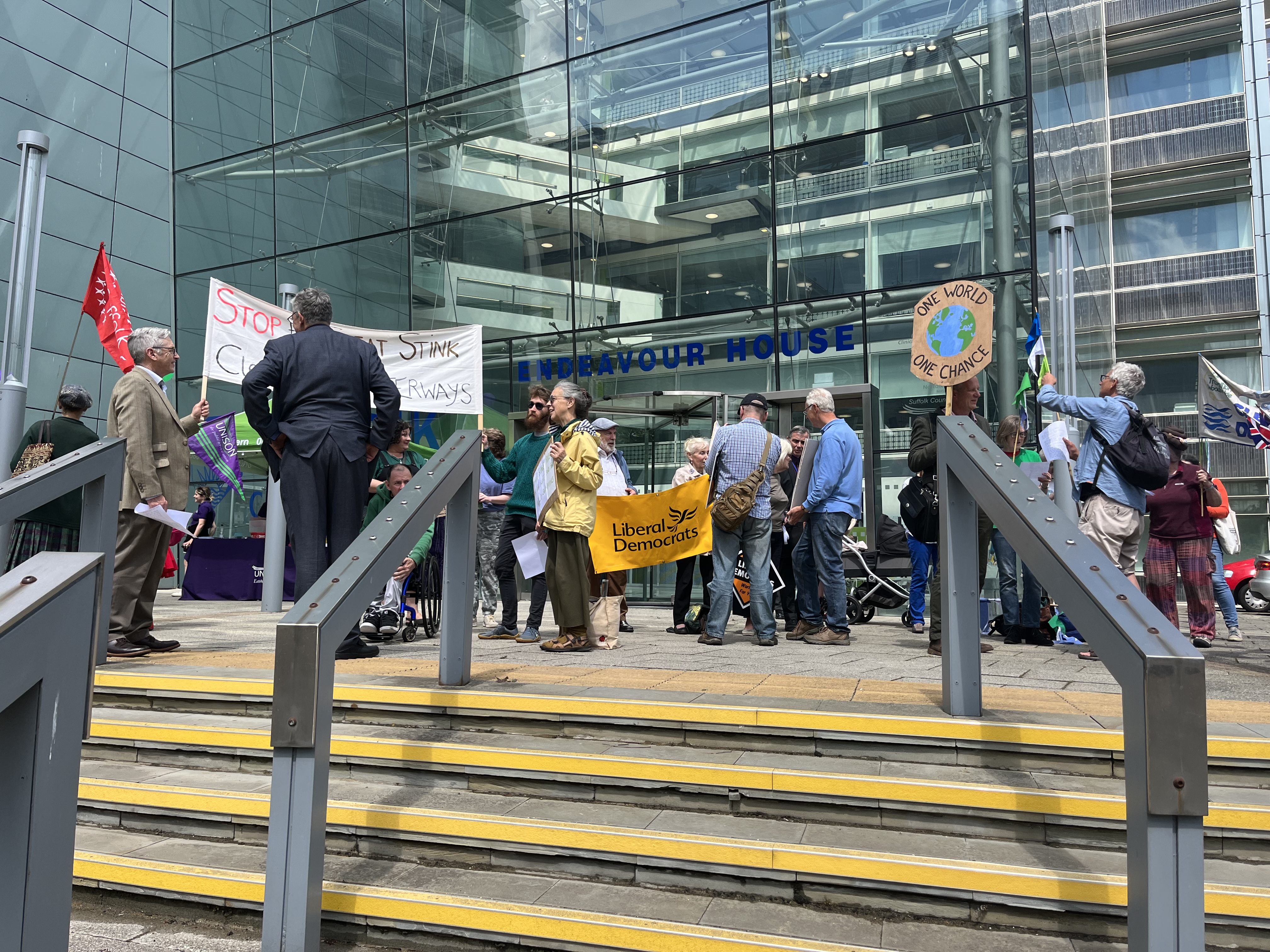
A genteel demonstration in the county town

I am not, by nature, the sort of person who enjoys demonstrations. I’m increasingly less keen on crowds as I get older (and I wasn’t wild about them even when I was young) and chanting isn’t really my thing either.

But I’d received an invitation to a demonstration outside County Hall at lunchtime and, given that my office is less than ten minutes away on foot, it seemed churlish not to show some support. The subject of the protest was sewage pollution of our rivers and coastline and, as this is both a Party priority and a matter of local interest in the Gipping Valley, it couldn’t do any harm to play “fourth spear carrier” for a few minutes.

Our County Councillors formed a joint Group with the Greens and Independents, and are the “official” Opposition, so were putting a motion to Full Council calling for action, and the demonstration was part of the publicity effort.

I arrived to find a collection of familiar faces, including my own (Green) County Councillor, Keith Welham, and a group from Mid Suffolk, and took the opportunity to get a few “politics” things done, whilst the Greens (and the odd Liberal Democrat) sang songs in a very “knit your own muesli” sort of way. Something else I’m reminded of - I’m not wildly enthused by communal singing unless a certain, albeit modest, level of alcohol has been consumed first.

That gave me an opportunity to escape, the media having taken their photos anyway and only really wanting to talk to the Group, so I walked into town for a little light food shopping before heading back to the office for a solid afternoon of compliance.

I don’t think that I’m going to change my mind on demonstrations…

Wednesday, May 12, 2021

And so, in a not entirely welcome turn of events...

Seventeen months ago, in a set of internal party elections whose outcome was not entirely unexpected, I lost my place on the Federal International Relations Committee (FIRC) and failed to be elected back onto the ALDE Party Council delegation, the latter despite a second bite of the cherry granted to me by the party's (relative) success in the December 2019 General Election.

I wasn't that far from success in either contest but, if you haven't won, you've lost. And, in fairness, looking at who had won, and indeed at some of those who had lost, I couldn't in all fairness have much complaint. I don't offer the electorate promises on policy that aren't actually salient - ALDE Party Council seldom discusses policy and is more like a rather large Finance and Administration Committee - and my reputation is as a bureaucrat rather than an internationalist (that'll teach me to care about structure and process, won't it?). And, the candidates who beat me could claim experience and knowledge that, in truth, I can't match.

Accordingly, I had reconciled myself to the outcome and was hardly pining for a return - life is too short, and there's a whole world out there for someone with a sense of intellectual curiosity and a desire to understand as far as possible.

A vacancy had arisen, following the resignation of one of the directly elected FIRC members, both from the committee and the Party, but I wasn't the runner-up, and you seldom see that many resignations, even in a three-year term. And so, Jonathan Fryer's untimely, and extremely unfortunate, demise created an unexpected vacancy on both FIRC and the ALDE Party Council delegation.

Having been consulted on how the vacancies should be filled, for reasons I don't entirely comprehend, I pointed the Committee to Jack Coulson, the Party's very capable Company Secretary, who handles such things in accordance with the Party's constitution, and left matters to take their course.

Internal by-elections are often quite hard to call, especially when you're effectively eliminating someone with a considerable number of first preferences. The way they split isn't easily predictable, especially if, in the original count, their preferences weren't transferred as part of the process. Looking at the original result, there were a number of candidates potentially in the frame, so I didn't get my hopes up. And, as already noted, I wasn't desperate to return.

The result was a bit of a surprise, in that I was now successful in both elections. There was, however, something unexpected, in that the Constitution says that, in the event of a recount, no previously elected candidate should lose their place, and, in the ALDE Party Council recount, exactly that had happened. And so, I appealed, knowing that, if my appeal was successful, I would lose my newly gained place.

I should be somewhat embarrassed by the fact that my appeal was unsuccessful - * long time bureaucrat in interpretation fail * - but sometimes you don't have all of the facts and it turned out that the interpretation of the constitutional validity of the initial declaration of the result of the 2019 election had not been widely known.

And so, I am back, at least until 31 December next year. I'm not planning to get comfortable, and I don't know if I'll even run for re-election - we'll see how it goes. But you can expect some coverage here about what I'm doing on the Committee and elsewhere, for there's little point in my representing those people who kindly voted for me, and indeed, those who didn't - I didn't take it personally, I promise - otherwise.

So, bureaucrat, parish councillor and international activist. It's an eclectic collection of roles, but each offers me the opportunity to contribute to making things better, even if only slightly. And, at the end of the day, if you're making things better, you are making a contribution towards the wider community, and isn't that something we should all aspire to?...

Friday, April 09, 2021

Do Liberal Democrats appreciate bureaucrats?

Thirty-five or more years as a bureaucrat, both professionally and on a volunteer basis within the Liberal Democrats has, to be honest, taught me that the answer is no, not really.

Given that, in my experience from five Local Parties, two Regional Parties, my State Party and a Federal Committee, most key administrative tasks are performed by busy people who, on the whole, would rather be doing something else, that leads me to wonder how vulnerable political parties are to organisational failure.

Most people join political parties because they either want to be something or change something. If you're lucky, they want both, because that means that you can fill the roles that need filling. That's primarily seen as being either a candidate or a campaigner, because what is a political party if it doesn't run candidates for public office? But, behind them are a small corps of people who enable, for want of a better word. They're the ones that ensure that your group is compliant with the law, like Treasurers, or the Constitution, like Secretaries.

And, unlike your candidate, who at least theoretically has a chance of getting elected and holding power, your Treasurer and Secretary are probably doing it because "someone needs to" and they're the ones too slow, or too nice, to escape. There is no glory, little gratitude, and a swathe of hassle from those who would rather criticise you for doing what they perceive to be a bad job than offer to do it themselves. You probably don't need to travel much though, so that's a good thing at least.

Then there are the organisational roles which are required by the Party's rules, with good reason. Neutral returning officers, members of disciplinary and appeals panels, for example. If you thought that there was little glory or gratitude to be had from holding local office, trust me when I say that there's even less in holding one of these positions. They can take days and weeks out of your life and, whilst occasionally, someone says thank you, it is perhaps a mark of how often that happens that I am pleasantly surprised when someone does. This year's Young Liberals fall into that category, for example. And, in normal times, you are expected to travel, though please keep the costs down.

To give you an idea, I was once barked at by a European Parliamentary candidate for not approving their manifesto (we used to do that once) within five hours. And they were right, in that I hadn't. The fact that I was on holiday in Argentina, and it had been sent at 3 a.m. my time was an irrelevancy - it was assumed that their urgency trumped respect for a volunteer.

My sense is that Liberal Democrats don't really approve of bureaucrats. They are, at best, an obligatory element of running a political party, but that lack of approval runs further than that, in that I've often found myself bridling slightly when Liberal Democrat politicians talk about the Civil Service. Admittedly, that doesn't happen perhaps as much as it should - when was the last time you heard a Liberal Democrat talk about Civil Service recruitment and retention, or pay and conditions, or how Government Departments might be better managed and led?

Perhaps a look a the 2019 manifesto might enlighten? Actually, no it won't... The 2014 Policy paper "Protecting Public Services and Making Them Work For You"? I'm afraid not.

Now, before the cavilling starts - "we're really grateful", "thank you for everything you do" - and for those of you who do, and have, thanked your friendly neighbourhood bureaucrat over the years, please don't feel the need to do so now, I wouldn't suggest that the problem is unique to Liberal Democrats, far from it. However, Labour and the Conservatives have the advantage of a pool of paid professionals who can handle much of the arduous bureaucracy.

And, when push comes to shove, the unglamorous, arduous bits of politics are just as unvalued across the political spectrum, which is why most politicians discussing bureaucracy are generally critical rather than constructive.

I am, perhaps, more resilient than most. In my professional life, I seldom expect to be thanked, or even liked - that would be a bit weird, if I'm honest. But, as a volunteer, doing a job that very few people want to do, you do need to receive a little respect and gratitude, commensurate with the effort outlaid if you're doing a decent job.

So, when your next AGM comes round, and your Secretary, who has been hinting that they'd really like to be relieved, is being urged to do "just one more year", perhaps it might be a good idea to do some succession planning in advance? At the very least, thank them for their service, lest they decide that a midweek evening is more pleasurably spent in front of a television scheme or with loved ones.

Tuesday, March 23, 2021

A Liberal Democrat manifesto for Suffolk

Whilst I might be best described as semi-detached from party activity in Suffolk - you only really appreciate what's going on if you hold some sort of organisational position unless you work at it - I do still get the various e-mails, and today news reached me of the launch of the Liberal Democrat manifesto for May's County Council election. And, as someone who 'has views', you won't be surprised to hear that I read it with some curiosity.

I have to admit that I'm impressed - it actually looks like a programme for (local) government - and I particularly approve of the transport section, which reads;

Integral to our plan is providing a safe, carbon efficient, and high-quality transport system, and attending to our neglected roads, cycle routes and public transport. Our transport plans include:

  • Introduce county-wide electric vehicle charge scheme by 2023, and no new home should be built without one.
  • All council vehicles to be zero emission by 2029 by securing a pool of electric cars for staff business use.
  • Support for rural public transport with a council owned bus company motivated by service, not profit, with buses to be ultra-low emission by 2025. We will start with a demand-scoping exercise on where priority demand is for bus routes.
  • Re-enable the use of concessionary bus passes on community transport.
  • Encourage cycling with electric bike grants and more cycle lanes, improve cycling infrastructure and maintain existing routes.
  • Implement more 20mph areas where they are supported by residents and couple these to the Quiet Lanes project.
  • Lobby for more direct rail freight network investment to our port.
  • Investigate alternative options to relieve the northern traffic inflow into Ipswich, such as more park and rides into town, improvements for cyclists, better traffic management, and possibly a second Orwell crossing, rather than the expensive and environmentally ruinous Northern Bypass.
It makes perfect sense to start building infrastructure to support electric vehicles and, in a county where most households have at least one car, building new homes with their own charging point should be a no-brainer.

I like the idea of a council owned bus company, because one of Suffolk's weaknesses is that its bus network is highly fragmented, with First Group and Ipswich Buses competing in the county town and its environs, and the rural network split between a myriad of small providers until you get to the Cambridge hinterland, when Stagecoach dominate.

Naturally, I support the Quiet Lanes initiative - Ros "invented" them as part of her input into the 2000 Transport Act - and they may improve pedestrian and cycling usage.

But, perhaps predictably, my warmest welcome is for the reference to re-enable the use of concessionary bus passes on community transport. Here in Mid Suffolk, the County Council signed a contract which meant that the contracted provider didn't accept them, which seemed hugely unfair given the number of small villages without regular bus services and the number of elderly residents who would certainly benefit from the community transport option.

It's a bit of a longshot for the Conservatives to lose control here in Suffolk - the combined Opposition are coming from a long way back with the Conservatives holding 49 out of the 75 seats, with two more ex-Conservatives in the chamber - but you never know after what happened here in Mid Suffolk in 2019.

It is, I admit, nice to see a manifesto that offers a meaningful programme of change, and hopefully it will be a means towards arguing the case for more liberalism in a county that's been a bit short of it in recent times.

Thursday, January 07, 2021

Suffolk Liberal Democrats select Justice campaigner as their Police & Crime Commissioner candidate

I don’t normally reproduce press releases here but I’ll make an exception for this one...

Justice campaigner and former Parliamentary Candidate James Sandbach has been selected as the Liberal Democrats’ candidate for the upcoming Police and Crime Commissioner election in Suffolk.

James has been involved in Suffolk politics for several years having been the Lib Dem Parliamentary candidate in Suffolk Coastal (2015 and 2017) and Central Suffolk and North Ipswich (2019). He lives in Saxmundham where he is Town Councillor.

Professionally, James has an active background in the voluntary sector, the justice system and the challenges it faces – over the past 15 years he has worked for leading national charities Citizens Advice, the Legal Action Group, and LawWorks (the solicitors pro bono group).

On the upcoming election, James said;

I am delighted to have been selected to be the Lib Dem PCC candidate for Suffolk. The PCC has an important role in supporting our fantastic local police force, and ensuring the policing needs of all of Suffolk’s communities are met.
Since I moved to Suffolk, I’ve been struck by the ever-diminishing emphasis on community policing – police numbers down, local stations closed, and the thin blue line stretched far too thinly. I strongly believe that when it comes to fighting crime, anti-social behaviour and low-level disorder, prevention and deterrence is always the best approach but to do that well there must be a strong bond between the police and local communities, accessibility, and a visible presence. 
I’m looking forward to talking to communities across Suffolk about their concerns and my priority will be to fight for better funding and resources to support the police in the vital work they do in the community.

I wish James good luck in the months ahead...

Sunday, September 20, 2020

Are Liberal Democrats too busy talking to themselves to reach out to the electorate?

I have to admit that I drafted this a month ago for Liberal Democrat Voice, but decided not to publish it at the time - I wasn’t sure that I wanted or needed the grief that would probably come from offering it up to a (probably) larger audience than it would get here. But, the nagging thought in my mind won’t quite go away... so here it is. It isn’t necessarily my final word, nor is it a perfect distillation of my views, although it does seem to reflect the views of our new leader, perhaps unexpectedly.

As we come to the end of a leadership contest which feels as though it has lasted forever - and I admit to not having cast my vote yet - it has occurred to me that we seem to have spent a lot of time lately having leadership contests (or, in the case of Vince’s coronation, non-contest). Tim vs Norman, Vince vs the radicals, Jo vs Ed, Ed vs Layla. Four leadership elections in five years, and a lot of talk about what happens next.

Or not, really.

To win a leadership contest, you have to persuade members to feel good about themselves. That means that we talk about issues that matter to our members. It isn’t, however, necessarily the case that the campaigns talk about issues that matter outside that group, i.e. to the overwhelming majority of the public.

Now, some of you will be thinking that I have an unspoken agenda here. “Don’t talk about minority issues, talk about schools and hospitals, jobs and crime instead.”, might be running through your head. And, perhaps, you may have a point.

I’m proud of our opinions on minority rights, on social reforms that allow everyone (and I do mean everyone) to live their lives in the way they choose, subject to the restraints of law designed to protect us from harm. Our policies on those issues are well thought out, easy to articulate, and will make a real difference to lives. Making sure that we express those views when we’re talking to those who want to hear them, or those directly affected, is exactly what a radical, social reformist political party should do.

But, in spending so much time talking to ourselves over the last five years, we seem to have stopped talking about things that actually affect large numbers of people, many of whom just want to feel that someone is listening to them. Yes, we spent a lot of time talking about Europe - our members would want little else given the reason why so many of them joined. We tended to be unequivocal about how much better being in the European Union was, rather than arguing the case for working together. There was a worrying tendency by some to assume that those on the other side were racist or stupid, or both, rather than being ill-informed by our media, or despairing of the day to day grind of lives that weren’t so fortunate. But whilst we were focussed on that, we stopped expressing ourselves about the other stuff.

How much did we talk about housing, when so many young people are struggling to find a place they can afford? What did we say about the instability of work in an era of zero-hour contracts and the gig economy? What did we say about how the tax system and the finance sector distort our economy and encourage short-term investment strategies? Was it anything more than sound bites designed to attract a moment’s attention?

Can you remember? I can’t. And, perhaps, that’s the problem.

It seems to me that, where we’ve been successful over a long period, it’s because we talk to people about the things that matter, we offer solutions that resonate, and we have a passion to serve those communities. It isn’t where we take a purist approach, insisting that people sign up to the overwhelming majority of our policies. Hell, I don’t sign up to all of our policies, and I’ve been a member of the Party and its predecessor for thirty-six years.

So, whoever wins when the votes are counted, we need to talk to people where they metaphorically live. No, that doesn’t mean pandering to them, even if it’s tempting. It means addressing the things that, if fixed, would make their lives genuinely better, making the case for the changes we think will work, and being patient.

Being a Liberal Democrat isn’t easy. If it was, everybody would be one. We aren’t going to go from 6% to glorious victory in one electoral cycle, or even two or three. But, if we have any aspiration to do so, we need to start talking to them, not just us.

Wednesday, September 16, 2020

The Kind Hearts and Coronets route to a place on a Federal Committee?...

Readers may recall that my campaigns for election to the Federal International Relations Committee and the Party’s delegation to the ALDE Party Council were less than entirely successful - I was the second runner-up for both. And that was alright, as I’m a great believer in democracy and have never seen myself as having a divine right to do anything. Besides, it’s not as if I don’t have other things to keep me entertained.

However, news reached me the other day that, after only eight and a half months, the Federal International Relations Committee has a vacancy, following a resignation. I know this because the Committee’s Chair contacted me to ask who would fill the vacancy, assuming that I had been the Returning Officer. I was slightly perplexed for a moment, given that I had been a candidate myself, but courteously pointed him in the direction of the Chief Executive, who can arrange for a recount to fill the vacancy.

And so I wait for news of the newly-elected member of FIRC. Given my somewhat lively past as a member, I won’t be lying awake at nights hoping that it will be me, although I still think that I have a different perspective to offer.

In truth, FIRC has not really achieved what I had hoped for it - a useful resource for the wider Party, bringing together expertise and marrying it with political strategy for the benefit of the Foreign Affairs teams in Parliament and for local campaigners who might come across specific issues in their local campaigning. It feels a bit like a bolt-on, rather than an integral part of the Party’s policy and campaigning effort.

Reporting back seems to have stopped too, although somebody would have to have the will to take the role and just take responsibility for it.

We’ll see what happens though...

Thursday, June 25, 2020

Not left, not right, but liberal?

So, Layla versus Ed, unless something very unexpected happens. And you're expecting me to have an opinion on which of them I believe will lead the Liberal Democrats into government at the next election.

My answer? Neither of them, to be honest. Going from eleven seats to government, even as a junior partner, is pretty unlikely, if you ask me. We can safely rule out forming a majority government - that sort of thing doesn't happen in fairy tales, and it certainly doesn't happen in British politics. Even the Labour Party don't believe that they can increase the number of seats they hold by 60% under normal circumstances, and in a country where 40% of the population still believe that the Conservatives are the best choice to run things other than a bath, you do wonder how bad things would have to get before opinion turned against them.

That said, the combination of COVID-19 and a hard Brexit might just do it...

A hung Parliament where adding Liberal Democrats would swing the outcome? Possibly, but how many seats would you want to have a real influence, as opposed to being a human shield? Coalition with the Conservatives? Regardless of whether or not it might make sense - and I really don't currently see how it could - the membership would never wear it. Coalition with Labour? Their activists hate us, and their MPs aren't exactly wearing their respect for us on their sleeves. No, either Labour would go for "one last heave", or they'd try minority government and dare the Scottish Nationalists to give the Conservatives a second chance.

That leads to the question, what are the Liberal Democrats for then?

We've tried to be a party of the centre-left, defining ourselves by comparison with a nominal political centre. We've tried equidistance, which means that we are defined by the behaviour of two other political forces. My gut feeling is that we're there to be liberal, because the other two sure as hell aren't going to be unless there's some short term advantage in it for them.

That means values, which drive policies. Now, from a personal perspective, this is some of what I mean (other liberals may vary);
  • does this decision offer new freedoms without necessarily taking freedoms from others?
  • is it transparent and accountable, i.e. is it explained and can it be challenged?
  • does it encourage people to take control over their own lives and provide them with the tools to do so?
  • does it balance the relationship between the individual and the State?
The thing is that liberalism does mean having to compromise along the way. There are very few perfect solutions, no policies that make 100% of the populace happy. You have to consider the benefits and the harms, but applying the four themes above might lead you towards a collection of pretty obvious policy stances.

And that's part of the challenge of being a liberal in any event. that our creed isn't really definable by a sentence as much as a set of guidelines. Not catchy, not really soundbite material, but something that you are and do.

And sometimes, that will be more "left" than Labour, and sometimes more "right" than the Conservatives - the latter's view of freedom being the right to do things that they approve of. But it will, or should, always be liberal.

And so, whilst I'd love to think that my endorsement carries some small amount of weight (it really doesn't, I'd suggest), I won't be offering one. I'll watch the debate, read the commentary, ponder the views of friends and colleagues, and then try to judge which candidate is most likely to lead and build a properly liberal political force before quietly marking my ballot paper in their favour.

My only request of the candidates and their supporters is this - play nice. if your chosen candidate is so great, they'll win on their merits, not because they're slightly less awful than the other one. And frankly, if that's the requirement for winning, the prize really isn't worth it...