Friday, August 29, 2025

Party Presidency: the field begins to emerge

So, the starting gun has been fired, and the process of gathering nominations is underway in earnest. As far as I can tell, we have three candidates plus a potential fourth, so it's probably fair to start considering them in terms of potential pluses and minuses.

Josh Babarinde

An MP is not necessarily the best person to be Party President. They have a responsibility to their constituency electorate, although there's nothing to say that they can't juggle the two competing roles. There will be those who wonder why Josh is doing it, given that of the four MPs who have held the role, two went on to be Leader, a third lost contests for the leadership before and during his Presidency and the fourth was Robert Maclennan, who had already been Leader of the SDP.

There will also be questions about his ability to navigate the internal workings of the Party, given that I'm not aware that he has served on any Party committees and his local government experience is limited to two years on Eastbourne Borough Council. That's not to say that he hasn't got the skills required, but that I haven't seen them displayed.

On the plus side, he has a strong personality, is likely to be good in the media and is a proven campaigner, as his campaign for the Presidency has already demonstrated.

Prue Bray

Prue, on the other hand, I've known for a long time, given that we both operate with the field of candidate selection. She certainly knows her way around the Party, having served on a wide range of Party bodies over the years. She can certainly campaign, and I don't doubt her liberalism.

The questions here relate to both her media skills and her ability to influence the direction of the party and to be taken seriously by the Leader and his entourage. Whilst I have to accept that Mark Pack has clearly been effective as President, is he an exception, or merely the first of many non-Parliamentarians to fill the post?


Natalie Bird

I can't find a picture of her that I am happy to use, which perhaps suggests one of the core challenges to her candidacy. She has apparently announced in a private Facebook group that she is running but, until today's piece in Liberal Democrat Voice, there appeared to be no trace of a public campaign for the post.

She will doubtless be seen as a single issue candidate, acting as a champion of those who might be considered transphobes, and her first formal statement is rather policy heavy, not something that Presidents have traditionally sought to lead on. Her liberalism is not mine, and my only experience of hearing her speak was not entirely convincing, regardless of my views on the content.

I also suspect that name recognition will be a problem, given that most of those who will have heard of her at all will associate her with her legal action against the Party.

Finally, there is a rumour that S R Forster is thinking about running for the position, according to an old friend who runs a private Facebook group on internal party elections. I'll be honest, I have no idea who that is, why they want to run or what their key priorities are. That does not suggest a winning campaign, but maybe more will emerge from her or anyone else who suddenly decides to announce their candidacy.

We'll find out how many candidates can persuade two hundred fellow members from at least twenty Local Parties or SAOs to nominate them, I guess...

Sunday, July 27, 2025

UK-India trade deal: perhaps we should be a little more enthusiastic?

On Thursday, Calum Miller was quoted as saying:
We support the opening of trade, which is vital in the face of the tariff wars launched by Donald Trump. But the gains from this deal are a small fraction of what the Government could deliver for jobs and growth from a better deal with the EU.

I don’t deny that, at the moment, that statement is true. But, as a first step, this is a significant trade deal. India now has the fourth largest economy, having overtaken Japan this year, and the growing middle class has a craving for branded goods, the sort of things that we, as a nation, are pretty good at. And that market is growing rapidly. GDP growth is expected to be just over 6% this year, slightly lower than the previous two years, but at that rate, the economy will be larger that Germany’s by the end of the decade.

I’ve always been aware that the Party doesn’t really pay a lot of attention to India in terms of policy. That’s partly because, in geopolitical terms, it’s become a relatively quiet part of the world. Yes, there is historic tension between India and Pakistan over Kashmir, and an ongoing territorial dispute with China, but for the most part, those relationships are managed fairly discreetly and flare-ups are limited. In other words, these are disputes that continue below the radar of international media, despite their significance to the diaspora and to those directly affected.

Federal International Relations Committee has, in recent years, focused on China, which is undoubtedly a source of concern on multiple levels, and I appreciate that there is only so much capacity amongst a group of capable and engaged volunteer experts, but I do think that some thought needs to be given to how we could strengthen the UK’s relationship with India, not only in terms of trade but as a military and diplomatic partner going forward.

And yes, there are issues that might make us uncomfortable. The Modi Government is not entirely enthusiastic about democracy, and issues of equality are troubling from a western perspective, but a stronger relationship might encourage change that we could applaud.

In an increasingly complex world, where many of the perceived certainties are coming into question, building partnerships with significant regional and global powers is a way of making up for the influence lost as a result of Brexit.

It’s just a thought, but it would be remiss of me not to raise it…

Saturday, July 26, 2025

A Presidential campaign kicks off…

I’ll freely admit that I don’t know much about Josh Babarinde, who launched his campaign for the Presidency of the Liberal Democrats yesterday. That isn’t a criticism - I may be one of the painfully few members of the Party whose attention is mostly on the other end of the Palace of Westminster (for perhaps obvious reasons). But I do know about successful campaigns for the post, having played a small part in one of the most successful Presidential campaigns in the Party’s history.

And, regardless of what I think about Josh or his ability to do the job, I’ve been impressed by the “shock and awe” impact of his opening gambit. Big name endorsements? Check. Support from across the Regions and States? Check. A clear statement of intent? Check. Getting out there early? Check.

I have said this over and over again. You can’t just turn up at Conference, gather the nominations and then persuade thousands of members, many of whom will never have heard of you before, to elect you to one of the two most prominent roles in the Party. Well, perhaps Paddy and Shirley could have done that, but really?

As a masterclass in how to campaign, I am impressed by Josh’s launch. Whilst I am not a campaigner by comparison with so many people I admire, I do have a firm grasp of how successful campaigns operate (mostly thanks to what I’ve gleaned from Ros, admittedly). And Josh, and presumably his campaign team, have done exactly what I would do in his situation. Now, any potential candidate is going to have to ask themselves the question, “Can I beat Josh, and if so, how?”.

And, with a lot of potentially key endorsers already committed (with, I suspect, more to come), the space for another credible campaign is squeezed.

That doesn’t make Josh unbeatable but it does mean that either someone pretty incredible is going to turn up, or run a sensational campaign, or Josh is going to have to screw up pretty sensationally. Any of that is possible, but is it probable? Frankly, I have no idea, and am probably one of the least likely people to find out.

Luckily, my endorsement isn’t ever likely to be highly sought - I’m part of the Party’s history and not its future - and Josh is representative of the new generation of leaders and activists who will take the Party into the mid-century, so I’m not going to have to make a decision for a while yet.

Therefore, I have the luxury of allowing the campaign to unfold, hear the arguments and ambitions of the candidates and judge who might do the best job as President. I had the privilege to have a front row seat for the Presidency which took the Party into government for the first time in seven decades, and perhaps my view of the role is coloured by that, but my vote will be an informed one nonetheless.

In the meantime, let the battle begin…

Thursday, July 03, 2025

Jenny Randerson - a memorial

To London, for one of my infrequent visits to the big city. And, on a mildly unpleasantly hot day, it possibly wasn’t the ideal day to don a suit and tie. But, given the occasion, one does what one must.

Jenny Randerson passed away early in the New Year, and today was the occasion of her memorial service, held appropriately at the Welsh Church in Central London, a short stroll from Oxford Circus. And, having “worked” with Jenny - we’d been on Federal International Relations Committee together and been to a number of ALDE Party events together - I felt that I wanted to attend.

I always found Jenny to be the sort of person with whom it was fun to be around. She wasn’t one to be overly respectful, and always had a smile and a wry comment about what was going on around us. But she knew her stuff and her internationalism was genuine and heartfelt.

Our “host” was Simon Hughes, but there were reflections from Caroline Pidgeon, Mike German, Jeremy Purvis, Joan Walmsley and, perhaps surprisingly, Nick Clegg, who also read a piece from Dylan Thomas. Family members spoke eloquently of those parts of Jenny’s life which were more private, whilst the Parliamentary Choir gave body to the singing of hymns.

It was, all in all, an opportunity to recall old stories, laugh at tales and let her family know how much she meant to so many.

There will be many who will be able to say what Jenny meant to them, and who will have tales of triumphs shared and victories achieved. I have none of that, but she was fun to be with, and I will miss having her to exchange a wry smile with and to gently mock some of the bigger egos in the room.

God bless, Jenny…

Tuesday, July 01, 2025

75 Years of local empowerment: Suffolk Association of Local Councils celebrates milestone with film premiere and vision for the future

I don't normally print press releases here, but as I'm a member of the SALC Board, perhaps you might forgive me on this occasion...

The Suffolk Association of Local Councils (SALC) has marked its 75th anniversary with a celebration and the launch of a new film showcasing the vital role of town and parish councils and parish meetings across the county.

Formed in 1950, SALC has grown into the trusted voice and support hub for over 400 local councils and parish meetings in Suffolk—the grassroots tier of the public sector. To commemorate this milestone, more than 100 attendees gathered in Bury St Edmunds for SALC’s Annual General Meeting, which was simultaneously live-streamed to audiences across the county.


A highlight of the event was the premiere of a new film capturing the voices and stories of councillors and clerks, shining a light on the people powering local democracy.


Sally Longmate, CEO of SALC, said:

This layer of government is closest to the taxpayer—hyper-local and deeply connected to community needs. It’s powered by individuals who step up to make a difference, supported by skilled clerks and officers. Our anniversary is a chance to celebrate their work and explain the impact they have. The film brings that story to life.

The event featured keynote speeches from Christine Luxton, CEO of Suffolk Wildlife Trust, and Baroness Ros Scott of Needham Market, President of the National Association of Local Councils (NALC). Both speakers underscored the power of community and the importance of collaboration.


Earlier this year, SALC was named County Association of the Year by NALC for its pioneering work with Suffolk County Council on guidance for Nationally Significant Infrastructure Projects (NSIPs).


Andrew Lewis, Chair of the SALC Board, added:

We’re incredibly proud of the SALC team. The mission set in the 1950s—to enable councils to be the best they can be—remains just as relevant today.

Looking ahead, SALC is actively engaged in local government reforms, climate action, digital transformation and the evolving role of AI in the sector. The Annual Report presented at the AGM reflects the last 12 months and outlines priorities for the future on behalf of town and parish councils and parish meetings across Suffolk.


Sally Longmate concluded:

Amid all the change, our core promise remains: to be there for our members. Whether it’s a quick call or an urgent email, that hands-on support is what our members value most—and that will never change.

Tuesday, May 27, 2025

Candidate selection changes - if the wheels have fallen off, what next?

Word has reached me that English Council, upon being invited to adopt the changes sought by the motion passed in Harrogate by Federal Conference, have chosen to do so, or not, as the case may be. There was a clear majority in the room, but not sufficient to overcome the two-thirds hurdle required to amend the English Party’s constitution.

This leaves things a bit pear-shaped, in that the suggestion that the English Party (or to be more precise, the English Candidates Committee) was the cause of much of the unhappiness with candidate selections has been somewhat reinforced. But, without the approval of the English Party, you might wonder how all of the marvellous things promised by the movers of F10 can now be delivered.

We are told that the Chair of the English Party will be consulting to see what might be done to find a suitable and acceptable solution going forward, and I don’t doubt that Caroline Pidgeon is working on that already (you know where to find me, Caroline…).

From my perspective as a veteran Returning Officer, former candidate assessor and a once upon a time member of English Candidates Committee, now repurposed as a member of my Regional Candidates Committee, there is a degree of uncertainty in terms of what we do now. It rather depends on whether or not there will be an attempt to reintroduce the proposal and, if so, how long that will take.

Attempting to pass the motion at the second attempt means that candidate selections, as well as all of the steps needed before they can take place, are likely to be delayed further. After all, if the new Joint Candidates Sub-Committee comes into being, it will have to:
  • Develop and implement candidate diversity action plans
  • Determine the criteria for candidate approval
  • Adopt rules for the selection and adoption of prospective candidates
  • Train Returning Officers so that they might understand and apply accurately the new rules
before we can get on with the selection of candidates.

Now I have been led to understand that the “shadow” Joint Candidates Sub-Committee has already been at work, although what it has done and who is doing it remains, if not a secret, then at least not widely known. However, without the approval of the English Party, they have no authority to act.

But, if you leave all of this to the supposedly ineffectual States and Regions, will all the good things be delivered? Presumably, there is little confidence in that happening, otherwise it wouldn’t have been necessary to change the Constitution, would it?

Now, I know what I would do if it were down to me, but whilst the English Party has already revised its Selection Rules, and has existing procedures for approving candidates, it is still to arrange Returning Officer training and, I presume, doesn’t have the confidence of the Liberal Democrat Campaign for Race Equality. Both of these things can be remedied, albeit some time will be needed to achieve that.

So, we’re still at a bit of an impasse, the constitutional equivalent of a Mexican standoff, if you like. Until someone makes a move which clarifies a way forward, there’s an element of not wanting to do anything that is likely to be overturned sooner rather than later.

It would be fair to say that the prospect of selecting 631 prospective Parliamentary candidates by July 2027 is receding somewhat, but I can only hope that a resolution is close at hand…

Monday, May 26, 2025

#interrail 2025: Day 9 - it had to go wrong eventually, didn't it...

The day dawned bright and sunny and it was time to take a stroll through Mainz, the birthplace of Gutenberg and the seat of the Archbishop-Elector, a key figure in the Holy Roman Empire. There's a nice statue of Friedrich Schiller, which stirred me to hum "Ode to Joy", and the walk past the cathedral down towards the River Rhine is quite nice.

Time was short(ish) as my day's fixed point was the Eurostar back to St Pancras, and I wasn't intending to miss it. But what could be the harm in a short stop in Koblenz on the way? The train to Cologne stopped there anyway, right?

Koblenz is where the Moselle flows into the Rhine, and it attracts plenty of tourists, many of whom are on river cruises or wine tours. The city centre is modestly picturesque, although I merely intended to visit the confluence of the two rivers and head back to the station as a means of getting some more of my daily 10,000 steps.

It was when I got back to Koblenz Hauptbahnhof that things went wrong. The 14.16 to Cologne was on the platform, ready to go. We even had a driver. 14.16 came. 14.16 went. The train stood. My eighteen minute connection began to weigh heavy on my mind but, eventually, we pulled away, only to stop a mile or so further on. An announcement in German didn't really help but I eventually managed to establish that a signal failure at Andernach was to blame. I wasn't going to make that connection and, thus, my Eurostar back to London.

We eventually limped into Cologne, nearly an hour late. Finding the Deutsche Bahn ticket office, a piece of photocopied paper was thrust into my hand, and instructions given to catch the Eurostar (ex-Thalys) service to Brussels. What I was supposed to do about the train to London was left for me to discover at some point. The Eurostar pulled into the platform whereupon chaos ensued. I clearly wasn't the only person whose connection had failed due to Deutsche Bahn's general decrepitude. The train manager dealt with the horde with a degree of sangfroid and I found myself in a fairly comfortable standard class seat.

It was at this point that I realised that I could change my reservation to London using the Eurostar app and, whilst it cost €20, it meant that I could be much more relaxed about missing my original train. The consequences weren't entirely pleasant, but I could deal with that later. There are worse places to be stuck than Brussels Gare du Midi. You can grab a decent meal, drink some really good beer, and do some light shopping for the most important people in your life - beer and fine chocolates never go amiss.

The journey back to St Pancras International was blessedly uneventful, leaving me only with the task of getting back to Ipswich. Greater Anglia's contribution to my trip was to offer a rail replacement bus service from Billericay to Colchester but, despite their best efforts, I made it back to my own bed, walking through the front door just after midnight.

It was good to be home...

Sunday, May 25, 2025

Enjoying the cultural side of the county...

I like to think of myself as a vaguely cultured soul. My fondness for sixteenth and seventeenth century music - I've recently discovered the works of Byrd, Dowland and Tallis, for example - brings me gentle pleasure. But I'm not entirely an active seeker of culture in the widest sense. As a Londoner, potentially exposed to some of the best art, music and theatre, I didn't really take advantage of it - there was always a sense that it was always there and that actually turning up wasn't urgent. And then, living in a small village, it became rather more difficult to actually attend any.

But, living in Ipswich, there perhaps isn't that excuse. A county town tends to be a focal point for the cultural life of the county, not exclusively, but nonetheless a focal point. We have some decent regional theatre, Dance East offers mostly modern dance, plus exhibitions at The Hold, Suffolk's archive, sport at Ipswich Town (least said the better just at the moment, perhaps) and some glorious ecclesiastical architecture. We also have some remarkable stately homes in the surrounding countryside.

And so, it was nice to actually partake of some of this over the weekend. On a (Ros-inspired) impulse, we went to see a matinee performance of "Noises Off" at the New Wolsey Theatre, a joint production of the New Wolsey with the Queen's Theatre, Hornchurch, The Theatre by the Lake and Les Théâtres de la Ville de Luxembourg.

I'm not always convinced by farce as an artform, but whilst the play starts somewhat slowly, the pace accelerates as chaos reigns and everything that can go wrong does. By the end, you began to wonder how the cast kept up with it all but a good time was had by all and we left having felt that it was an afternoon well spent.

It's playing the Queen's Theatre, Hornchurch from Wednesday until 7 June so, if you're anywhere near that part of furthest East London, it might be worth a look.

Today was a countryside day, a walk around the grounds of Ickworth House, the ancestral home of the Herveys, a mostly bonkers family who, despite everything, first built and then developed an amazing house just outside Bury St Edmunds. The National Trust's potted family history gives you a taste. There is a valley walk which takes you along the course of the River Lark through fields full of sheep with their growing lambs, which takes about an hour at our pace.

So, a nice weekend, all in all. I guess that I really ought to do more of this kind of thing...

Wednesday, May 21, 2025

#interrail2025: Day 8 - the search for schnitzel continues…

It isn’t very far from Basle to Mainz - there’s a direct train that will get you there in just over three hours. But that’s hardly entering into the spirit of the thing, is it? And I still hadn’t had my schnitzel and so, obviously, it was necessary to go to Austria to get some. And beer, of course…

I had a reservation at a restaurant I’d eaten in three years ago, and a route planned, and so there I was, at the station to catch the 9.33 train to Sargans, on the edge of Switzerland, where I had a slight detour planned. It’s a lovely run across Switzerland, skirting lakes, gazing at snow-capped peaks.

One of the great things about Switzerland is the way that public transport connects. You get off of a train, the next train (or bus) isn’t far away. And, in Sargans, my rather unusual connection was waiting for me.

There aren’t many places where you get a regular bus from one country to another, passing through a third on the way. But the number 11 bus from Sargans does just that, leaving Switzerland to travel the length of Liechtenstein before delivering you to Feldkirch in Austria. And all for the princely sum of €5, which can be bought on an app.

I wasn’t actually intending to stop en route - schnitzel is too important for that - but it’s a nice ride, and the schedule got me to Feldkirch just in time for my table reservation.

The sun was shining in Feldkirch, and my schnitzel (and beer) was excellent.

I did still have the minor task of getting to Mainz though, and so I had a seat reservation on the Railjet Express to Darmstadt, a train which mysteriously arrives at Feldkirch as RJX960, and leaves Bregenz as RJX890. It’s one of those trains that isn’t likely to be ridden from end to end, as it starts at Vienna Airport and travels all the way to Frankfurt, the indirect way. But it did what I needed it to.

That did leave me with about an hour and a half to kill, and so I went for a walk. And, actually, the town centre is rather charming. I had a very enjoyable stroll, extended by news that my train was running about thirty minutes late - the ÖeBB app is really good at keeping you informed.

As it turned out, by the time we reached Darmstadt, we were nearly an hour late, but you can be so much more relaxed about that in a comfortable first class seat, knowing that you’ve got a connection that you’ll make easily enough, plus a hotel close to the station.

And the last leg was waiting for me…

Tuesday, May 20, 2025

Creeting St Peter - "Eight time winner and still undefeated..."

It is, occasionally, easy to forget that I first became Chair of Creeting St Peter Parish Council in 2018 and, apart from a brief intermission in 2022, I've been in the role ever since. My colleagues, a mostly revolving cast of lovely people, keep telling me how good I am at it (which is nice), although I deeply suspect that this is by way of ensuring that they don't have to do it themselves.

And so, last night's Annual Parish and Annual Parish Council Meetings were, whilst theoretically an opportunity for someone to take over, I sensed that, despite my plea that someone else, someone who actually lives in the Parish perhaps, might be better doing it, I was likely to be re-elected as Chair. And so it came to pass.

I'll be honest. Whilst I'm incredibly proud to be Chair of the Council, and whilst it has given me much pleasure and satisfaction in making a contribution to the life of the community, it does feel slightly like an academic exercise in governance. I miss the day to day connection, the walks around the village and the outlying areas, the conversations with neighbours about things that interest or concern them. It is never likely to be the same without that. But I continue nonetheless.

We did have a crowd in though, which is usually a bad sign. There's an honourable argument that, if nobody cares enough to attend, you're probably trusted to get on with things. Large attendances are usually linked to a controversial planning application, which tends to lead to passionate debate and an occasion struggle to maintain order.

And there were two planning applications on the agenda, one from the local concrete products factory, the other from a local resident who is establishing an events venue in the grounds of his home.

The former was fairly easy to deal with, especially as the applicants have a history of challenging the planning regime. They want to put up a new gantry crane as a prelude to applying for a new building extending the production facility closer to the properties at Creeting Hall.

The expectation that production will increase, and thus lorry traffic on the already highly unsuitable road that links the site with the A14 in either direction, and the suggestion that approving this will make the later application a fait accompli, made it easy for us to detail our concerns for submission to the District Council.

The second set of planning applications, seeks a change of usage of an out building, and additional parking for sixty cars, to make Flint Hall a viable venue for weddings, corporate events and private parties.

It's a fairly isolated property, so the impacts are limited to a small number of properties none of which are immediate neighbours. Our concerns about traffic and access to the site had already been addressed by a previously granted planning application, and there were very few concerns, as long as the right of way that runs through the site is maintained. The applicant was present, which helped in terms of understanding, and Council agreed to positively support the application.

This would normally be the moment when the audience leaves, especially given that the rest of the meeting was reports from the County and District Councillors, and an awful lot of process. But they all (but one) stayed, and the meeting proceeded in a rather relaxed manner for the next hour or so until the end was reached.

I tend to allow public participation throughout the agenda, because whilst Council makes the decisions, I believe that we benefit from the collective wisdom of the community. And, when everyone is behaving, it does help towards gaining wider buy-in than we might otherwise get.

And so, another year begins on Creeting St Peter Parish Council...

Wednesday, May 14, 2025

#interrail2025: Day 7 - one last bask in the Italian sunshine…

I really ought to finish my blog about my Interrail trip, so here goes...

I’d slept well, and with a rather pleasant breakfast consumed, it was time for another walk along Rimini’s promenade.

Rimini is, effectively, cut in two by the railway, which parallels the coast, and so there is a clear delineation between the resort and the rest of the city. That means that all of the historic stuff, and most of the shopping streets, are kept apart from the resort. And, in early April, the resort is fairly quiet as a result.

It was nice to have the sun in my face, especially given that whatever lurgy I was suffering from was now causing a nasty chesty cough. By now, I’d been less than 100% for a fortnight, and was feeling more like a convalescent than a traveller.

But it was, inevitably time to go. There are four primary routes across the Alps into and out of Italy - Monday’s route via Villach and Treviso, Innsbruck to Verona via Bolzano, Milan to Zurich via Como and Lugano, and Milan to Berne via Domodossola. And, having done all but the last of them, it was time to head for Milan and the connection to EC64, destination Basel.

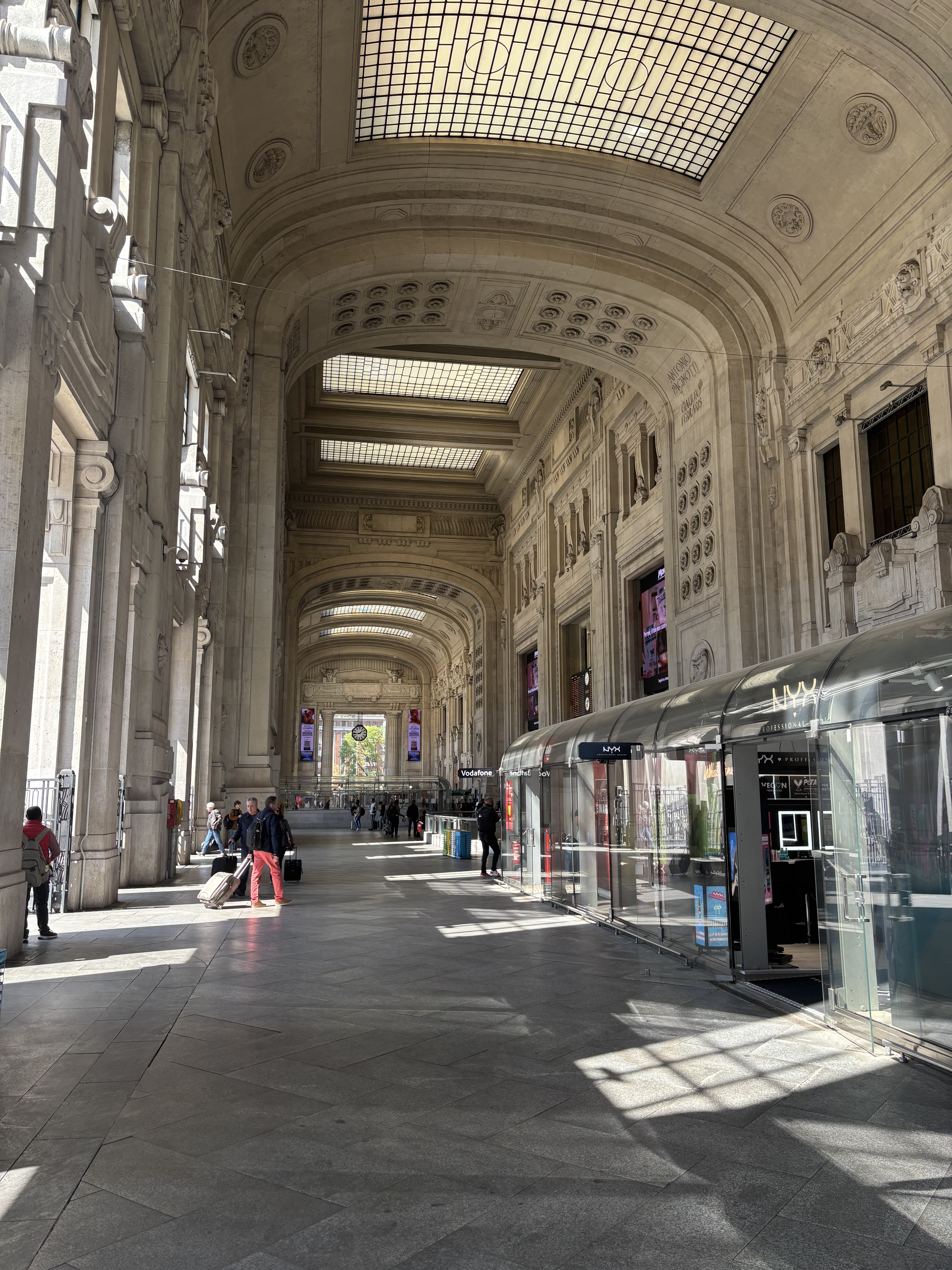
Another Frecciarossa from Rimini, with more free Prosecco, got me to Milan with time for a bit of an explore. And Milano Centrale is quite something to behold. It is a vast building, designed to impress upon visitors that you are in a serious country with ambition. I could spend a lot of time there.

There are also trams, and someone has clearly decided that antique trams are a desirable thing. I wholeheartedly agree with them…

EC64 takes just over four hours to convey passengers to Basle, gliding along the eastern shore of Lake Maggiore, through the Simplon Tunnel before weaving its way across Switzerland using the valleys and the odd tunnel. It’s a beautiful run, with views of lakeside villas, snow-capped peaks and the odd dairy cow once you’ve left Italy.

By the time I reached Basle, however, I was bone tired. It was time to catch a tram and get to the hotel…

Having settled in, I steeled myself to head to the bar and order a beer and a club sandwich. Remind me not to do that again, no matter how good they were…

Friday, April 18, 2025

#interrail2025: Day 6 - turning for home… but how?

After a good night’s sleep, and with my ability to speak somewhat restored, it was time to catch the Frecciarossa to my next destination, somewhere I had fleetingly visited twice a couple of years ago, Rimini. Previously, it had been the jumping off point for my journey to San Marino, but this time, I had a hotel room booked.

It’s six hours from Lecce, but the surroundings (and a couple of glasses of free Prosecco) were perfectly charming. This is the peak of Italian rail travel, with leather seats and bags of space. But, whilst I’m sure that there are people who prefer to spend more than eight hours to get to Milan, the mostly empty seats suggested that most Italian business travellers prefer to fly.

I did use the time wisely though, deciding what the next leg of the journey would be. Well, even I have to make a decision eventually…

I reached Rimini with plenty of the afternoon left, which allowed me to take a walk along the rather stylish promenade in the spring sunshine, as the resort prepared for the tourist season to come. One of the things that is slightly unusual about Rimini is the sheer depth of the beach. You can see the sea from the promenade, but it’s a fair stretch.

Indeed, it’s so far that the beach is divided into sections, or stabilimenti, privately owned, whose owners maintain that section of the beach and provide a variety of facilities. They ensure that the sand is kept clean and free of litter and, in return, you pay a fee to them. And, of course, they compete for your custom.

It was time for dinner though and, as it turns out, Rimini is like a lot of seaside resorts, in that the restaurants are a bit variable and not necessarily wholly inviting. But I did find somewhere eventually, and had some very nice pasta with sausage. There may have been wine involved.

I needed some sleep though, as I was crossing the Alps again the next day…

Saturday, April 12, 2025

#interrail2025: Day 5 - to the beautiful south…

I made my connection in Rome easily enough, and had a little time to explore Roma Termini station - not exactly pretty on the outside but an excellent shopping mall inside.

But my next destination was Italy’s heel. Trenitalia’s crack trains only run as far as Lecce, which is also the limit for Interrailers (the local rail services are run by a regional affiliate which doesn’t accept Interrail passes). I arrived to find warm(ish) sunshine and a city centre which is full of small, narrow streets providing welcome shade for most of the day. And, once I’d found my hotel, it was time to explore.

I admit, I was somewhat distracted by gelato, and then, having had an explore, a glass of the local Primitivo. Having done so, it seemed churlish not to stay for dinner - lightly fried cod, followed by seared octopus with a celeriac cream. There may have been more wine, but I probably deserved it, given that I was still barely capable of speech…

Lecce is an interesting place, famous for its limestone which gives everything a slightly golden hue. And, given that the city is two thousand years old, it is blessed with the marvellous church architecture that Italy is so good at. I did pop in to light a candle for my grandmother (you never really escape Catholicism or, at least, the underlying sense of vague existential guilt).

It was nice to be in the sunshine for a bit, but I’d come about as far as I could go, to quote “Oklahoma”. It was time to turn for home. I didn’t actually have a plan beyond the next train ride, but something would turn up, right?…

#interrail2025: Day 4 (and a bit) - the time-saving short cut…

So, Trieste Centrale on a sunny evening in April, the world your oyster. But not the obvious option for a footloose bureaucrat. No, I had some serious miles to cover, and the overnight sleeper to Rome to catch.

Now, compared to the Nightjet, Austrian Railway’s rather elegant sleeper service to Rome from Vienna, Trenitalia’s Intercity Notte service is a mite basic. None of this “en suite bathroom and shower” nonsense but, given the price difference, I was willing to make the sacrifice.

I found my berth easily enough, despite Trenitalia’s attempts to bewilder (and why not number the carriages 1, 2, 3, 5, 4 and 6?), and found that my bed was already made up.

We were slightly late off, but with a scheduled eleven hours and forty-eight minutes to Roma Termini and a built in two hour rest at Bologna Centrale, I was confident that my ninety minutes connection would hold.

Back through Udine, and onwards across Friuli, it suddenly dawned on me that this train served Venice as well, which meant a crossing of the lagoon to Venezia Santa Lucia. I’ve never been to Venice - it feels like one of those tourist traps where you end up begrudging every last penny you spend - but there’s no doubt that it’s one of those places where you ought to go.

Having crossed and re-crossed the lagoon, it was time for some sleep…

I was awoken abruptly just before six, although the presentation of a cappuccino and a miscellany of breakfast items did make up for it a bit. We were, on the other hand, running half an hour late, for reasons that never did become clear.

But, having had breakfast and freshened up, I alighted for on the train on a sunny morning, with another train to catch, heading south…


Friday, April 11, 2025

#interrail2025: Day 4 - backwards and forwards in Friuli-Venezia…

I didn’t really have any plans for most of Tuesday and, if you don’t have plans, Udine is a splendid place not to have them. You can just wander around, soaking in the architecture, eating and drinking as you do. And so, that’s what I did, with the one proviso that I had a meeting of the National Assembly of the National Association of Local Councils to fit in.

Udine in the sunshine is glorious, so a walk was called for, and up to the castle I went. Built on a thirty-metre high mound, it’s pretty but not daunting, although the mound itself, apparently constructed during the Bronze Age between 1400 and 1300 BC, is rather more impressive.

Back to the hotel, where I’d arranged to use the hotel balcony for my meeting, and whilst I was still only partly capable of speech, I managed to get through without too much difficulty.

By now, I was getting hungry and, as dinner was going to be a bit tricky, I set off in search of a hearty lunch. What I found was pizza and a half-litre of friulano. It was extremely enjoyable but I had to leave - a train beckoned.

It’s only a short hop to Trieste, and my sole aims were to walk along the Adriatic and to provision for the next leg of my journey.

Trieste is, I’m sure, perfectly charming, but you’re only going to see so much in less than an hour and a half, and I really couldn’t miss the next train.

So, a brisk walk along the shore, and an unexpected encounter with James Joyce later, I was back at Trieste Centrale.

I was about to take another huge leap for bureaucratkind…

#interrail2025: Day 3 (part 2) - over the Alps via Stevenage?

So, Brno (and the Czech Republic) left behind, it was time for a change of scenery, as I was heading for Italy. The obvious route is to change trains at Vienna and catch the Venice-bound Railjet there. But I’ve been to Vienna, and I wanted to get some bonus steps in, and so, I picked Wiener Neustadt as my connection point.

The journey to Wiener Neustadt was a relatively uneventful one, and my first destination soon hove into view. Dropping off my luggage at a convenient located left luggage point, I set off to explore the charms of the town. That didn’t take long.

In fairness, it should have been obvious really. “Neustadt” is a bit of a clue. And yet, the town was founded in 1194, was the site of a royal residence (Empress Eleanor died here in 1467) and is the home of the Theresian Military Academy, where the Austrian Armed Forces train their officers. Unfortunately for all concerned, the town was bombed to smithereens during World War II, as a major strategic target.

In most of Central Europe, there was a concerted effort to rebuild and restore. Wiener Neustadt, on the other hand, decided to take a different route. I don’t know if the planners for the town were comparing notes with their opposite numbers in Stevenage, but there is a strange similarity between the two. This is not entirely meant to be a compliment.

But I did find somewhere to buy a few needed toiletries for the rest of my trip, and the cinnamon bun I bought at the station was very nice.

Back to another train, the “Gondoliere” to, believe it or not, Venice. I’d never been there, and it wasn’t going to be my destination this time either. But it’s a pretty route, up the Semmering Railway (a UNESCO World Heritage Site, no less), through the Alps, along the banks of the Wörthersee and, eventually, into Italy.

At Udine, it was time to get off. Ros had strongly recommended it as a place to see and, I must assure readers, she’s absolutely right. It is absolutely stunning, a small jewel somewhat off the beaten track and probably in the shadow of Venice to the south-west, and even Trieste to the south-east.

I was in need of refreshment, and a glass of the local Friulano was definitely called for. So, I found myself a bar in Piazza Matteotti and ordered one. And another…

As the sun set over Friuli-Venezia, it was time for a stroll back to my hotel. As I passed the Civici Musei, it cried out to be photographed.

But a proper explore would have to wait until the morning. For tomorrow was, kind of, a day off from trains…

Wednesday, April 09, 2025

#interrail2025: Day 3 (part 1) - a whistlestop tour of Brno

Brno, Monday morning. I’d taken a stroll around the town the previous evening before dinner, and rather liked it, and so I was up early to do it all again, but this time in daylight.

I started with an unexpectedly stiff uphill climb to the cathedral - stone steps, a right knee that wanted to grumble a little and signs of impending fragility made it more challenging than I had anticipated - which is described as a bit dumpy by one commentator but I rather liked it. You know that St Peter and St Paul’s is there, which to my mind is exactly how a cathedral should be.

The climb does give you a decent view of Å pilberk Castle, which saved me having to do that too.

Apart from the steps, Brno is a very walkable city, with a relatively compact city core. I did remember to look both ways for trams.

It was, however, time to leave. I might by this time have pretty much lost the ability to speak, but a train was calling me, even if it wouldn’t hear my response…

#interrail2025: Day 2 - “We don’t talk about Brno?”*

Sunday morning dawned bright and early. Cool too, as the temperature had dropped sharply. But Nuremberg is perfectly charming on a Sunday morning without the crowds of a Saturday night, and I thought that a walk would clear the cobwebs before the next train.

As you might expect, Nuremberg has that comfortable sense of a city that does quite nicely for itself, with a high class array of retail opportunities and, despite the results of US and UK-inspired urban renewal, has retained some interesting architecture. The Weißer Turm, which actually has a U-Bahn entrance underneath it, marks the gateway to the shopping district, and I managed to get as far as the castle before turning back to pick my luggage and head for the station.

On reflection, I might have given myself an extra five minutes, as it was a slightly breathless bureaucrat who threw himself and his luggage onto the 10.38 to Schwandorf, where I had discovered a scenic route into the Czech Republic, rather than the obvious Railjet dash via Vienna.

Deutsche Bahn Regional Expresses can be a bit of a mixed bag, and things were made more complex by the unexpected splitting of the train at Neukirchen (bei Sulzbach-Rosenberg). Luckily, I’d got the right half…

I’d left myself just over an hour to connect in Schwandorf (there was an alternative with a six minute connect but I try not to do those anymore), which was intended as an opportunity to get in a few extra steps (yes, I’m still doing my 10,000 steps each day) and whilst I did have luggage to drag, I strode boldly down the mean streets of Schwandorf.

As a small Bavarian town, it does attempt to live up to the cliché. Pretty, white-washed church? Check. Beer garden by the river? Check. I didn’t see anyone in lederhosen, but it was probably only a matter of time.

Back at the station, my connection to Prague was pulling in. Described as a Regional Express from Munich to Prague, the Alex service runs via Plzen and has compartments in first class, which I approve of in an old school sort of way, especially when I get to be undisturbed for three hours, as we wandered across Bohemia. A quick connect to a rather swish Railjet, and I was in Brno in time for dinner. As was Political Animal and his family who, somewhat unnoticed, had picked the same route as I had. And no, I really wasn’t stalking them… or were they now stalking me?

There may have been beer and dumplings involved again, bread dumplings this time - my personal preference - before a relatively early night. A change of scenery beckoned…

* with thanks to Helen Belcher, whose knowledge of Disney hits is clearly superior to mine…

Monday, April 07, 2025

#interrail2025: Day 1 - a day of tight connects made…

I like trains. And no, not in a “isn’t that locomotive interesting” sort of way (although there’s something about a black-painted electric locomotive that calls to me). But I like travelling by train, albeit in comfort. And now that I’m officially aged, it costs rather less to do so.

And we older people get discounted Interrail tickets accordingly, of which I approve hugely.

It would, under such circumstances, be churlish not to take up such an opportunity, and so I bought myself a “ten days in two months” Senior first class Interrail ticket a while ago. I did rather dither about where I would go, but that sort of thing works itself out, right?

Saturday morning was bright and sunny, and an early start found me in London at a decent enough hotel. I skipped breakfast, as Eurostar feed you in Standard Premier (or Eurostar Plus, as I’m going to have to get used to), and headed for St Pancras International for the 9.01 to Bruxelles-Midi. I’d taken the advice of the Man in Seat 61 and reserved a seat near the front of the train so as to make my twenty minute connection that bit less stressful.

As starts go, Eurostar is a fairly easy way to ease yourself into the rhythm of the thing, with a carriage attendant with a wry sense of humour and a sense of speed that I might not see too often in the days to come.

Breakfast was… meh in terms of quantity, although the pain au chocolat was actually pretty good, and the tea drinkable. The yogurt with pecans and caramelised apple was better than I might have feared, but I was not entirely replete when we arrived in Belgium.

A brisk stroll across Gare du Midi, and ICE315 to Frankfurt was, how should I put it, a bit busy. Even a first class ticket didn’t guarantee a seat, and I was pleased that I had taken the precaution of making a seat reservation a couple of days earlier - the Interrail app tells you whether seat reservations are optional, recommended or mandatory, which is a useful thing to know.

What that meant was that “at table” service wasn’t available, so I had to make my way to the restaurant car to get a sandwich and a beer.

But, courtesy of BlueSky, I discovered that I wasn’t entirely alone. Political Animal, who works for the Local Government Association, was on the train with his family, and so we exchanged slightly stalkerish messages. It turned out that both of us were heading for the same place (eventually). Not stalkerish at all, right?

Arriving in Frankfurt on time (Deutsche Bahn, you’re spoiling us…), all that was left was to make a theoretically easy connection for the day’s final destination. Theoretically, because Deutsche Bahn usually have at least one surprise up their sleeve. We were, supposedly, departing from Platform 7, but that was indicating a train to Bamberg which was supposed to have left two hours earlier. And then, the Easter egg, a late platform switch which led to a slightly unseemly scurry to Platform 3.

I made ICE721 to Nuremberg though, a rather emptier, more genteel affair, and arrived in Franconia’s capital in time for a stroll and dinner. My goal… pork and beer.

What I found, apart from a quite buzzy city centre, was Bratwurst Röslein, which claims to be the largest bratwurst restaurant in the world. Yes, really. And, if Germans are claiming that, I’d wager that it’s probably true. There was pork, and a vast potato dumpling, and too much red cabbage for me to eat without exploding. And, of course, beer.

I strolled back to the hotel, rather more slowly this time. It was all going to be alright, even if my ability to speak was becoming increasingly limited…