Friday, September 22, 2006

Nation building and America - a philosophical disconnect

In recent weeks, the sheer scale of the failure of the West in terms of building what might be recognised as functioning democracies in Afghanistan and Iraq has become ever more painfully obvious. I've become suspicious that the problem lies with the American attitude to constructing a civil society, combined with the failure of Europe to provide an alternative example.

If you are genuinely intent on changing a nation for the better, you really do need to understand the social construct of that nation. Why does it favour democracy over dictatorship? Does religion play a greater or lesser role in cultural and social life? What factors impact on social cohesion? I sense that recent American administrations, especially Republican ones, have failed to grasp the importance of proper research, and in some cases, really don't care that much. After all, American democracy has proved to be such an example to the rest of us... with its inclusiveness (the amount spent by British political parties in 2005 wouldn't fund a gubernatorial race in California), transparency (voting machines with dubious codes, recounts decided at the pleasure of the Supreme Court rather than by actually counting ballot papers...) and plurality (how many different political parties have elected someone to the national parliament in the last fifty years?).

And yet the view is that a democracy must look vaguely familiar. This flies in the face of all of the evidence, and tends to be honoured more in the exception anyway. For example, Singapore is considered to be a democracy and it is, after a fashion. One party has been in power since independence, and tends to respond badly to even the most rudimentary challenge from a barely tolerated opposition. India is the world's largest democracy yet can be somewhat chaotic in terms of practice.

On the other hand, until very recently, the men of Appenzell in Switzerland met in the town square, swords in hand, to debate the issues of the day, and that was cantonal government. Democracy develops best when it has examples to be influenced by, when debate emerges from within, rather than by being imposed by outside forces.

If we must insist on invading a country to 'improve' it, we need to be far more honest about what we hope to achieve, and how we propose to do it. The debate over whether or not to invade Iraq was a farce, with both the Bush administration and the Blair government promoting different reasons for doing so depending on what polls showed to be popular from week to week. They failed to convince their own people as to their sincerity, so how did they think that the people of Afghanistan and Iraq were going to buy into the supposedly bright new future?

In the places where democracy has flourished in the past two decades, there has either been a tradition of democratic government (most of Eastern Europe post-1989 and South America come to mind) or democracy has come about after the emergence of popular movements. In the latter case, it tends to emerge slowly, as in Jordan and other more liberal Middle Eastern nations.

However democracy emerges though, it tends to do best where the local populace have a genuine say in how it is constructed, rather than where they have a model imposed upon them by an outside, rather unsympathetic force. And that is where Europe needs to do more. If we are to rely on the Americans for muscle, then we must provide the means to build viable, representative civil societies, teaching people the basic building blocks of democracy, encouraging diversity of the press, helping to build education systems for the young, and providing them an example, to follow or not according to local taste. Why not provide university education to the potential leadership of tomorrow, so that they can go back to their countries and work to build freer communities. We used to do that quite successfully in the days leading up to independence in our former colonies with, admittedly, mixed results.

But most of all, we have to set an example in the way we manage our democracy. I firmly believe that one of the key reasons for the fall of the Soviet Union was the increasing inability of the Communist Party to suppress the messages coming from the West. Once it became clear that the democracies were not the terrible places that Poles, Rumanians and Ukrainians had been told to expect, expectations emerged that the control economies could never meet.

By your actions, ye shall be judged, and not necessarily by the people you might expect. The building of civil societies isn't glamorous, and it isn't quick. But in the long run, it is cheaper, safer and more likely to protect our people from the threat of terrorism. Not so much a war on terror as a campaign against ignorance, conformity and oppression...

Summer is over... at last it's time to celebrate!

I have had the dubious privilege for supporting my beloved martlets for more than thirty years, one of the cursed collection of sporting teams which suffer my backing with more forbearance than I deserve.

However, days like today make it worthwhile, as Sussex County Cricket Club swept to a thoroughly deserved County Championship, slaughtering Nottinghamshire by an innings and 245 runs as Trent Bridge... this is cricket we're talking about, for the benefit of those who are wondering what I'm on about. When Sussex won the title in 2003, the Wisden headline was '164 years of hurt, never stopped believing' and I have to admit that I had begun to despair of ever celebrating the glory of victory.

The star? Who else but Mushtaq Ahmed, apparently not good enough to play for his country yet perfectly capable of destroying a series of opposition batting line-ups in spite of a collection of strains, muscle pulls and other ailments that would have left most Premiership footballers in the treatment room for months.

But let's not fail to recognise Chris Adams, Michael Yardy, Jason Lewry and so many others whose efforts led to our best season ever, with the C&G Trophy to add to the cabinet. If only I had the time to go and take in a day or two... maybe next season...

The problem with so-called politicians...

Alright, this is going to come across as a mite naive but what the hell...

As one of the political theatre's more delicate actors (albeit more understudy than star), the one thing that really bothers me is the way that some people seem to think that it is better to undermine others rather than earn credibility themselves. I accept that it is probably easier (credibility is hard to gain, and remarkably easy to lose), but the collateral damage is often unfortunate, to say the least, and often affects those who least deserve it.

In the public sphere, attacks on politicians hurt families, loved ones and friends, and are often done in such a way as to cause maximum humiliation. Alright, politicians need thick skins but those around them are often unused to the glare of publicity and of guilt by association. They often don't choose public life and, in some cases, were never really consulted on the subject in advance. How many politicians actually ask their spouses whether they want them to become elected officials, with all the impact this can have on family life? Not enough, I fear. And what effect does it have on the prevailing political culture?

If you thought that your private life was likely to become the subject of prurient investigation by the tabloid press, wouldn't you rather go into commerce, where your private life is much more your own affair? And does the steady drip, drip, drip of poison encourage the average citizen to respect and trust their politicians? I don't think it does. Perhaps voters get the politicians they deserve...

And yet it can be worse within your own political family. The constant fight for competing agendas, personal or political, factional or philosophical, can leave a trail of emotional corpses, a fact often forgotten in the heat of battle. And all this by people who are supposed to be on your side! Politics is, at the highest levels, a game played by the hugely ambitious, with a long term goal of exercising power, regardless of the forum. The concepts of honour and principle are usually early victims and for the rest of us, realisation of this can become all too dispiriting, and it is no wonder that the burnout and dropout rates are sizeable.

Sometimes, in my darker moments, I find myself wondering if some of my colleagues have forgotten why we seek power in the first place. Something to think about, perhaps?

Thursday, September 21, 2006

For you, Herr Valladares, ze conference is over...

Unfortunately, due to a rather unfortunate lack of leave (yes, well, all of the trips I've taken thus far this year might account for that...), I am home, for good.

It's been, as far as I'm concerned, a pretty good conference. The tax debate was a welcome sign of the economic maturity of the Party, and I renewed a series of old acquaintances, some of which have led to a new appointment (subject to ratification, of course).

I have had the pleasure of acting as Returning Officer for the European Parliamentary selections for the South East Euro Region on the past two occasions (in 1998 and 2002/03) and was rather delighted to be asked if I would be available to perform an encore. Naturally, my current colleagues on the English Candidates Committee will have to approve this in due course, but I'm optimistic that they will.

I spent most of this afternoon debating positive action with my friend, Jo, from Beckenham. She argues the position fron the perspective of an ambitious candidate, I from the perspective of someone whose role is to create and maintain a level playing field within our current selection rules. We finally agreed that, regardless of what route we take in order to get more women and ethnic minority parliamentarians, there is going to come a point when our principles become contradictory. I suppose that it is a luxury that stems from not wanting to get elected that allows me to be somewhat uncomfortable with the prospect.

On the downside, a confidence I had shared was leaked, somewhat to my detriment. I am saddened that someone should choose to do such a thing, especially as I believed myself to be acting entirely honourably. Clearly, the same people who didn't believe that last year still haven't got the message. Curious, really... but I'm guessing that this won't go away...

Tuesday, September 19, 2006

'Liberal Bureaucracy' goes transatlantic!


No, I'm not getting on an aeroplane bound for some far flung, exotic location in the Americas, tempting though it might be. It is with great pleasure that I welcome any American readers who might have linked to this via the website of Americans for Democratic Action.

I've been a rather distant member of the ADA family for fifteen years now and, whilst I would be considered a mite hawkish by the mainstream standards of the organisation, I have tremendous respect for their knowledge, expertise and warmth. They truly care about their country and the people in it, and share a common sense that we have to create equality of opportunity in order to truly succeed as a nation.


So, on with the medley, and keep in touch!

A year later, more warm words, but real progress?

I've already indicated that I had been unimpressed by the tenor of the motion scheduled for consideration on equality and diversity issues. And now, gentle reader, I have to report that the debate which followed was, frankly, equally unconvincing.

We are promised greater resourcing for staff to address these issues, yet the Federal Treasurer had, the previous day, indicated that this would be "very difficult". I sympathise with him on that, knowing that all three political parties have difficulties in funding current activities, let alone additional mandates.

The first amendment, from Surrey East, sought to remove language that I had created for the motion debated in Harrogate. If it had subsequently been argued that the idea that ethnicity or gender of the chosen candidate be a factor in deciding between two equally worthy options as to whether central support and funding would be available, they probably wouldn't have tried to remove it at all. Alas, there are some who would try to use the concept and torture it beyond mercy. Fortunately, it fell.

The second amendment, requesting that "our top target seats at the next general election include a fair proportion of ethnic minority and women candidates", is, I'm afraid, meaningless and I am disappointed, although unsurprised, that it was successfully passed. After all, it came with the imprimatur of the Ethnic Minority Liberal Democrats... which, dear Federal Conference, doesn't actually make it any good.

Having now created a sense that something will happen, I have to confess that it almost certainly won't. Good prospects are already selecting, and, given that Local Parties are entirely sovereign in terms of who they select, how do you make this particular dream come true? In two years time, when disenchantment has set in, this particular chicken will come home to roost.

Effectively, any progress on the whole issue of getting more women, and more ethnic minority Liberal Democrats elected as parliamentarians is now dependent on the goodwill of the leadership. We must now effectively trust them to do the right thing, adhering to our shared liberal values whilst doing so. My question is, do they want to make a difference, or be seen to be trying to do so? And that, my friends, is the crux of the dilemma.

But never mind, I've got a tax debate to get to, and we all know how much I love those...

Monday, September 18, 2006

To Brighton, where a new blog emperor is crowned...

To Brighton for the opening salvoes of the Autumn Federal Conference. For reasons best known to myself, I originally decided not to book a hotel room in Brighton, having found the prices being quoted a mite extreme even for my somewhat bourgeois taste. However, on discovering that English Candidates Committee would meet at 9.30 on Sunday morning, I realised that I had no urge to get up at 6 a.m. to get there in good time. So I booked a room in the Hilton for Saturday night and got an astonishing reasonable rate.

Sunday saw, apart from the excitement of English Candidates Committee, where I provide a touch of humour (not always a good thing) and a bit of colour (I still like the shirt...), a series of technical debates related to internal Party matters. Quite dull, particularly to campaigners and policy wonks, but nonetheless important. I had been tapped on the shoulder earlier in the week to ask a question on staffing numbers and staff diversity which, whilst I was actually interested in the answer, I can't help feeling was an opening shot in someone else's campaign strategy. So I should thank those who set me up... and for giving me a chance to test the brightness and contrast settings for the monitors on stage.


The evening saw the Lib Dem Blog of the Year award ceremony, with the august figure of Iain Dale in attendance. Lynne Featherstone made the presentation of the award, looking a little like the Lara Croft of Lib Dem blogging (check out the picture for yourself on the Party website). I'm not quite certain what brought that image to mind, but there you go... There was even a gold envelope, which I thought was quite a nice touch.

The winner? Stephen Tall, from Oxford. He does write very well, and isn't afraid to court controversy or lead the agenda, and he speaks well too. The overall quality of the top six really should encourage the rest of us to 'up our game' a bit, although I'll try not to overreach myself. But now it's time for bed, and my own at that. Back to Brighton tomorrow, no, make that today, though for more Liberal Democracy...

Friday, September 15, 2006

A week in the life of someone else's Local Party

One of the things about being a self-acknowledged faceless bureaucrat is people assume that you understand 'stuff'. And so I found myself in Bromley and Beckenham this week, helping the two respective Local Parties (Bromley and Chislehurst and Beckenham), grope through the minefield that is Local Party boundaries in order to ascertain what is the best configuration for the future of Liberal Democracy in the London Borough of Bromley.

Following the report of the Boundary Commission, a new seat of Lewisham West & Penge has been created, which includes part of the old seat of Lewisham West and part of Beckenham. The complication is that the three Lewisham seats of old were combined under one borough-wide Local Party. The three Bromley seats were all standalone constituency-based Local Parties.

My understanding of the Electoral Commission's rules for Local Parties is that they must either be, in London at least, either collections of whole constituencies or whole boroughs. Thus, the problem becomes clear. The three Beckenham wards can only remain connected to the remainder of Bromley if the three new constituency parties (Beckenham, Bromley and Chislehurst and Orpington) are willing to come together to form a borough-wide Local Party for Bromley Borough. Otherwise, either Lewisham Borough Liberal Democrats have to absorb the three Bromley wards, or let go of the four Lewisham wards to allow the formation of a new Lewisham West and Penge Local Party.

Now for those of you who are not connoisseurs of South East London politics, you might wonder why any of this matters. However, for those of you who are more in the picture, you will realise that Lewisham West and Penge is a rather interesting seat, in that it is a potential Labour vs. Liberal Democrat battleground, so organisation is vital.

So to be at the heart of the debate was fascinating, especially after I was asked to chair the Beckenham meeting. At this juncture, it would be improper to indicate what the outcome was, especially as the final decision lies on the hands of the Regional Party, but it was intriguing to see what motivates local activists and the extent to which the needs of coordinated campaigning were at the forefront of discussion.

Regardless of the result though, it will be interesting to see how any new structure develops, and I suspect that I'll be an occasional visitor to that part of suburban south-east London in the coming months to lend my support where it is useful.

We're all recognition junkies now...

Much excitement in the Lib Dem corner of the blogosphere after Iain Dale's announcement of his top 100 Lib Dem blogs. Modesty forbids me from commenting on my rather surprising ranking but, needless to say, I wouldn't have put myself on the left hand page (and possibly not the right hand one, either...). So have a peek, you might learn something, and discover some very good writing too...

Whilst the idea that Lib Dems should be getting worked up about what a Tory thinks of us is, on the face of it, somewhat absurd, I would suggest that it is a mark of the respect that many of us have for him and his achievements in the field of political publishing that causes us to take his opinions so seriously.

Politico's was a laudable attempt to broaden interest in something other than thirty-second, red-top headline politics and, as someone who firmly believes in the concept of an informed, participatory democracy (whilst winning elections is nice, winning the argument is much more satisfying), I have a sneaking hope that he made some money out of it too (don't tell me Iain, remember, I work for Revenue and Customs!).

As for his blog, I may not agree with him all the time (I'm a Liberal Democrat, duh...), but his recognition factor within the wider political blogosphere and beyond says something for his ability to break stories and comment in an articulate way on issues that engage the reader.

It's a good thing that Iain will be attending the Lib Dem Blog of the Year Award ceremony tomorrow evening. I'll be there, drink in hand to toast the winner... I might even buy Iain a drink, if he's willing to accept sustenance from one of those evil Lib Dem types!

Wednesday, September 13, 2006

Diversity and equality - missing the point?

I feel kind of bad about returning to this topic but, regretfully, have little choice it would appear. I've already noted the lack of actual content of the motion, and now I have to admit to being somewhat depressed about the quality of the response.

EMLD (Ethnic Minority Liberal Democrats) and the EMETF (Ethnic Minority Election Task Force) are touting their own amendment which includes the following gems:


Delete lines 10 to 11 and replace with

Conference urges all individual members, all local Parties and every section of the Liberal Democrat organisation to help recruit, encourage, mentor , support and select candidates from the under represented groups, and in particular visible (my emphasis) ethnic minority and women candidates for the Westminster Parliament, the Greater London Assembly and Local Councils.


I loathe the word visible. I'm an ethnic minority, albeit not of the heart on sleeve variety. Am I to be discriminated against because I'm not visible, although my surname marks me out as anything but white, anglo-saxon and protestant? Nought out of three ain't bad... but apparently not good enough to merit support...

Oh, but how about this...


Delete to end of line 27

Replace with

Furthermore conference urges State and Regional parties to sign up to the principle of equality in representation and to commit to implementing procedures which will ensure the chances of ethnic minority and women candidates being discriminated against are minimised.


What on earth does this mean? Are we to presume that the candidate approval process and the selection rules militate against ethnic minority candidates? For the record, the procedures don't. So are we supposed to roll out diversity awareness training to our members? I'm really sorry, but whining that life is unfair and asking your oppressors to come up with a solution is lame, in the extreme.


After line 32 add

Conference calls on the Leadership and the Campaigns Department to produce a strategy for speeding up the election of ethnic minority MPs followed by the election of MPs from other under groups. In particular conference asks that our top 100 target seats in the next general election include a fair proportion of ethnic minority and women candidates so as to reflect the community we serve.


Furthermore conference calls for any seats vacated by Liberal Democrats MPs at the next general election to be reserved for ethnic minority and women candidates.

The first paragraph here is well-meaning but dangerous. If the vast majority of our top 100 target seats are in areas where the ethnic minority population is below 5%, as I thoroughly expect them to be, is this a demand for, effectively, less ethnic minority candidates? As for the second paragraph, words fail me. Are you seriously proposing restrictive lists for certain constituencies? Didn't you learn anything from Blaenau Gwent? If even the massed control freaks of the Labour Party wouldn't wear it, what chance do you really think you have of persuading a bunch of, whisper it cautiously, liberals?

Sometimes I despair, I really do...

Wednesday, September 06, 2006

Where in the world was Mark Valladares?

It seems that everyone is generating maps to show where they've been so I thought I might join in...

or check our Venice travel guide

There are some quirky omissions, and I'm working on the gaps, so it might look quite different in a few years...

Monday, September 04, 2006

When satire becomes reality... or does it?

Last month, in one of my vitriolic moments, I wrote a piece suggesting some of the things that Cameron's shiny new Conservative party could apologise for. I was only joking... at least, I thought so until I read my Guardian this morning and found this article..


As a piece of politics, it's actually pretty clever. In 1997, a significant number of civil servants were enthused by Labour's promises to improve the civil service and government in general. In the years since then, disillusion has rather set in as it has become apparent that Tony Blair doesn't really like us that much. Many such individuals are looking for a political party that they can put their faith in, and I occasionally wish that my gallant Liberal Democrats were rather more considerate of the feelings of my fellow bureaucrats (if only Party spokesperson were half as considerate towards civil servants as they are towards nurses, doctors, policeman etc... deep sigh...).

Unfortunately, many of us have reasonably sharp memories of the beggars auction that took place not so long ago about the number of civil service jobs. My recollection is of an unedifying rush to promise more job losses than the number offered by Her Majesty's loyal opposition. There is a paper, apparently, although I could only find this report on the Conservative Party's website. As you can see, it seems to focus entirely on the 'touchy-feely' bits of the public sector yet avoids the fundamental question, "What sort of public sector do we want and how do we manage and fund it?" I'm not expecting to get an answer that I'll like...

Thursday, August 31, 2006

And it's goodnight from me...

It's official, and minuted accordingly, and I will cease to be Chair of Dulwich and West Norwood Liberal Democrats on 31 December, despite the possibility of running for a third term.

I hate being Chair. It's not that I don't like the people I have to work with, nor the endless committee meetings (although they are endless, tend to start at times that cause me to leave work earlier than is convenient and make me feel vaguely influential yet powerless) but the leadership aspect that really gets to me. I'm not a leader. I'm uncomfortable with power and tend to give it away to others at the first possible opportunity. However, I'm apparently quite a nice person and can therefore get away with a degree of well-intentioned amateurism.

Yet I enjoy being a bureaucrat, so I will be running for a different position at our Annual General Meeting on 30 November. I can't say what that is as it would be unfair, and somewhat improper, but it will be a job that I can do, will enjoy, and won't cause me stress.

In the year after I separated from my ex, I lost thirty pounds and felt quite good about myself physically (a bit fragile emotionally, but that's a different story). In the two years since then, I've put all the weight back on, feel pretty good emotionally but am mildly concerned about my physical condition. Perhaps that indicates that politics can be bad for your health, particularly if you sit on committees rather than doing real work (that's meant to be ironic, by the way...).

So I need some time for myself. Not too much, you understand, but enough for me to have a life (I love chamber music and cricket) and perhaps develop some other interests. I might even do some housework!


Wednesday, August 30, 2006

Postcode lottery - or a new localism?

Let me make one thing clear - I share the view that infertility is a terrible thing, blighting lives and denying people the opportunity to do something many take for granted, i.e. raising a family. Unfortunately, the debate today, whereby women are encouraged to complain about the lack of access to IVF treatment in their area, raises a question, the answer to which is going to be unpopular, whichever way you cut it.

It is claimed that access to IVF treatment varies depending on where you live, and this is clearly true. However, this is based on choices made by Primary Care Trusts, something that, as a liberal, I support. It should be the right of a Primary Care Trust to cut its limited cloth according to what is felt to be best for the community as a whole. In some areas, cancer is a priority, in others care for the elderly. You cannot prioritise everything.

I am fascinated by the suggestion that service and access levels should be the same across the country. If you asked these same people to comment on the increasing centralisation of government, they would be the first to complain about interference from Whitehall. Ah, the joy of contradiction... so, we can obviously expect the Conservatives to be in favour of standardised access...

So, should we seek standardised access to healthcare on a national basis, or do we encourage Primary Care Trusts to reach out to the communities they serve to determine what is most desired in terms of service and access levels? The answer, in my mind, is a combination of the two. There should be nationally set guarantees of minimum levels of access and service, with Primary Care Trusts free to invest in additional, top-up services based on the perceived needs of their communities. But this all hinges on proper community involvement - they're our services, we should engage in the debate.

I was, I admit, somewhat annoyed by the comments made by a woman interviewed by the BBC, stating that "I've worked all my life and I've paid my NHS contributions, so why can't I have IVF treatment on the NHS? It's due to finances, oh yes, and my weight...". She's two stone overweight (her claim, not mine), and such circumstances increase significantly the risk that IVF treatment will fail - wasting NHS funds and denying someone else access to treatment. If healthcare is to be rationed due to limits on the amount of funding (your choice, Mr and Mrs Public, you can pay more tax if you want...), then clinical factors are the best and only fair criteria to apply when deciding the appropriateness of treatment.

I don't have children myself, never wanted them, and don't particularly like them (although I make an exception for my own family - they're all angels...) but admire anyone who has the desire and patience to bring them up themselves - it isn't easy. But there are children out there in need of adoption, and they deserve an opportunity too...

Monday, August 28, 2006

I coulda been a contender - Part III

At least I've amused Susanne. I got over-enthusiastic and changed my template, thus removing all of my changes and removing all of my personalisations, ha, ha, ha...

So, I've redesigned the links section, and for those of you who have been namechecked, if you have any fundamental objections to your tagline, please don't hesitate to let me know...

I coulda been a contender - Part II

The telephone rings, and it's Susanne, noting that my links column is a bit untidy. A quick tutorial later, and it looks pristine...

Thanks, Susanne!

I coulda been a contender

News of the Lib Dem Blog of the Year Award has reached this sleepy corner and, as someone without a hope in hell of winning it (no, really, not false modesty), I have taken an interest in the views of those indicating their personal favourites.

I am consequently reminded that my own humble blog isn't really connected to the outside world, mostly by my London Region colleague, Susanne Lamido, who is forever encouraging me to add buttons and do more with this blog. So I'm spending the afternoon adding buttons and links so as to provide more links to people who either have similar views or are just plain interesting. There is no need to reciprocate, think of it as due homage...

Sunday, August 27, 2006

Diversity and equality - haven't I seen this somewhere before?

And so we now have the motion for debate at Brighton, somewhat later than originally promised but at least available for challenge. After a fairly shambolic process whereby a working group hand-picked by the Party President failed to meet until early July and the initial paper to the Federal Executive came from who knows where (I know of at least one member of the working group who claims not to have seen it until it was introduced at the Federal Executive meeting), a somewhat wet motion has been generated.

In the David vs. Goliath (aka Simon Hughes) contest that has taken place thus far, the score is tied after two rounds, with David winning the first contest, defeating Goliath's appalling proposals at Blackpool, but Goliath snatching a late winner in Harrogate after David made most of the running.

I fear that Goliath is going to win the decider too, as the motion is entirely reasonable if almost entirely lacking in detail. Rumours of slush funds for ethnic minority and female candidates imply that the initial idea (providing support for such applicants to create a level playing field) appears to have been subverted to the notion of bribing Local Parties to select them (say it ain't so, Simon, say it ain't so...).

The commitment to fighting for proper representation of all sectors of our community is extremely laudable, and it is nice that we make it, but I was hoping for something more concrete.

James Graham has, elsewhere in the blogosphere, indicated what he believes to be wrong with the Federal Executive and there does appear to be a tendency to use it as a place to park issues where the leadership doesn't agree with the membership. And this, sadly, is one of those occasions where a number of people who are quite knowledgeable on the subject of candidate selection throw their hands up and say, "Simon, you really don't get it, do you?". Because, Mr Hughes, you don't...

Friday, August 25, 2006

Return to the madding crowd

Alas, I am back in London after two weeks of quiet contemplation to find remarkably little piled up awaiting my attention (apart, of course, from five cats craving food, water and love). The calling notice for elections to the Regional Executive has arrived, so I have the task of coming up with 100 words to explain why I should be re-elected.

Last year, I came up with the following...

"Whilst truth, beauty and good administration are not necessarily synonymous, as Regional Secretary, I have tried to uphold all three in 2005. A better run Regional Executive makes for improved decision-making, greater transparency and involvement and better governance. In turn, you benefit from a more joined-up, more enabling Regional Party.


There is much still to do though and, if re-elected, I intend to utilise my quirky sense of humour, flair for systems and fanatical love of order to take the Regional Secretariat to new heights. “Vorsprung durch verwaltung” (projection through administration), as we say in Dulwich and West Norwood…"

Amazingly, I was re-elected so how do I follow that?

The e-mail is under control somewhat and whilst I do have some papers to type up, they won't take long. So a weekend of shopping, laundry and ironing awaits this bureaucrat. Can't wait...

Monday, August 21, 2006

Now what is it that I do exactly?


Strange things, holidays. I'm used to zapping from place to place, spending just long enough in one place to have to reorganise my packing before catching another plane. Restricted to one, albeit lovely, place, I'm beginning to forget about thinking - it's all becoming rather hard work.

It is at moments like this that I begin to transform into 'armchair philosopher' mode, and start to dream of things as they might be. I actually have time to start designing my future, the sort of fun project that can keep me harmlessly amused for hours. Having said that, I really do need to plan rather more than I have for a while, as I am horribly overstretched and really bad at delegation (and I mean, really bad...).

So, is there anyone out there who wants to be Chair of Dulwich and West Norwood Liberal Democrats, Secretary of London Region or any of the other myriad jobs that I currently hold? Would you be happier doing them than I am? Would you be better at doing them than I am? Would I have more fun if you were doing them (you don't have to answer that question)? Answers in a bottle, thrown into the ocean, please...

P.S. Don't worry, I'm not losing the plot... more rewriting the old one...

I wasn't Alfredo Stroessner's love child


This week saw the passing of General Alfredo Stroessner, former Paraguayan President and hard man, in a Brasilia hospital, aged 93. He is one of history's rare cases of a dictator who actually appeared to like the idea of being re-elected, although it would be fair to say that he was far from being a democrat, ensuring that there was no chance of his actually being defeated. It is perhaps an indictment of his regime that he was finally removed from power at gunpoint by his own son-in-law!

Paraguay is one of South America's more tragic countries, with a history of insane, corrupt and/or psychopathic leaders interspersed with the occasional brutal and pointless war. However, things have improved and the country has stabilised, with elections that aren't completely corrupt and a democratic opposition that is allowed to function. The Authentic Radical Liberal Party has a noble tradition of opposition to the former regime and was well respected on the international Liberal circuit. I hope that they have been rewarded for their persistence.

Wednesday, August 16, 2006

There really isn't any escape, you know...

A conscience is a terrible thing. It makes you want to sit by a swimming pool on a sunny day and read the Selection Rules for Parliamentary candidate selections so that you understand them. It makes you spend time thinking about internal communications strategies instead of focussing on your evening card school.

On the other hand, it prevents you from feeling guilty about not doing these things when you promised that you would. Besides, lying in the sun all day can get terribly wearing... although it is raining as I 'write'. Invitations to meetings, details about Annual General Meetings, plotting, scheming, arranging the assassination of political enemies, all the usual day to day stuff, doesn't stop just because you do. Besides, it's easier to do it properly than try to catch up on your return.

And it is nice to have time to stop and think. There are so many other things going on in my life, and I'm so bad at saying, "You know, I really don't have time to do that, perhaps you ought to find someone else?", that the absence of telephone calls and work really helps me to put things into proper context. Also, given my family's comparative lack of interest in politics, they have an alarming tendancy to ask questions like, "Why is that important?", or, "Why can't someone else do that?". My response? "Good question, don't know, perhaps I ought to find out..."

Ah well, back out into the unreal world for a few more hours...

Saturday, August 12, 2006

En vacances avec la famille Valladares

Curiously, although perhaps unsurprisingly, I'm away again, this time deep in the Indian Ocean on the island of Mauritius. It's a long story, so I won't bore you with the details, although fortunately, our flight left before London's latest terrorist scare (but only just, it would seem).

This time, I'm with my family, mother, father, kid brother, his wife, their three lovely children and my cousin, Kim. Apparently, this is something that they've been doing for years and now that I'm single again, I can come too (I'm assuming that Rachelle and I were too busy before - and in fairness, that was a pretty safe assumption).

Kim and I have been doing some comparisons and we reckon that Mauritius is a lot like Goa, and Fiji is also similar in many ways (large Indian population, sugar cane, island in the Southern Hemisphere...). The resort that we're staying in is very nice, and because we were there last year, the staff recognise us - a nice touch, I think.

Far from the beaten track though we are, Mauritius is very connected to the outside world. Tonight, there is an anti-war demonstration in Port Louis, the capital, although I won't be doing any reportage on the event, and the African Athletic Championships are taking place between our resort at Flic en Flac on the west coast and Port Louis. It's the last day of competition tomorrow so I may yet drop in.

Otherwise, this is an idyllic spot to spend some time. The pace of life is fairly gentle, the island is big enough to have variety but small enough to allow exploration of its furthest corners, and the climate at this time of year is well nigh perfect (highs in the low eighties, occasional showers to freshen the air, and gentle breezes, especially here in the central plateau (this message comes to you from Curepipe, the country's second city).

But enough blogging for the time being, I'm off in search of a haircut (it hasn't been done since Fiji and I'm looking a little ragged). There might even be a cold beer involved...

Wednesday, August 09, 2006

Second thoughts, or a change of heart?

Two weeks ago, I found myself entangled in a debate about how we should select our candidates for the London Assembly. I had taken the viewpoint that we should seek to engage our list candidates more effectively, not, on the face of it, a terribly unreasonable concept.

The proposal has been somewhat controversial, as I indicated a fortnight ago. There has been some enthusiastic lobbying from certain parties (and not only the ones you might expect, either), and I must admit that I have been swayed. Ironically, it isn't particularly due to the lobbying, more the simple fact that the initial proposal doesn't actually achieve what I want.

So I have a dilemma. If you are campaigning in a list system, how do you encourage those candidates high up the list, and thus almost certain to get elected regardless, to campaign actively across the Region? Can you, or should you, use the selection system for punitive purposes? Alternatively, should you, or can you, create a structure to monitor the performance of your elected representatives, so that you can measure their success against quantifiable targets? If the latter, who should do this, and what authority should they have?

Taking the question of manipulation of the selection system first, I had initially thought that you could use it as a tool to encourage those likely to be elected from the list to campaign in somewhere other than the heartlands, at least for some of the time. However, there are two obvious arguments to the contrary. First, if candidates high up on the list have no incentive to campaign actively across the city, on what basis might you assume that they would have an incentive to campaign in their constituency? Secondly, and this is quite important, Liberal Democrats are philosophically opposed to manipulating the electoral system to get something socially beneficial. We prefer to address the underlying causes of underachievement to lift overall standards. So I am now minded to avoid manipulation of the list places.


As for performance monitoring, there is an argument that this is the role of the electorate at large, and I agree to some extent. However, it is possible for someone to be a very good elected representative and yet, from the perspective of the Party, be a disaster. In order to benefit from the support, reputation and activity of the wider organisation, a candidate should accept a degree of supervision (and I use that in its widest sense) by senior members of the Party. Most local councillors have to go through a process of reapproval before being allowed to stand, and in such instances, they are weighed against a set of agreed, preferably quantifiable, criteria. Any who fail don't get to run again, at least, not as a Liberal Democrat. All political parties have to answer the same difficult puzzle, but for Liberal Democrats, opposed as we are to coercion, it is particularly tricky.

I'm guessing that this question will exercise a number of people in coming weeks, if only because I'm intending to put it on the table. Fortunately, I'm catching a flight this evening to somewhere far away, so if there is a desire to put a horse's head on my pillow, someone will have a long way to come to do so!

Sunday, August 06, 2006

The last of the well-intentioned amateurs

Taxi for Mr Valladares! Taxi for Mr Valladares!

I have to admit that my sense, after yesterday's briefing session for Returning Officers on the impact of the new Selection Rules, is that we're all going to have to become a lot more professional in order to function successfully in our somewhat expanded role.

Don't get me wrong, this is a thoroughly good thing. Unfortunately, as most of my best friends will admit (and a number of my enemies, for that matter), time management is not, and never has been, one of my great strengths. I'm easily distracted unless my heart is really into something, and in the past I've managed to get away with an element of disorganisation because democracy really matters to me.

So I have a choice, get with the programme (more structure, morning sessions with a punchbag and set of Selection Rules, duelling with live candidates, that sort of thing), or perhaps find some other way to contribute.

I've actually just been appointed to run a selection somewhere south of Watford and west of Slough, so I'll actually get a test run, so to speak. If it works out, and I enjoy it, I'll stay on. If not, I'll have to seriously think about taking a back seat for a while...

Friday, July 28, 2006

You know, we have rules for a reason!

I've noticed that it appears to be open season on the system by which the Party approves and selects Prospective Parliamentary Candidates. "Too complex, too bureaucratic, too time consuming, too expensive...", the arguments flow seamlessly. "We don't approve/select enough women/ethnic minorities/aliens," comes the cry from other quarters.

So let's remember how we got here from the 'good old days' when it was all so much simpler. Ah yes, the days of the 'interview in the pub', whereby the local 'good ol' boy' was invited to meet the local worthies over a pint or two and, as long as they didn't throw up over anyone, they were the candidate. There weren't many women, even less minorities, but it was easy, and cheap, and quick...

But we wanted better candidates, ones who could make a speech, who weren't an embarrassment on television, might actually resemble a credible government in waiting. So we needed to test them for the obvious skills, teamworking, media presence, campaigning, policy, public speaking. It was kind of like applying for a job, after all.

So we developed an assessment day to do that. A small number of experienced members were trained up to do the assessing, most of whom gave up what limited spare time wasn't already dedicated to the Party in order to do it. Gratitude? You have to be kidding, don't you? But it worked pretty well, and that was all that was important.

And with greater credibility, came greater competition for selection. You see, these people might actually get elected, and get a big salary, and power (after a fashion...). We had some pretty basic rules by which selections were run but ambition led a minority to do things that we hadn't really imagined they would try. "But we're very nice people, we wouldn't do that, would we?". You bet we would. The fat salary alone attracted some not quite so nice people, competitive types who would do whatever it took to win.

So we amended the rules. We were always one step behind because we were terribly reasonable people who thought in straight, curiously honourable, lines. We wanted everyone to have a chance, so we changed the rules a bit more. Best of all, we left the management of the process in the hands of the same sort of very busy people as the assessors were. Even better, none of them had the sort of cynicism required because, for the most part, they were doing it because they believed in the internal democracy of the party. So selfless, so naive!

The rulebook got bigger... and bigger, and more complex, as a minority of candidates grew more and more devious. We had to have an appeals procedure so that breaches could be prevented. Yet we couldn't rule out what many might have seen as frivolous appeals, because that wouldn't be very liberal, would it?

And then, the very groups who had never really liked the process, actively tried to undermine it because, after all, this democracy process is such a bore. It's such hard work so why not put the decision in the hands of a small group of local worthies? Abolish appeals and give Returning Officers dictatorial powers, that's the job. Quick, efficient and cheap. Liberal principles? You can check them at the door on your way out...

Frankly, when we strangle the last Federal Executive apparatchik with the small intestine of the last member of the Parliamentary Candidates Association, I for one will open a bottle of champagne and drink a toast to a healthier democracy...

Wednesday, July 26, 2006

How to guarantee you'll upset someone

As a member of the Regional Candidates Committee, I have a front row seat in the process of deciding how our candidates for the London Assembly will be chosen. Yes, I understand that there will be an election but, let's face it, the various political parties will effectively decide who sits in the Assembly as they choose the candidates, including the list ones, whose names never really reach the public consciousness, and the order in which they are placed.

As an aside, I'm a supporter of a list-based system whereby voters pick a party preference AND number the candidates on that list in order of preference, thus putting power back into the hands of voters and taking it away from parties. It would also give candidates further down the list greater motivation to campaign vigorously.

Back to the plot though... so I found myself in a rather warm Cowley Street with my fellow committee members, discussing various briefing papers from particular interest groups, plus a really good document from one of my fellow returning officers, Andy Harding, outlining the various possibilities and their pros and cons. Very astutely, he didn't actually come down in favour of a particular outcome...

For what it's worth, I tend towards a selection process which encourages the broadest spread of campaigning effort and might help to build up some of our weaker Local Parties. In 2000, Susan Kramer fought a Mayoral campaign which reached every high street in the city - literally - and was generally thought to have had a positive effect on the linked Assembly campaign. It also encouraged some of our weaker groups to believe that someone higher up the party 'food chain' actually cared about them and their patch.

At the end of a fascinating evening, we reached a broad consensus which will be passed on for consultation and further discussion before we submit a recommendation to the Regional Executive in mid-September. However, in the spirit of meaningful debate, I'll keep my lips sealed on our thoughts thus far, as any public comment might imply that it is a done deal and it is still far from that. Needless to say, given the various preferences espoused from different quarters, someone isn't going to like the outcome. But then, that's what a democracy is all about, isn't it?

Sunday, July 23, 2006

The bride looked lovely, whilst the band played on...

To Westminster for the evening reception of Caroline and Paul following their afternoon wedding. As usual, I ran late, on an evening not really designed for dressing up - hot, humid but at least sunny.

The room was filled with the elite of Southwark Liberal Democrat circles which, given Caroline's position as Executive Member for Education, should have come as no surprise. I had never really realised just how many twenty and thirtysomethings there are amongst our ranks, whilst those who don't fall into that category seem determined to carry on as though they are anyway...

Caroline looked lovely in a sleeveless dress in a colour I would describe as midway between lavender and purple (alright, I'm not great at colours, I'm a bureaucrat not a fashion designer) and I couldn't help but smile to see her so 'unbuttoned'. The band were really very good indeed and, if you happen to need a band for an event, I'm sure that Caroline and Paul will be happy to pass on contact details, although you might want to wait until they get back from their honeymoon!

It is said that most political negotiations take place at official weddings and funerals and I know understand why. After all, at official negotiations, everybody knows why you're there and operates accordingly. At weddings and funerals, the focus is on the betrothed (I like that word, it's comfortingly old-fashioned) or the deceased, so you can have a quiet chat with someone without drawing too much attention. And yes, I did take the opportunity to have a quiet chat with a few people on subjects of mutual interest...

Afterwards, back to the Marriott at County Hall for drinks, before I decided to escort a young lady home, as any gentleman should. Tea and an entertaining conversation followed (I like to see passion in my politicians) before I headed home for bed at 5 a.m.

All in all, a very pleasant evening indeed!

Wednesday, July 19, 2006

An opportunity to say thank you

In my experience, politicians aren't always very skilled at thanking others. It's a skill that is still greatly valued, and perhaps even more so given the rise of the professional political classes who tend to rise through political parties and into government without trace or interaction with the outside world these days.

As a faceless bureaucrat, I don't expect a great deal of gratitude, especially working for HM Revenue and Customs as I do by day, and as a political administrator by night. That should never become an excuse for becoming thoughtless or callous though.

So I thought I should take this opportunity to pay tribute to Sally Burnell, the Political Assistant to the Liberal Democrat group on Southwark Council, who announced her departure last week to go and work with a worthy and socially valued charity.

As a rookie member of the Council Group (Local Party Chairs are awarded that status in Southwark), and as someone who had never paid much attention to the inner workings of Southwark Council until that point, Sally was a welcome support, and made me feel that I wasn't entirely out of place. Her briefing documents have enabled me to contribute to debates in a meaningful and informed way, to the extent where the Group leadership occasionally seek my views on matters where I might have useful input (not what I would have predicted eighteen months ago).

There have been some less than enjoyable moments for her, the vitriolic and wildly inaccurate attacks from the Darbyshires, for example, and we aren't the easiest bunch of people to work with. But she has maintained a cheery visage throughout, and her talents will be missed. On the other hand, she'll still be about the place and I'm sure that her knowledge and expertise will be called upon from time to time.

So, thank you Sally, it's been a blast...

Monday, July 17, 2006

News just in: Conservatives admit mistake!

I am astonished by reports that the Conservatives have admitted that they made a bit of a cock-up of rail privatisation. They now realise that they should have gone for vertical integration of trains, track and other infrastructure, rather than breaking the system up into small pieces and making the legal profession even wealthier at my expense.

Is this the new Conservative strategy, intended to build upon the foundations of, "we're nice people, really we are, and when we've got some policies, we'll let you know."? If it is, here are some suggestions for the next phase...

  1. "We're really sorry about creating such high levels of unemployment in the 1980's. We still believe that it was the right thing to do in terms of building a stronger economy, but we really didn't care about the individual lives that we destroyed. We're really sorry about that..."
  2. "We're really sorry that we gave the Argentinians the impression that we didn't care about the Falklands. If we hadn't done that, we wouldn't have had to send other people's children to fight and die at Goose Green and elsewhere. Please accept our apologies...".
  3. "We're sorry that we spent more than two decades undermining local government and local democracy. We only did it because we didn't want Labour councils to get in the way. But now that we run those councils and not the government, we realise the error of our ways. Please give us another chance..."
  4. "We're really sorry that we spent so much time attempting to destroy both the morale and the capacity of the Civil Service. Admittedly, most of them didn't vote for us anyway, so we didn't see what we had to lose by upsetting them. Perhaps some of them might vote for us now..."
But turning back to the railways, who do I approach for a refund? The idiocy of rail privatisation (and remember, you were warned by virtually every expert in the field at the time) cost the British public an absolute fortune - just look, for example, at the profits made by the three companies who comprise the rolling stock leasing market. So, until Chris Grayling and his ever so caring sidekicks come up with a meaningful apology, they can rot in a siding for all I care (although they'll probably have to pay line rental charges on that siding so get your cheque book out, gentlemen!)...

Sunday, July 16, 2006

Reflections on an outrage...


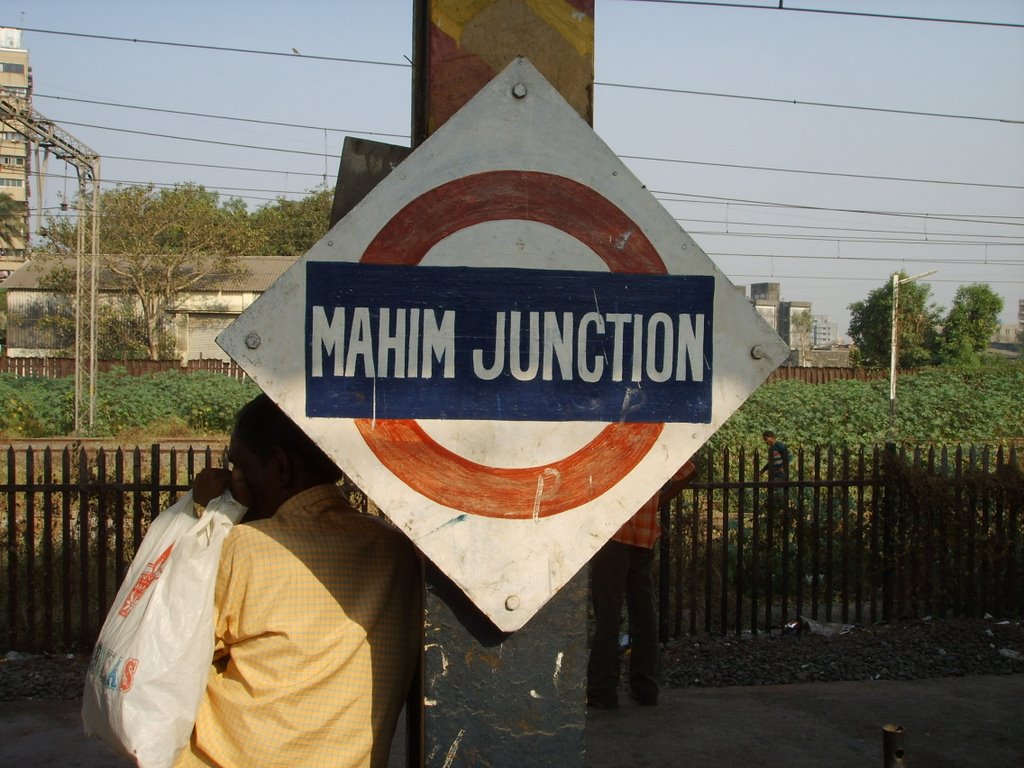
Mahim Junction is the nearest station to the Valladares manse in Mumbai, and I took this picture in early January when I was in town for a family wedding. It isn't the world's most evocative railway station, although it is an important one (you could call it Mumbai's equivalent to Clapham Junction - lots of people pass through it but most don't stop for long).

Last week, it was a scene of the latest horrific, large scale act of terrorism, as were the stations on either side at Bandra and Matunga Road, amongst others.

Ironically, Mahim itself is one of those multi-cultural parts of the city with a sizeable Catholic population (my grandmother is buried behind St Michael's Church there), plus a visible Muslim community. There has been tension in the past, especially when the city government was run by Shiv Sena, a rather ghastly Hindu nationalist, pro-Marathi party, whose greatest wish would be to make the city 'safe for Marathis'. Every incidence of terrorism, regardless of where it was, or who was to blame, was an excuse to ratchet up inter-communal tensions.

I fear that this outrage will lead to more incidents of violence, which is exactly what the terrorists on one side, and the extremists on the other, want. And, caught in the middle, will be the Catholic community.

The Western Railway is a part of my Mumbai, and I use it whenever I'm in the city, travelling to visit my family, or to go shopping in the Fort area. In fact, my Uncle Ritchie and Aunt Vanessa live in an apartment which overlooks the railway tracks. As a child, I used to look out of the window and watch the trains go past. So it's particularly horrible to think of the carnage that would have been caused on trains packed like sardines next to crowded platforms full of women, children and all of the other innocents who were simply trying to get home on a midweek evening.

There continue to be concerns about the response time of the emergency services here in London after last year's attacks. We have all of the modern equipment, trauma support, a free health care system and the means to get people to a place of safety quickly. Healthcare is less easily accessible in Mumbai, the roads are congested, support services limited. And yet Mumbaikars will somehow pick themselves up, dust themselves off, and carry on. Perhaps we should remember that the next time we complain about the supposed insufficiencies of our emergency services, and realise how lucky we are to have them at all...

Saturday, July 15, 2006

Paper, paper everywhere and not a drop to drink...

It has been a week of meetings, meetings and more meetings. And with that comes paper, reports, accounts, briefing notes, minutes, all of which really ought to be read, digested and responded to. There are never enough minutes in the day to do so and you end up skimming through them in the naive hope that you've gleaned enough detail to be able to comment intelligently if called upon to do so.

And yet, this is better than the alternative, turning up at a meeting where you are inundated with verbal reports which, for the most part, tend towards a rambling discourse on whatever is on the mind of the speaker at the time, and not necessarily the things you need, or want, to hear about.

So I was quite pleased that, for the first time since I became Regional Secretary eighteen months ago, every Officer actually wrote, and circulated, a written report for the Executive to consider. It wasn't the easiest of meetings, as a number of fairly controversial issues had arisen, but I did feel that we were able to have a meaningful debate of the aspects of the problems and, compared to some of our past meetings, which have run much longer to far less effect, it was quite enjoyable.

So, I now have minutes to write, plus action points and a diary to update. Just another weekend in the life of a bureaucrat...

Sunday, July 09, 2006

The dark romanticism of bureaucracy

It was always my ambition in life to be the dark, brooding romantic type and, although it often surprises people, I achieved it in a way that I might never have expected.

Romanticism and bureaucracy are not words that are immediately associated by many and yet, I have become a slightly unstable combination of the two. Tonight, I am crouched in front of the keyboard in a room lit only by the flickering light of a candle, catching up on my Regional paperwork to the strains of Johann Sebastian Bach's Fantasy and Fugue in G minor (BWV542 for the Bach scholars amongst you).

Bureaucracy has become my passion, and occasionally an all-encompassing one, which coupled with an old-fashioned sense of honour and a broad streak of Catholic guilt, occasionally leads me to do things that I might regret (last year's resignation drama was one of them...).

On the other hand, being a bureaucrat in politics give you a leeway that few others get. There is little competition for such roles and, as long as things get done, even the most eccentric are left alone to get on with things (heaven forbid that a campaigner should get involved with administrative stuff - doesn't win any votes, does it?).

So perhaps it is time to let loose the latin in me (where did you think the name came from?) and fight beneath the blood-soaked banners of good administration, old-fashioned courtesies and free trade liberalism. I always fancied the uniform of an early nineteenth-century Austrian cavalry officer (although the balls, music and diplomatic intrigue would probably have been even more fun) and, even if I can't have one, it might be fun to behave as though I was wearing one.

To sleep, perchance to dream, and tomorrow, let there be passion!

A night out in Crystal Palace

To Bromley Highlands, aka Crystal Palace, for a night celebrating the birthday of a friend.

Jo Christie-Smith is a comparatively new addition to my circle of friends, and I met her through politics (how else?) in my role as Returning Officer to Lewisham West Liberal Democrats. My first task was to tell her that she was ineligible to stand as she remained unapproved to take part at the close of nominations, not, perhaps, the best way to start a relationship.

I pointed her in the direction of my own seat of Dulwich and West Norwood and, whilst she was unsuccessful there, she was later selected to fight Mitcham and Morden, the less salubrious half of Merton, where she fought a spirited, if terminally under-resourced, campaign. I appeared on her horizon once again as the stand-in Returning Officer, and we've stayed in touch ever since.

Barbecues are often a gamble at this time of year but this one went off smoothly enough and the conversation flowed as freely as the alcohol, helped by a remarkably catholic range of guests. I was able to relax and gently lower myself into the current and had a really good time, debating a range of adult topics, i.e. mostly not politics (life is too short!).

So, many thanks to Jo, and I trust that you will get some pleasure out of my gift, perfect for those chilly evenings in front of a roaring fire...

Running around with a pair of scissors in my hand

One of the results of the work of the Boundary Commissioners is that the boundaries of the various Local Parties change. Normally, this isn't a particularly difficult task but I've been drawn into the debate on one of London's trickier changes, the creation of the new constituency of Lewisham West and Penge, a cross-borough seat straddling the boroughs of Bromley and Lewisham, and a potentially winnable one at that.

At the moment, we have a Lewisham Borough Party, and separate Local Parties for the three current Bromley seats (Beckenham, Bromley and Chislehurst and Orpington). Lewisham members want to remain a borough-wide group and as for Bromley, much discussion is taking place as to the best future configuration. It's quite a technical debate, but it has ramifications for the different tiers of campaigning (borough, GLA and Westminster) and, if the wrong result emerges, it will be a potential setback for our campaigns over the next five years.

I seem to be have been drawn into the discussion as a potential 'honest broker', a position which, whilst I think I can deliver it, is not the role I would obviously select for myself. At least I know most of the key players and that they're all pretty sensible people. I'm bound to upset someone though...

Sunday, July 02, 2006

Deep in the heart of England

A day out of the big city for English Council in England's second city, Birmingham. Typically, Virgin had chosen the weekend for major track repair so, given the similarity in journey times from Euston and Marylebone, I picked the more scenic (and slightly cheaper) route via High Wycombe and Banbury. And with the pleasant company of our Regional Policy Chair, Havard Hughes, the journey sped by, even if the train itself didn't.

A brisk but quite impressive stroll through the shopping area brought us to Victoria Square, dominated as it is by the rather grand Civic Buildings, our venue for the day. In the sunshine and with the fountain with what my friend, Grant, described as the floozie in the jacuzzi outside (there's another one of those in Dublin, but that's another story), it was a lovely day to be in the fresh air. Unfortunately, English Council was inside...

Not the most thrilling English Council ever but then, it isn't really intended to be. What it does do is give you prior warning of things that are expected to happen and will impact on you, as a Regional Officer, or Local Party Chair, or whatever. It also gives you an opportunity to challenge the hierarchy, or perhaps influence them to head in a direction that you favour.

I had arranged to meet up with an old friend from my Young Liberal days afterwards, Grant Williams, from Walsall. Grant is currently studying for his LLB (law degree) and is very likely to get it with an impressive pass. Picking me up from the meeting, we walked back through the city centre before heading to Lichfield for a leisurely afternoon of alcohol, food and conversation in the scenic surrounds for a pub just outside the city (it isn't a town, it's got a cathedral...).

Then, back to Moor Street for a late train to Marylebone and on to bed... a good day out, all in all.