Saturday, April 22, 2023

In the light of the Dominic Raab story, a civil servant writes…

I’ve been a civil servant for more than thirty-six years, and thus am rather nearer to the end of my “career” than the beginning. But, whilst my personal ambition has been limited, my belief in the power and value of public service remains undimmed. After all, I’m clearly not doing it for the money…

Now I ought to preface what comes next with an admission that I don’t know what happened between Dominic Raab and his civil servants. As someone who believes in due process and the rule of law, I tend to acceptance of the findings of independent reports and thus, if it was found that his behaviour was inappropriate, I lean towards the idea that it probably was.

But I’d like to mull over the relationship between politicians and civil servants, predominantly because, if all is well, a mutually respectful relationship between the two is more likely to lead to good governance and better decision making. Now I should emphasise that, by that phrase, I don’t mean “policy that I like and agree with”. No, governance is more nuanced than that.

The best “rule of thumb” for the relationship is “politicians decide, civil servants advise”. If a politician, particularly a minister, wants to do something, the role of the Civil Service is to determine how it might be delivered, what legislative change (if any) is needed, and what the possible consequences are. If the proposal is currently illegal, or will negatively impact on some, that should be explained, preferably with whatever evidence exists. That isn’t about opposition or obstructionism, it’s about offering a decision maker the information needed to make what they (the decision maker) believe to be the best choice from the available options.

In return, politicians need to be open to the possibility that their ideas might be flawed, unworkable or illegal. That requires, a sense of mutual respect that entertains the notion of honest doubt.

Increasingly, in recent years, politicians have blamed the Civil Service for the difficulties they encounter in making the sorts of systemic changes they believe to be necessary. They refer to “the Blob”, or to “the Establishment”, accuse civil servants of balking their pet projects, anything rather than admit that, when push came to shove, their demands couldn’t be met because the consequences of action were rather worse than the status quo. Thus, if a politician starts from the premise that his or her officials are a problem rather than the means to a potential solution, that suggests an ongoing relationship based on confrontation rather than collaboration. It’s not likely to end well.

Civil servants can’t really push back. For one thing, there is an ultimate acknowledgement that the politicians have a mandate and a basic right to make decisions as to how the country is run. The second is that we mostly operate under a set of guidelines that discourage open debate and are covered by the Official Secrets Act. And, ultimately, we still respect the fact that a politician, with a personal mandate, has certain rights and obligations that we as civil servants don’t.

So, if Dominic Raab had high standards, that’s fine. We want higher standards in government. If his management style was such as to distress his staff, then we have an obvious problem.

If you’re being criticised for doing your job as an advisor, you may stop offering information that your minister isn’t going to like, or soft-pedal that information so that it might not be seen to carry as much weight. That leads to unbalanced information in the hands of a decision maker and thus the risk of error in policy making. And given that all decisions in government have consequences, it might reasonably be concluded that the consequences of decisions made without all the facts are likely to be worse for all concerned.

It has been suggested that politicising the upper tiers of the Civil Service, in a similar manner to the way things are in the United States, would engender a more responsive bureaucracy. I suspect that, if you allow Ministers to appoint people who share the same beliefs, and who are entirely beholden to the Minister, the prospects of receiving independent advice become much lower, and you create a chasm between those who advise and those who deliver what is decided. You’d also reinforce the very suspicions that politicians have of their officials if an incoming government is welcomed by senior officials directly appointed by their political opponents.

So, to summarise, for good governance to flourish, there must be mutual respect between those involved in the process of governance and policy making. The Dominic Raab report appears to suggest that, at least in his case, that mutual respect wasn’t there, and his response to it doesn’t indicate that self-awareness has been triggered yet. If he intends to return to government any time soon, it might help him if he takes some time to reflect on what led so many civil servants to complain about him and why some political observers have characterised him as angry and slightly psychotic.

Friday, April 21, 2023

Federal Council: “Kind Hearts and Coronets” but without the murder…

One of the things about narrowly losing a Federal Committee election is that you’re potentially on standby to step in if a successful candidate implodes, resigns or, tragically, dies. Indeed, that’s how I found myself back on Federal International Relations Committee two years ago, after Jonathan Fryer’s sad demise. And that was not the only such loss, as FIRC Vice-Chair, Ruth Coleman-Taylor passed away last year. I miss both of them, if truth be told.

But given how close I got to being elected to Federal Council last year, and given the number of directly elected members, I had the sense that, merely by remaining a Party member in good standing, I might yet find myself promoted. And so it has come to pass, following the resignation of Alison Eden, first from the Party and then consequentially as a member of Federal Council. I won’t comment on the background to that saga, as I only know what happened as opposed to why, but it may not have come as much of a surprise to those involved.

There will be some catching up to do, and some cultural acclimatisation - every committee has its own rhythm in my experience and I’ve found it more effective in the past to simply go with it rather than fight it. But the Chair, Antony Hook, is someone I know and have worked with in the past, and the rest of Federal Council are, for the most part, people I have worked with in one of the myriad of roles I have performed over forty years of lyric bureaucracy within the Party.

I’ve swapped messages with Antony, discovered that there is a Federal Council Slack group, put the date of our next meeting in my diary and now await my first set of papers. In the meantime, I suspect that an induction pack might be coming - there was one when I rejoined FIRC - and I ought to read the constitutional stuff to refresh my memory of what it is I’m supposed to do.

I am kind of looking forward to a new challenge, and am optimistic that the skills I’ve picked up in my multiple roles in the Town and Parish Council sector will stand me, and my colleagues in good stead for the next three years or so.

So, wish me luck as I wave you hello…

Tuesday, April 18, 2023

They call him the Count… because he can’t…

My degree, for what it’s worth, is in Mathematics (with Statistics), and I am, by most people’s standards, highly numerate. This allows me to look at Rishi Sunak’s announcement that the Government is going to raise standards of maths skills with a soupçon of scepticism.

I’ve always been of the view that, at the level confronted by most people, maths skills are as much about confidence as they are about technique. I encounter people who will throw their hands up and declare how bad they are at it and yet, if given the time and space to work through a calculation, will come up with the right answer.

There is a sense that, with the advent of calculators and, these days, calculators in smart phones, that the ability to add up, multiply, divide and subtract is obsolete, although I’d argue that, without a basic grasp of numbers, the risk of missing a typing error is higher than I’m comfortable with. My confidence in my numeracy skills means that, if I make a data entry error, I’m likely to spot it before it becomes critical.

But Rishi’s announcement does have a feel of John Major’s national cones hotline about it, but without the same potential viability. We already have a chronic shortage of mathematics teachers and a recruitment and retention crisis due to uncompetitive salary scales, and the announcement glosses over these issues without offering any sense of what might be done to remedy them. Indeed, it suggests that whilst young Sunak understands how government should work, the reality of how things actually are escapes him.

In fairness to him, he has no real experience of actual service delivery, so perhaps I should be as troubled by the fact that his Secretary of State for Education doesn’t appear to have pointed out the flaws in his announcement, nor any member of the Cabinet. But then, there’s not much sense of practical awareness  amongst most of them either.

The irony is that, in isolation, the idea of boosting maths skills is a thoroughly good thing but making an announcement to deliver an outcome when the resources required to deliver it simply don’t exist merely reminds us that Conservative government doesn’t add up. Perhaps the subtraction of hundreds of Conservative councillors next month might suggest a solution in 2024…

Sunday, April 16, 2023

Procession, peanuts and policy…

Crossing the High Street with care

It was the Needham Market Civic Service yesterday and, in my capacity as Chair of one of its neighbouring Parishes (but mostly as Ros’s husband), we were part of the formal party. That requires us to process up the High Street from the Community Centre to the Parish Church for the service.

I’m sure that, in past years, the High Street was closed and we processed down the middle of the road, Mayors of the surrounding towns in their regalia and robes, their Consorts by their side but it all seemed rather more low key this time. We walked on the pavement, crossing the High Street at the pelican crossing and then entering the church. Progress, I guess.

There was a nice tea afterwards, and I caught up with Steve Phillips, one of our retiring District Councillors, putting our very small part of the world to rights.

These sorts of things feel rather cozy, but perhaps they act as a reminder of an era of civic pride which is increasingly anachronistic in a world where such things are frowned upon as old-fashioned and rather fusty. I do get that - how does it help the community and does it put newcomers off? - but tradition has its place, particularly in terms of community cohesion in rural and semi-rural communities. And in Suffolk, where what are now relatively small towns were once of national significance, these events are an anchor to its proud past.

Perhaps it’s regret, or perhaps I’m simply getting older and mistily nostalgic, but I’d be sorry to see these things fade out of existence…

Pay peanuts, get?…

So, apparently the Civil Service pay remit suggests an increase in paybill of 4.5% for 2023/24, compared to inflation at 10%. Pay levels are now so low at clerical grades that they’re being swept up with the National Living Wage. And yes, that means that the person you rang to ask about your tax problem is earning the same hourly rate as the person stacking shelves at your local supermarket.

And when even broadsheet journalists are noting the vast discrepancies between Civil Service pay rates and those for private sector companies competing for the same skill levels, you shouldn’t be surprised to find that the sort of person who might altruistically opt for public service rather than private profit becomes increasingly rare.

You get the government you pay for, I’m afraid to say.

A resolution (or forty-three) to consider

I admit that my one remaining function as a Liberal Democrat - member of the Party’s delegation to ALDE Party Council - is mostly far less onerous than many of the posts elected by the Party membership. After all, going to six meetings over a three year period isn’t exactly going to kill me. It isn’t cheap - the meetings have been held in cities such as Yerevan, Bratislava, Palermo and Dresden, to name but four - but it is intensive, with a whirlwind of activity in the weeks leading up to the events.

This time, we seem to have had far more resolutions to consider - whereas it’s usually no more than twenty, it’s over forty this time. Our delegation has to consider them both in their own right but by comparison to Party policy - you really wouldn’t want us to be freelancing on potentially controversial issues here at home.

I’d better start reading, I guess…

Thursday, April 06, 2023

Creeting St Peter: hail to the Chief?

In recent times, the period around the close of nominations for local elections has been slightly more fraught than for most people. As a serving councillor, the concerns come in two parts:
  • can I successfully submit my nomination papers?
  • am I actually going to have to fight an election?
The second question is, I admit, more of a Parish and Town Council thing - principal authority elections are seldom uncontested - as many contests… aren’t.

Having handed in my nomination papers in person on Tuesday morning and had them vetted by Mid Suffolk’s Head of Election Services, I was pretty confident that I had been validly nominated (and how embarrassing would it be if an “out” bureaucrat screwed that up?). All that was left was to await the formal publication of candidates.

Having clicked on the link on the Mid Suffolk website yesterday afternoon, I was somewhat surprised to find that the total number of Town and Parish Council contested elections was… one. And it wasn’t Creeting St Peter.

And so, I am gloriously re-elected. Four years ago, I noted that it wasn’t so much an endorsement of my ability and hard work as a sitting councillor as a sense that I wasn’t annoying anyone enough to provoke a challenge. I suspect that this is less the case now after more than four years as Chair, including over the pandemic. People appear to know who I am and what I do, which is nice, and events of the past year have demonstrated that the role isn’t as easy as my colleagues think I make it look.

I even delivered upon the goals I set four years ago. The street lights have been replaced at far lower cost than I had feared (thanks must go to the County Council for offering us an exceptionally good deal) and the emergence of village Facebook and WhatsApp groups has allowed me to convey useful and/or important information to most village residents quickly and efficiently.

So, what are my aims for the next four years? It would be nice to support our Parochial Church Council in raising additional funds to refurbish the Church Room, and the recent discovery that they could apply for Section 106 funding is very encouraging. We also would like to improve our playground, especially given that we have a surprising number of small children in the village.

I’d also like to finish off the job of dragging Council into the twenty-first century in terms of how it operates. The appointment of a new Clerk and Responsible Finance Officer was a big leap in that project, but the work is still ongoing. As Chair, if they’ll continue to have me, that does put an onus upon me to actively engage rather than just acquiesce but that might not be a bad thing.

So, another four glorious years are launched. Maybe I ought to crack open a bottle of champagne?…

Thursday, March 09, 2023

Creeting St Peter: might there be some tangible benefits from Gateway 14?

Well, work on the infrastructure needed for Gateway 14 is pretty much complete, and construction of the first (and largest) building on the site is approved and underway.

The next issue for our community is the distribution of the Section 106 (Town and Country Planning Act 1990) funds associated with the project, something that we have little experience of. Being a countryside village, as defined by Mid Suffolk District Council, we don’t get much development, and thus we’ve never been assigned any such funds in the thirteen years since I first joined the Parish Council.

I’d attended a Town and Parish Council Liaison Meeting last month, hosted by the District Council, where they updated us on key issues that might impact our sector and communities, and part of that was a presentation by the Communities Team. Their role is to interact with us to improve our relationship and help us to achieve benefits for our towns and villages.

I thought that this might offer an opportunity to deal with some of our key issues - the playground and the Church Room - and so I stopped Simon Lanning, the dedicated team member covering our area, and had a few very polite words. That led to an agreement that a more structured conversation might be helpful. And so, on Tuesday, we met on Teams, accompanied by Josh Holmes, one of his colleagues who specialises in grant applications.

My first question was to confirm the size of the pot, which turned out to be £190,000. Now, that does have to be shared with Stowmarket, but it was noted that Stowmarket do have access to other pots of cash, which means that, whilst we shouldn’t be greedy, a simple division based on population shouldn’t limit our requests.

So, resetting our playground’s slide would be smiled upon, as well as some new equipment if needed. And, whilst the only community building belongs to the Parochial Church Council, as it is the key social hub for the village, funding may well be available to make it, say, accessible for disabled users. Some of the more desperately needed repairs might be covered too, which would be very welcome.

There was also news on the footpath which links the village to Gateway 14, in that funds have been set aside for a major upgrade. Simon and Josh have agreed to seek an update from the County Council in terms of what is happening and when, which is very kind of them.

So, we may see improvements to our village, which would be lovely, and a legacy to future residents.

Wednesday, March 08, 2023

Enter bureaucrat stage left with the early morning call for a separate vote

So, with a bit of help from my colleagues, especially Nick da Costa, the ever helpful Chair of Federal Conference Committee, I’ve managed to navigate the Conference Standing Orders (note to self - might be worth reading them at some point) in pursuit of my proposed change to Business Motion F3.

It’s been agreed by FIRC and the current Liberal Democrat member of the ALDE Party Bureau that I am right to be concerned, and that they won’t object to my proposal, and Nick has advised that he’d prefer a separate vote. And so, I lodged the request using the surprisingly user friendly webform by the deadline and all appears well.

I am going to find out what is required of me next. My working presumption is that I ought at the very least to be in the hall for the motion, and that I ought to prepare a few words of explanation so that Hannah Bettsworth (FIRC Vice Chair) can accept it on behalf of the movers.

Now you might wonder why I’m so vague about this. Curiously, I don’t think that I’ve ever tried to amend a motion at a Liberal Democrat conference - I’m not a policy geek and, usually, not that organised. I’ve amended my name to amendments from time to time, but only as “fifth spear carrier” and not with any intention to intervene myself. So, it will be a new experience for this bureaucrat.

I will, at least, hopefully be fortified by a decent cooked breakfast…

Sunday, March 05, 2023

That'll teach me to read the Conference papers a bit earlier next time...

I'm a Liberal Democrat and I read constitutions. That makes me, it seems, slightly geeky, even by the standards of Liberal Democrats. However, occasionally, I spot something that makes me think and, having started the process of organising my diary for Spring Conference, I allowed myself to be distracted by the content.

That allowed me to spot agenda item F3: Business Motion - FIRC. It is, in the generality, a good thing, in that it tidies up the way in which the Party delegations to the Alliance of Liberals and Democrats for Europe (ALDE) and Liberal International are chosen and led, codifying what was done by custom and practice in the past. The problem is that I think that it contradicts the Internal Regulations of the ALDE Party. See what you think...

F3: Business Motion - FIRC

1. Our delegation to the ALDE Council shall comprise:

b) Any Liberal Democrat members of the ALDE Bureau, unless they already have their own place as Council members.


whilst the ALDE Party Internal Regulations say:

The following persons will be entitled to attend the meetings of the Council, with voting rights:

b) Members of the ALDE Party Bureau. Each Bureau member carries an individual vote and cannot take an additional proxy vote, either on behalf of another member of the ALDE Party Bureau or of an ALDE Party member party.

Now call me quirky and old fashioned, but that suggests that ALDE Party Bureau members can't vote on behalf of member parties, whilst the Business Motion puts any Liberal Democrat member of the Bureau in exactly that position. Doesn't it?

There is still time (just) to amend it, but I don't want to appear to be being awkward for the sake of it. Suggestions, Liberal Democrat hive mind?

Saturday, March 04, 2023

National Grid: bringing power lines to a village near you whether you like it or not

One of the challenges of changing the energy mix is that you need infrastructure to support it. So, if you're going to build a swathe of new offshore wind power generation, you need to get that electricity onshore and to the places that it is desperately needed. And, in Suffolk, that means that we're a bit in the way. 

We get that, we really do. However, what we'd really like is that, if you're going to run overhead cables across the countryside, we'd like to be consulted and we'd like them not to run over the village. We aren't even a big village, so it wouldn't take an awful lot to meet our wishes.

I ought to admit that, when the East Anglia Green project was first mooted, I wasn't terribly engaged. In the absence of a Parish Clerk, I was rather more focussed on keeping the Parish Council show on the road and my "bandwidth" was somewhat limited as a result. But, now that I have taken a closer look at it, one thing stands out. Whilst, in the rest of the county, the preferred route for the new overhead transmission lines avoids villages, in our case, the graduated swathe (the purple stripe on the map) passes straight over us. And yes, the darker colours (where they would ideally route the pylons) are just to the east of the village, but they might well be very close to our small community.

So, because I'm curious like that, I rang the East Anglia Green consultation hotline three weeks ago. I reached a recorded message thanking me for my call but, at the end of that message, instead of encouragement to leave a message or, better still, a human being to talk to, there was silence. I waited for a while but nothing seemed to be happening. Perhaps there had been a glitch and I had been cut off so I rang again, only for the same thing to happen. This time though, I waited... and waited... and waited... for more than two minutes until, suddenly, another recorded voice invited me to leave a message.

A little bit later, I received a telephone call, apologising for the fact that I hadn't gotten through. A very polite woman listened as I explained the problem with their telephone line and assured me that someone would call me, either later that afternoon or on Monday, to answer my question and any others I might have.

Fair enough, I thought, and awaited a call. I'm still waiting for it.

My suspicions should have been aroused by what happened when I rang the hotline in the first place. It did seem as though, by accident or design, that it was a means of putting off potential questioners. And, if they hadn't noticed the problem already, it offers a sense that they don't really care.

I'm not opposed to having pylons. They've got to go somewhere, and the existing infrastructure means that a north-south route across Mid Suffolk is inevitable. But we'd like to talk about the type of pylons used - we'd quite like the more modern T-shaped ones - and we'd like to input our thoughts into the exact route.

But I have a nasty feeling that being reasonable is, in their eyes, the same as being a doormat. And they wonder why local communities are so opposed to major infrastructure projects on their doorsteps...

Thursday, February 02, 2023

Creeting St Peter - a little bit closer to McDonalds…

It would be fair to say that the Gateway 14 development has been a part of my life for the best part of five years now, with the initial controversy over the placement of a business and enterprise park on our doorstep succeeded by the long and wearying hybrid planning application phase during which a plucky parish council, working alongside a residents actions group, strove to improve the original proposals.

In the end, the District Council, the owners of Gateway 14, pretty much got their way, as was fairly inevitable. We did get some mitigations, with a bund to screen the site from the nearby group of properties at Clamp Farm, a promised electric bus service to transport workers to and from Stowmarket town centre and improvements to the lighting and ecosystem protection.

Last week saw a ceremony to mark the commencement of work on the new distribution centre for "The Range" and today we had the official opening of Gateway Boulevard, the spine road for the development.

So far, so meh. But, for residents of Creeting St Peter, it meant the final closure of our old road to Stowmarket, and its replacement with a new, more direct route to Tesco (our nearest supermarket), Stowmarket and the A14. And so, a few of us turned up for the opening ceremony.

What had been a bright and sunny morning had become a rather raw, cloudy afternoon, heavy with the threat of rain, but the local dignitaries had turned up, councillors, the Mayor of Stowmarket and the board of Gateway 14 Ltd, to witness the cutting of a ribbon by James Caston, Chair of Mid Suffolk District Council.

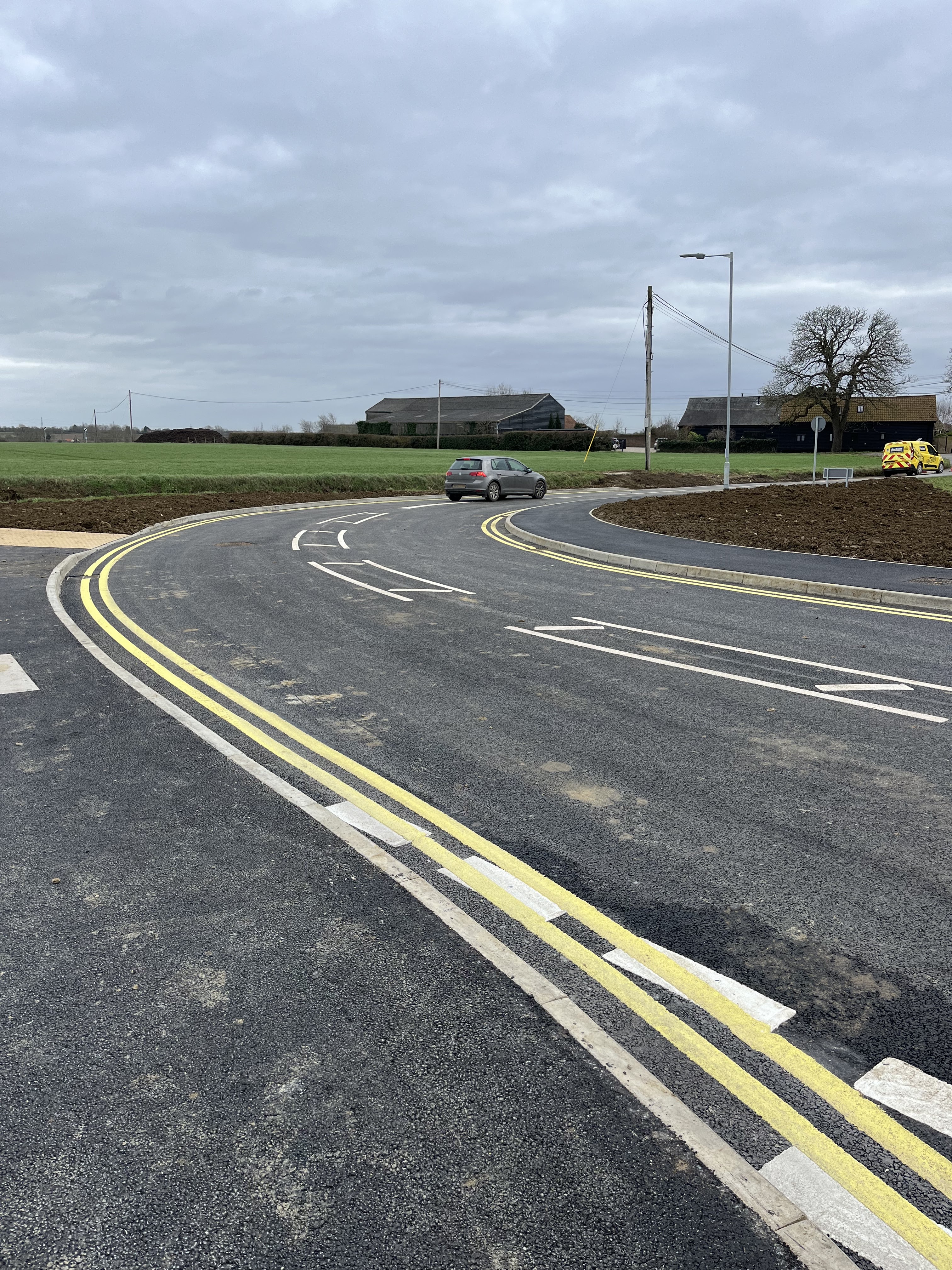
With the official opening complete, there was an offer of tea and cake. However, given that it was a bit bleak, and I had work to get back to, Ros and I decided to skip the free calories and drive home... using the new road. In the picture, you might make out a yellow van, out of which an employee of the contractors got before kicking the cones into the nearby ditch and thus effectively opening the road to through traffic, which makes us the second people to drive out of Gateway 14 towards the Creetings.

I'll remember it for the rest of my days.

It must be said though that, finally, the whole Gateway 14 thing feels a bit more real and, for residents of Creeting St Peter, there is a tangible benefit, in that our journey times are reduced and a few existing highways problems have been solved.

It also means that we feel a little less detached from Stowmarket which, if you don't live here, might seem a bit strange. But our village has always been far enough away from Stowmarket to feel as though we're not connected, yet close enough for residents to benefit from a convenient mainline railway station and the services that a decent-sized town has to offer. I do wonder if, in time, it will change the dynamic of our community.

And now, we're all going to have to get used to using different routes to get back to the village. I'm sure that we'll adapt eventually...

Friday, January 27, 2023

Ros in the Lords: Net Zero

I was asked at a recent Parish Council about the action we have taken towards Suffolk's goal of being carbon neutral by 2030. And yes, even a tiny parish like Creeting St Peter can make a contribution, as Ros noted yesterday...

My Lords, I too thank the noble Baroness, Lady Hayman, for securing today’s debate so soon after the publication of this excellent report. In his report, Skidmore says that
“there must be more place-based, locally led action on net zero. Our local areas and communities want to act on net zero, but too often government gets in the way. The Government must provide central leadership on net zero, but it must also empower people and places to deliver.”
I could not agree more. At this point, I should declare an interest as President of the National Association of Local Councils, the representative body for town and parish councils. They cover everything from the tiny parish in which I live, with a precept of a few thousand pounds, to some of our largest towns with budgets of many millions.

So, as the first tier of local government, they should not be overlooked in the delivery of net zero. Many are already providing place-based, locally led action. Many have put climate change on their agenda and are actively looking for ways in which they and their communities can play their part in delivering net zero. If time permitted, I would share with the House some of the many case studies of strong local leadership and practical projects, such as tree planting, recycling schemes, car charging points and much more.

With their clear place-based remit, they are uniquely positioned not just to act themselves but also to act as a catalyst for community and faith groups, local businesses and local government at other levels. Crucially, they can ensure that action is not just concentrated in large urban centres, and that even rural parishes can play their part. So, when the Government come to consider recommendation 20 on the establishment of trailblazer net-zero communities, I do hope that at least some of them will be led by ambitious town and parish councils with a proven track record. But they could do more. These councils need to be empowered by extending the general power of competence, and by the removal of administrative barriers.

Government funding streams are, frankly, a mess. Across government, there are too many funding streams that are too complex, too expensive to administer and deliver and often incoherent. That is not just my view but that of the NAO. Indeed, the Climate Change Committee has made many of the same points on this agenda. Local authorities now find that they cannot bid because they simply cannot afford to. The Government should undertake a massive simplification, particularly with regard to net-zero funding, and ensure that, this time, town and parish councils are entitled to bid and play their part, because they are often denied access.

I would add the Levelling-up and Regeneration Bill to the list of Bills that have already been mentioned. There is an opportunity to do some of this quite quickly, since what I have said reflects not just what Skidmore said but what all the organisations that gave evidence to him said. Parish and town councils are leading the neighbourhood planning revolution, and they will be vital to the next stage of delivering net-zero neighbourhood plans with their communities and their buy-in. However, that Bill offers some challenges to the neighbourhood plan process, and we will explore that as it progresses. Can the Minister assure us that the levelling-up Bill will be assessed against Skidmore’s report to make sure that it is not actively working against it?

Polling shows that there is a great public appetite to do more, but people are unsure about how best to contribute. It all feels somehow remote and too big for them as individuals to make a difference, but local action can bridge that gap by involving people and communities and making a real contribution to net zero.

Thursday, January 26, 2023

I am, for the first time in a long time, without a role within the Liberal Democrats. It feels... okay.

I am, as I've admitted in the past, the consummate Liberal Democrat bureaucrat. I have a seemingly unlimited curiosity about how the organisation works, read constitutions and standing orders because they matter and serve on committees so long as they interest me and I can make a contribution.

I stood down from Federal International Relations Committee at the end of last year having not sought re-election. I felt that I had pretty much run out of purpose - the Committee is running well, it's far more politically effective than it was when it first emerged from the last Governance Review, and there are some really good people leading it forward. I could have run - I might even have won - but I'd come to a good endpoint.

I did run for Federal Council - as much because I felt that my skills would be useful than out of a desire to take part in the wearying internal conflict over transphobia and its definition. But I lost, albeit narrowly, and was fairly relaxed about it. And I did earn a place on the Party's delegation to ALDE Party Council, which I'm still really pleased about.

For those of you who voted for me, many thanks.

But that leaves me with the responsibility to attend two meetings a year, somewhere other than in the United Kingdom. It's not exactly onerous, is it?

In truth, I find British politics a bit depressing. The never-ending sense that we have a government led by people who don't understand the importance of ethics and morality is bad enough, but I increasingly fear that they don't care, that they are actively attempting to undermine most of the truths I hold dear - that good governance is at the core of a successful, thriving state.

I've got my Parish Council responsibilities, which I take seriously enough, and my new roles at County and National level within the Suffolk Association of Local Councils and the National Association of Local Councils, where I sit on committees and offer up my thoughts in a scrutiny role. It's a bit like the Liberal Democrats but without the angst.

I am planning to attend Conference in York though - a hotel room is booked - so it's not as though I'm giving up the whole yellow thing. Perhaps a rest will be as good as a change...

Wednesday, January 18, 2023

Ros in the Lords: Levelling Up Bill (Second Reading)

As has been noted by many, this Bill has been so gutted that the Conservatives are being told not to refer to "levelling up" any more. What that's going to do for the Department of Levelling Up, Housing and Communities is anyone's guess. However, it does offer an opportunity to make some gains for the Town and Parish Council sector, ably represented in the Lords by the Honorary President of the National Association of Local Councils, one (checks notes) Baroness Scott of Needham Market...

My Lords, I wish to focus my remarks on what I regard as the crucial role played by parish and town councils throughout England—one which, I suggest, is essential if the aspirations of the White Paper and this Bill are to be met. I declare my interest as president of the National Association of Local Councils, which supports England’s 10,000 local councils, covering everything from my own tiny parish and its precept of a few thousand pounds to some of our largest towns with budgets of many millions.

Local councils represent an existing, sustainable and accountable model of community leadership and service delivery. Crucially, they help to create that spirit of place which is so essential in building well-being and a strong civic society. They provide parks and open spaces, facilitate street markets, support high streets and organise community events. Part of their strength is that they are close to the people, but they are also part of the important fabric of the local area, alongside community groups, faith groups and voluntary organisations. Working alongside those partners, they are increasingly innovating in areas such as local climate change action, tackling loneliness and dealing with the cost-of-living crisis.

It is in the area of housing—neighbourhood plans led by local councils, with the full involvement of residents—that local councils have proved themselves more than capable of adding to the stock, rather than diminishing it. I pay tribute to my noble friend Lord Stunell for introducing this. There were people who said, “Well, they’ll all just say no to everything”, but they do not. When local people have buy-in, we end up with more housing rather than less. In the last decade, 3,000 neighbourhood plans have been made; 1,300 referenda came about as part of that, and 88% of people voted yes. However, neighbourhood plans are not available in unparished areas, and it is fair to say that the attitude of the principal authorities is not always supportive. This Bill could contain measures to help deal with some of that, but it also contains some measures—we will return to this in Committee—which could adversely impact on the way neighbourhood plans are currently running.

True devolution is not just about passing a bit of power down one level. The framework set out in the Bill says nothing about onward devolution; therefore, there is very little in it about devolution to local and community councils. The White Paper contained a commitment to carry out a review of neighbourhood governance. It is a shame that we have not yet had that, because the measures needed could have been part of this Bill. Can the Minister say when this review might take place? I ask her, please, not to say, “in due course”, because I have been told that about four times in Written Questions. The UK Social Fabric Index shows that areas with full coverage of local councils score higher in measures of community strength than those without.

There are significant and sometimes ridiculous limitations on the financial powers of local councils, which are excluded from a whole raft of government funding streams. The result is either that a local area does not bid at all, or that it has to set up a whole new organisation and paraphernalia in order to bid and then run it. Reform is needed on this and in other areas, including extending the power of general competence, rights over community assets, clarity on funding for church halls, and parity with the rest of local government in order to be able to pay a carer’s allowance.

The sector made good use of remote meetings, which were forced on all of us during the pandemic. There is lots of evidence to show how engagement—both people joining the council and people joining in with council meetings—increased during that time, so we would like to see that brought back.

The Bill provides a really good opportunity for local councils to build on what is already an impressive record and to play their part in rebuilding and regenerating the social, as well as the economic, fabric of their areas. They do so with very little support and training. They do the best they can with what they have, but it would be good to see local councils have parity with principal councils when it comes to government funding. I know that the Minister has a good track record of working with the town and parish council sector, so I hope she will use the passage of the Bill to make some improvements and enable it to motor.

Saturday, December 10, 2022

ALDE Party Council - some post-Council reflections

I think that I've remarked before that I'm not always good at conferences. I'm a bit shy, not necessarily the best at small talk with people that I don't know and tend to be a bit aimless unless I actually have something to do. Yes, it's nice to catch up with old friends, and conferences do offer that opportunity, but I can find them a little daunting.

Bratislava, however, went better than I might have feared. It helped that the relatively intimate gathering that is Council allows more time to catch up with old friends and colleagues and that the lobby bar at the venue hotel was actually rather nice, with comfortable armchairs and sofas, and not too brightly lit.

That meant that, as the evening passed, I found myself in conversation with some familiar faces, with the time to catch up on the rest of our lives, rather than talking politics all evening. And I accept that this seems a bit strange, given the reason we've all gathered, but I still find people fascinating, and as I have no ambition other than that of competence, it makes for a much more enjoyable, relaxing time.

Turning to the politics, I have found, I think, a niche within our delegation, and there were enough things to engage me to give me the impression that my presence was useful. And that matters because going all the way to Slovakia for a relatively short event is not without cost.

Whilst I occasionally kick back against the idea of being pigeonholed as a bureaucrat, there is a role for someone to hold the ALDE Party Bureau accountable, rather than just focussing on the policy and campaigning elements. As I've said before, a political party is better at winning elections if it is well-run and well managed. Without a strong base, all of the policies in the world mean little if you don't have a machine by which they can be communicated to voters. The trick is to balance the various demands of campaigning, ideas generation and compliance.

Reassuringly, the current Party delegation seem happy enough to trust me to fulfil my role in such a way as to not upset too many people and, in return, I make sure that they understand what I'm doing and why. That reassurance is a two-way street, in that knowing that I have their confidence makes me better at what I do.

With that confidence comes a greater ability to chip in on policy making. I'm not an expert, unlike some of my colleagues, but I'm well-informed, bring the viewpoint of someone with a South Asian background, plus a degree of gentle cynicism about the glories of Western democracy. That means that, when we're debating something within the group, I can perhaps tweak the language of a resolution or amendment or judge the efficacy of an idea and occasionally convince my colleagues to change tack a little.

And, given that I've been around rather longer than many, especially within the ALDE Party, I can find solutions to problems that might otherwise be complex. I know who to talk to and when, I know how the Statutes and Internal Regulations work, and I have a comfortable relationship with the ALDE Party Secretariat. Sometimes, that can be very useful.

I think, therefore, that I can look forward to three more years as a member of our delegation with a degree of confidence. Not too much, because I'm not that kind of person, but enough to allow me to be a little more relaxed, a little more "me". The first test of that will be Stockholm at the end of May. Let's hope that I pass... 

Friday, December 09, 2022

ALDE Party Council, Bratislava 2022 - so, what did I actually do?

So, having given a more formal report on events in Bratislava, it’s really rather about time that I offer a more personal perspective on events, one that focuses more on me and what I did there.

Delegation Meeting

Whilst our primary business was discussing the urgency resolutions, my contribution was to offer some compromise language and update my colleagues on some technical details.

Individual Members summit

The leadership of the Individual Members are deeply unhappy about the proposal to bring the current arrangements to an end and create a new “Friends of ALDE” group. Members of the new group would not have voting rights at Congress or Council and would be supporters rather than active participants. I’m a Liberal Associate (the descriptor for non-EU members) with rights pretty much equivalent to those proposed under the new arrangements and had two reasons for attending, one rather more controversial than the other.

As a member, I had every right to attend and express my views. However, as one of the primary authors of the paper that was to be presented to Council the next day, I am partly responsible for the proposals by which the Individual Members will be wound up.

I do think that the leadership of the Individual Members has been pretty poor in recent years, resembling nothing more than a group of squabbling children arguing over possession of a rather shabby toy. The meetings I have attended have been pretty unedifying and behaviour has been poor. But that is, in itself, an argument for finding better leaders rather than simply abandoning the idea. Instead, my concern is that the policy demands of the Individual Members leadership seem determined to reduce the influence of the member parties to a point where there would be little value in paying an annual subscription. There is a philosophical chasm between the objectives of the two sides, and I can’t see how it can be reconciled.

I’m also not convinced that the leadership represent much more than themselves. The participants in their policy working groups come from a very small pool indeed. I am convinced that the majority of Individual Members join for three reasons - to show support, to be kept up to date with events and to attend briefings and seminars. The new proposal would allow all of that.

I didn’t want to say too much - I don’t agree with the stance they are taking - but felt obliged to correct some of the inaccuracies in their claims. And, whilst I don’t think that they’re in the mood to listen, I did at least try to convince them to stick to the facts.

Stuttgart Declaration session

I was a bit late for this, due to the Individual Members but I did make a contribution. The 1976 Stuttgart Declaration was the founding document for what is now ALDE and it is proposed to update it for a new political age.

It would be successful, I suggested, if we could come up with a statement of principles such that, if someone was to attempt to guess our policy stance on a particular issue, the statement would point towards what it might be. The great liberal philosophers remain valid because their arguments resonate across the ages, and our document should too. The policy statement which follows would be more of an appendix. That seemed to meet with approval, so perhaps I’ve hit upon something.

Council

As the delegation’s “house bureaucrat”, I’m given licence to lead on finance and organisational stuff. So, I queried why we weren’t offered an indication of the current 2022 budget outturn figures when asked to approve the 2023 budget. Comparing it to a 2022 budget which may, or may not, be a fair reflection of what actually happened, rather hampers Council from doing its job of scrutiny. The Treasurer suggested that it would be inappropriate to offer us unaudited figures and I guess that my perspective as a tax inspector differs from his as an accountant. I think that he’s wrong - my job is to scrutinise his work, not merely to applaud it, and I don’t doubt that I’ll return to that topic in May.

I also had a central role in the discussion of how a Secretary General is appointed and evaluated, given that I co-wrote the document that the Bureau presented to Council. The failure of the Co-Presidents to manage the agenda meant that it didn’t really get the airing I had hoped, which augurs badly for the discussion that has to take place at the next Congress. I raised the issue of a “conflict of interest” clause, preventing Bureau members from seeking the position within two years of the end of their term as a Bureau member - something we take for granted in government here. I sensed that Co-President Timmy Dooley wasn’t keen and whilst I did rather spring it on him, it’s an argument that I haven’t given up on.

I had to explain to the delegate from the Individual Members that the paper on the future of their organisation wasn’t a platform to argue whether or not they should be abolished - that decision was taken in Dublin at the previous Congress, after all - so trying to make the argument wasn’t particularly helpful. I’m guessing that this will run and run, not helped by some of the contradictory messages being conveyed.

If I had to sum up how Council went, from a personal perspective, I’d say that I did what I promised I would do, scrutinising the work of the ALDE Party, offering a perspective stemming from a firm belief that an organisation should live its own values in terms of how it operates and how it treats its people. 

Friday, November 18, 2022

Liberal Democrat internal elections: winning (and losing) here…

So, I fought two elections and emerged with a 50% success rate. Given that I don’t generally benefit from group endorsements, and am not wildly keen on “slates”, I rely more than some on the friends I’ve made over the years and the strength of my manifesto. Luckily, longevity and a willingness to do those jobs that people need doing but would rather not do themselves, means that I know a lot of people (or, rather more importantly, they know me).

A study of the endless count sheets for Federal Council will show that there was one candidate who was neither elected or eliminated. That would be me. I hovered between 20th and 23rd throughout the count but, in the end, fell just short. In the event of a vacancy through resignation or death, I’m in with a shot of promotion, although there are no guarantees in a recount - it depends on who goes and where their votes are redistributed.

Coming, effectively, 22nd out of 59 is pretty good, if not good enough, so I can’t be truly unhappy with the outcome. And I’m always pleasantly surprised by the level of support that I get, given that I’m not at the core of anything much these days, so I must thank all of you who did vote for me, wherever that might have been in your preference order.

The contest itself was not for the faint-hearted, and I have a sense that Federal Council may be a bit of a bearpit - it’s not entirely clear to me that some successful candidates are particularly bothered about more than a very narrow agenda. That, however, is not something that I can do much about, so I won’t lose sleep about it.


Having lost that, my expectations in the contest for a place on the ALDE delegation were lowered somewhat. Whilst there were ten vacancies, three were effectively gone already as I’m not Scottish, Welsh or young. It was therefore a bit of a surprise when word came that I’d actually won. Admittedly, I have no idea how, as the actual count information hasn’t been published, but I probably came in the top seven in a tough field, so I’m really pleased. It was, it seems, a complex count, needing five recounts, so I’ll be intrigued to see how it all unfolded.

I’ve really enjoyed my time attending ALDE Party Council meetings - they suit my skill set as a bureaucrat, reader of constitutions and keen process geek. I actually think that I add value, confirmed by one of the responses to my reaction on Twitter.

I’ve built a strong relationship with the ALDE Party’s secretariat, partly because I think that it’s important to work effectively with the professional team but also because, in my experience, politicians can be weak on process and sometimes lacking in respect for those who have to deliver their decisions - you can take the boy out of the Civil Service, but you can’t take the Civil Service out of the boy. In return, they’ve been supportive when I’ve wanted to change things, tolerant of my occasional flights of fancy and kind on occasions when it has mattered.

All in all, I have much to be grateful for, and another three years in which to represent my Party and, hopefully, do good. And, as I promised, you’ll hear about it here… and here…

Monday, November 14, 2022

Everybody has an agenda, it seems, and I’m no different…

Whilst the Liberal Democrat internal elections draw to a close - you’ve got a couple of days left to vote, by the way - the campaign isn’t cooling much. Suggestions by one candidate that they have contacted the police in relation to comments against  them on social media don’t give comfort that the declaration of a result will end the unpleasantness that has ensued.

But there is no doubt that the campaign has certainly exposed two camps, each of whose positions are seemingly unacceptable to the other. And, because the nature of the divide, those less able to restrain themselves on social media become the justification for their opponents to ratchet up the unpleasantness themselves.

Now you might think that this is me gently leading up to a plea for tolerance and mutual understanding and, under normal circumstances, you’d probably be right. The catch is that I’m not entirely convinced that the chasm between the two sides can easily be bridged.

You see, one side appear to want to punish an entire group of people for the theoretical behaviour of a few individuals who may, or may not, actually be members of that group. The other side feel that offering people freedom to live their lives as they wish, punishing those who transgress as and when they do so, is the way to go. I’m instinctively with the latter group, whilst understanding that fear is a very hard motivator to overcome.

I could be being unfair, and I’m happy to consider an argument to the contrary, but my working hypothesis for liberalism is always about freedom and the balancing of freedoms between groups - does the freedom given to one group impinge on the freedoms of another, how do you mitigate this if it does, or do you simply have to accept that life is imperfect and you can only do your best?

Some talk about power, a concept which, whilst I recognise its importance, makes me vaguely uncomfortable. I firmly believe that power is, like freedom, something to be shared, and, as a bureaucrat, my job is to provide the information sufficient to allow people to make good decisions. Not necessarily ones that I agree with, but decisions that work for them. And that’s as true for the organisations I work with as it is for those I care for.

I chose to run for Federal Council this year because I think that we should try to make it work in a manner which helps the Party to grow and thrive. I don’t have “answers”, partly because we don’t yet have any questions, but partly because politics moves quickly, and the issues that might be critical today may be irrelevant tomorrow. But good governance doesn’t change, and it acts as a platform for good decision making.

My manifesto does give the impression that I might like to chair it if elected, and I would be dishonest if the idea hadn’t crossed my mind. I am, apparently, quite a good chair - at least, people are very kind - partly because I’m not keen on the sound of my own voice, like to reach consensus and have developed an ability to peer benignly over my spectacles at people. I’ve also benefited from watching a lot of people chair committees, some good, some bad, some indifferent. But there are a few minor hurdles to clear before we get to that stage… especially given the possibility that I might not get elected in the first place.

There is also the decidedly high possibility that the contest that has emerged during the campaign will be carried into the new Federal Council, where those whose manifesto focussed on policy issues are likely to be confronted with the uncomfortable truth that policy is highly unlikely to be at the core of its work - it is meant to be a scrutiny committee. Defining the role of Federal Council, putting meat on the bones of the constitutional skeleton of the committee, will be essential to prevent it from becoming the talking shop that some believed it was always intended to be.

So, regardless of whether or not I get elected or, if I do win a place, Federal Council should be interesting to say the least. Ah well, not long to wait now…

Wednesday, November 09, 2022

The Boundary Commission for England reports... can I see three constituencies from my house?

I currently live in Bury St Edmunds constituency, Conservative majority 24,988. The Liberal Democrats didn't contest it in 2019 - it was one of the seats ceded to the Greens for little effect (they came third with 15.7% of the vote). And the new proposals move Creeting St Peter into the revised Central Suffolk and North Ipswich constituency in the centre of the map, I've marked us with a green dot.

This represents a return to where we were prior to the last boundary changes but what is interesting is the significant redrafting from the previous proposals. Suffolk still moves from seven to seven and a half constituencies, the difference now is that, instead of sharing a constituency with Essex (Haverhill and Halstead), the cross-border constituency is with Norfolk.

Originally, a chunk of West Suffolk was to be parcelled off to the proposed Haverhill and Halstead seat, with Bury St Edmunds constituency shuffled westwards. The gap would be filled by splitting Central Suffolk and North Ipswich in two, north-south and expanding westwards, forming a North Suffolk seat and an Ipswich North and Stowmarket seat, whilst Waveney shrank to Lowestoft, and Ipswich, South Suffolk and Suffolk Coastal remained relatively unchanged. Creeting St Peter was going to be in the Ipswich North and Stowmarket seat.

The new proposals retain West Suffolk - possibly good news for Matt Hancock if his future plans include being an MP - and instead create a new Waveney Valley seat from parts of Bury St Edmunds, Central Suffolk and North Ipswich, Waveney and South Norfolk. It’s a pretty huge seat, stretching from Stowupland in the south-west to the western edge of Beccles to the east and as far north as the Tivetshalls in Norfolk. Bungay and Diss are probably the largest centres of population, but it’s going to be a pretty challenging task for anyone trying to take the seat from the Conservatives given the difficulty in forming a campaign team that can effectively reach the dozens of small parishes strewn across the area.

Bury St Edmunds and West Suffolk are both squeezed further westwards, whilst Lowestoft remains as originally proposed, losing Bungay and the Elmhams to Waveney Valley. Again, South Suffolk and Suffolk Coastal remain basically untouched, whilst Ipswich sees no changes.

Luckily, this requires very little disruption for Liberal Democrats in Suffolk, as we’re organised on local government boundaries. However, in Norfolk, they’re organised on constituency boundaries, which is going to make for some interesting discussions over Waveney Valley between Mid Suffolk (split between three constituencies, East Suffolk (likewise) and South Norfolk (now torn asunder).

But perhaps we ought to get the district elections out of the way before we worry about that…

Monday, November 07, 2022

Leader and President - perhaps the boundaries aren't so clear cut?

It's odd really, but I'd never given a lot of thought to the role of the Leader. After all, they're the Leader, right?

One of the candidates for Party President is emphasising the words at the beginning of Article 20 of the Federal Constitution:

The President shall be the principal public representative of the Party...

and, of course, Liz Webster is absolutely right to point that out. But what, exactly, being the principal public representative of the Party means in reality is rather less clearcut.

I thought, therefore, that I ought to see what it says about the role of the Leader. And that was something of a revelation. Article 18, which refers to the Leader, tells you how one is elected but doesn't actually tell you what the Leader does.

Now I hear you exclaim, "but it's obvious, the Leader leads, right?". Well, yes, but what does that mean, especially if you have a President who wants to be front and centre, as Liz does.

So, if Liz is going to take up a campaigning role, what happens if the Leader sees it differently? What if internal polling shows that her stance isn't as popular as she thinks it is, or the Leader wants to soft pedal that. Is Liz going to insist that her mandate gives her the authority to override him? Now, I don't know the answer to that question, but I do suspect that, if the relationship between the Leader and the President is poor, then the President is likely to come off worst. No Leader is going to want to be seen as not in control of their own Party.

In truth, I've always seen the President as being the principal public representative of the voluntary Party. The idea being that the President is the bridge between the members and the Leader and Parliamentary Parties, conveying hard messages in private and being supportive in public. By chairing the Federal Board, the President manages the voluntary Party and guides the professional team.

At the moment, I don't entirely get the impression that Liz entirely agrees with me and, of course, voters may agree with her. But, at the moment, there are a lot of assertions and little in the way of actual proposals for action. And, as I noted on Saturday, slogans may not get you very far when, in early January, you turn up for your first Board meeting...

Saturday, November 05, 2022

A Presidential contest, but not exactly a happy one…

I have noted in the past that I have an unusual perspective on the Presidency of the Liberal Democrats. When you’ve been nearer the heart of a successful campaign, and then acted as Presidential Consort for two years, your sense of what is required to win the Presidency and then do the job is perhaps a little more acute than most.

So, in deciding how I was going to vote, I had quite a lot to reflect upon.

But here are some thoughts, both on what I think of the three candidates and on the campaign so far.

Starting with the incumbent, Mark Pack… I had reservations about his candidacy last time - can a non-Parliamentarian really hold their own amongst the big beasts of the Party, will they be taken seriously by the Leader and the Chief Executive, can they motivate and manage the Party’s internal leadership?

In truth, I don’t really know if he has achieved that - I’m somewhat remote from events in HQ these days, and the pandemic hasn’t helped in that sense. But there’s no sense that the Party is struggling organisationally, nor that Mark has failed. He’s managed to make some constitutional and structural changes that I might not have expected to succeed, there’s a sense that the Party has the capacity to improve its position, and I’m not hearing any suggestions that he has done much wrong.

I rate Lucy Nethsingha very highly. A very capable Regional Chair, a successful campaigner and leader, and a former MEP, she should be a thoroughly credible candidate for the Presidency. The fact that she’s from the neighbouring county helps.

I know rather less about Liz Webster - she’s passionately opposed to Brexit, comes from a farming background but other than that, she hasn’t really come onto my radar. I presume that, like a lot of our membership, she’s joined since 2015, but that in itself means little.

So, it would be fair to say that, in theory, I could have voted for any of the candidates.

It is very hard to just rock up and run for the Presidency, even in the age of social media, unless you have a very high profile already. Paddy could very easily have done so, had he ever fancied the job, Shirley likewise. The fact that their first names remain easily recognisable says much. And the Presidency is not an easy gig, you really need to have given some thought to why you want the job and nothing says you haven’t necessarily thought it through like turning up at virtually the last moment and announcing your candidacy. For example, Ros campaigned for more than two years before her decisive victory in 2008. When the formal stage of the campaign was reached, she had a clear vision which she could articulate, a killer campaign team, supporters and influencers across the Party at every level, and an understanding of how the Party functioned (or didn’t).

That was one of the things that puzzled me when Lucy announced that she was running - I would have expected some sense of a campaign building, especially when you’re attempting to “take down” an incumbent. And, in truth, I still don’t have a sense as to why she’s running. Her campaign material is very policy heavy - what her intentions are for leading Federal Board, for example, are something of a mystery. There’s little or no social media, and no sign of anyone reaching out to contact voters. Lucy has my e-mail address, and if there was a campaign team, I’d expect to be contacted seeking my vote.

But if Lucy was late into the fray, Liz was last minute to the point that there was a question as to whether or not she would get the required nominations. Ironically, the innovation of online nominations almost certainly made her campaign possible. However, given the impression that she was only running because Jo Hayes couldn’t, I sense that she’s decided to run first and then come up with a strategy second. And her campaign has shown that - it’s policy heavy and signals a potential clash with the Leader and the Parliamentary Parties.

I am deeply uncomfortable about her pledges to support various groups, pledges that she has very little likelihood of being able to deliver upon as Party President - it’s not a policy role as such. If she does take views that undermine the Parliamentary strategy, especially that of the Leader, what happens if those are exposed during a General Election campaign?

I also have to say that I don’t take kindly to the tone of her campaign and especially that of some of her supporters. Smearing your opponents is bad enough in retail politics, but doing so in an internal contest is not the sort of behaviour that makes friends and influences people and, if your goal is to lead the voluntary side of the Party, making enemies amongst the Committee stalwarts is probably not going to make it easy.

And whilst I note what she says about the membership figures, pinning the decline on the Party President displays a very shaky grasp of how the Party works, especially when she doesn’t appear to offer any answers in terms of how the situation might be improved.

Mark’s campaign doesn’t inspire. But, as the incumbent, he doesn’t have to, having the advantage of a track record to run on. He’s got the serious endorsements, from people who evidently think that his leadership has helped them to succeed. He also has the advantage that he is fully prepared for a campaign, having spent a long time (and I mean years) preparing first to get elected and then to gain re-election. You might fairly say that he’s run a classic Liberal Democrat campaign over a long period, just as the experts tell you that you should.

So, who have I voted for? The lack of enthusiasm might point towards an abstention but then, I’ve been around a long time and don’t have a personal investment in this contest like the one I was involved in during 2008. After all, I did marry the candidate during the campaign…

The answer is… Mark. He is the only candidate who, in my eyes, understands the job, and given that a lot of people whose views I respect, and have been in the room for the key meetings, say that he is worthy of re-election, there is a perfectly respectable argument for voting for him. Lucy doesn’t give me a sense that she really wants the job or have a vision for what she would do if she won, and I am suspicious of Liz’s motives for running and whether or not she would be a team player.

Mark sees his priority as getting the Party machinery “match fit” for a General Election, where the funds needed to fight a credible campaign, employ the best staff and present our argument are available, that we are able to take advantage of whatever opportunities come our way. And I respect that - it worked in 2009 and 2010.

But, for me, the clincher is that Mark appears to understand that the Presidency is about soft power, not about command and control. And, if you know the Party well, you know that in an organisation where power is more diffused than many appreciate, the ability to identify who can make something happen is critical.

So, those are my thoughts, for what they’re worth. We’ll see what happens soon enough but, regardless of who wins, I wish them good luck. The Presidency is a huge challenge for whoever holds it, and there’s no shortage of work that needs to be done, but the country needs a strong liberal voice, now more than ever.