The musings of a liberal and an internationalist, living in Suffolk's county town. There may be references to parish councils, bureaucracy and travel, amongst other things. And yes, I'm a Liberal Democrat.
Monday, September 26, 2022
Liberal Democrat Internal Elections: "a million thanks, dear friends!"
Wednesday, September 21, 2022
Recognition for the unsung heroes - the Suffolk Community Awards
It's one of the things about moving from a city to a small village as I did more than a decade ago, you become much more aware of how communities survive and thrive. In a city, because the level of population churn is greater, you may not gain a sense of continuity, and of individual contributions to civic society. That's not to say that it doesn't exist - there are no end of community groups operating in our towns and cities - but it can easily feel impersonal.
In our small towns and villages, however, where the presence of local government is less "overt", the importance of volunteers is more evident. From Parish and Town councillors to good neighbour groups, from village hall committees to Parochial Church Councils, you're more likely to know the people who make things happen, who go that little bit further to improve communal life.
And, in Suffolk, three key umbrella groups have come together to recognise those people - the Suffolk Association of Local Councils, whose Board I have the honour to serve upon, Community Action Suffolk, where Ros is a trustee, and Suffolk County Council. The Suffolk Community Awards are open to nominations from across the county, and last night saw the awards ceremony.
Now I ought to note that the awards are not just for small towns and villages, with Felixstowe and Carlton Colville being recognised for their achievements in the fields of health and physical activity and community building respectively, but my particular interest is in how small villages and hamlets face up to the challenge of sustaining communities in the face of the challenges wrought by the shrinking of local government in the tiers above them.
And when Bredfield won the award for the best small village in the county, I was amazed to hear what they've achieved in terms of creating opportunities for residents both in their village and in its neighbours to take part in a range of activities. Given that Bredfield is barely larger than Creeting St Peter, with a population not much above 300, it sets the bar rather higher than I could have envisaged. I'm not daunted... much...
Other awards went to young volunteers, and to groups working with young people to enhance their lives and to create opportunities, and it is rather moving to hear of the impacts they have despite limited resources.
The organisers, whose efforts should really be applauded, had managed to persuade Mark Murphy, the former BBC Radio Suffolk morning show host, to present the awards, and he enthused the audience and engaged with the various winners in a very natural and encouraging way.
All in all, a really invigorating evening, and one almost perfectly designed to spur on those of us in the audience to give just a little more of ourselves in the campaign to build stronger communities across our county.
Wednesday, September 07, 2022
Creeting St Peter: it's time to bring the professionals in...
Saturday, August 27, 2022
It’s going to be a brutal winter, so we ought to be thinking ahead…
I have to admit that, reading the various reports on the prospects for household finances, my blood runs somewhat cold. If, like me, you’ve been paying attention to the data on household financial resilience, you’ll know that there are already alarming numbers of households where something like a boiler failure would send them into debt. The prospects of finding thousands of pounds to pay heating bills will add two or more million households to that group, and any extended period of high gas prices will add more and more.
And, whilst attention has turned to energy costs, households are also facing food inflation which feels higher than the already painful 10% as reported. The loaf of bread from Tesco that cost £1.10 not so long ago is now £1.40. Worse still, all the evidence points to food inflation rates being higher for the poor than the rest of us, with rates of up to 18% reported.
One of the things about living in a small, somewhat remote, village is that we don’t actually have mains gas - we evidently weren’t worth connecting up - and so mostly rely on heating oil for heating and hot water. That might be somewhat to our relative financial advantage over the coming months but, up and down the country, village communities are going to face problems.
We’re already hard hit by the increased cost of petrol - many households run more than one car by necessity in the absence of meaningful public transport - and for those villages that do have mains gas (and 85% of all households have gas heating), the older your house is, the harder it is likely to be to keep it warm. Village halls and what public facilities remain will be more expensive to keep warm, whilst retail and small businesses that are already marginal will struggle to keep going. And, once your village butcher has gone, you probably aren’t going to get them back.
As a Parish councillor in a micro-Parish, my problems are inconsequential compared to some of our neighbouring villages. We don’t have a building and, fortunately, our aging streetlights are all due to be replaced with brand new, highly energy efficient, LED lights imminently. But I deeply suspect that colleagues elsewhere would welcome support to enable them to open up village halls as “heat banks” for elderly residents, or to improve energy efficiency and/or insulation for these key community assets.
We may also need to think more strategically about solar farms in rural areas. They are seldom popular, with accusations of agricultural land being lost and landscape blight. But solar energy is going to become an essential part of the diversified energy mix needed to keep the lights on at a price we can afford, and there’s going to have to be a little more give and take, especially if we want to improve self-sufficiency in energy. It may not help this winter, but it will eventually.
In addition, many rural homes are suitable for solar panel installation - we’re mostly detached or semi-detached, with roofs open to the sun. Not only can we potentially supply much of our own electricity needs, but with the right incentives, some of us can supply power back to the grid. We’ll need some to power our electric vehicles, but even so, it’s a good investment all round.
There’s a crisis coming, and it’s going to be grim. But, in solving the immediate problems, we shouldn’t give up on planning for the future…
Thursday, August 25, 2022
A new constitution to play with...
- constitutions should protect all parties as far as is possible
- change should not stem from personalities, but from situations, even if the personality has created the situation
- complexity should be kept to a minimum
- the laws of the legal jurisdiction should be at the core of constitutional change
As I understand it, we are to report back to Council in Bratislava at the beginning of December, so time is short, especially if, as I hope, we don't "spring" our proposals on an unsuspecting room full of delegates. And now, I must draft something for my colleagues...
Wednesday, August 24, 2022
Not so fast, Cllr Valladares...
Three months ago, I reported that my
I've discussed the matter with my remaining colleagues and they have decided that they'd really rather I return to the post. Under the circumstances, I don't really feel that I've got a choice - Council must have a Chair, and if nobody else will do it... well, I'd rather do it with good grace than grudgingly.
There is some good news though, in that our organisational problems appear to have been solved, with a new Clerk and Responsible Finance Officer starting on 1 September. Unusually though, especially for a small micro Parish, they're two different people.
Another Parish Council in Suffolk has been innovative in doing this, and it seemed like a perfect solution for us. So, having approached their Chair, I was told that their Clerk and Responsible Finance Officer might be willing to act for us too. I spoke to them both, and was impressed by their enthusiasm and expertise, and Council was happy for me to proceed. Hopefully, that will make my role less onerous than it had become, and I won't lie awake at night wondering what I've missed.
Council meets again in less than four weeks, and I'm hoping that we can also fill the two vacancies that have arisen over the summer - we're currently only just quorate with three councillors. I also intend that we take the Civility and Respect Pledge, not because we have a problem with that but because I think that it sends out a message to both those we represent, but also those beyond the Parish with whom we interact.
And so, I'm a responsible adult again. At least, more responsible than I had been. Wish me luck...
Friday, July 01, 2022
The big train ride, day 9 - on a very comfortable wing and a prayer
It was earlier in the morning than I would like, and I hadn’t actually seen Tarragona in daylight, but sometimes, a traveller has to do what a traveller has to do.
Tarragona has two stations, one in the city, served by regional trains from Barcelona, the other a twenty-five minute bus ride away from the city’s bus station, thankfully conveniently located for my hotel, which is served by high speed trains between Barcelona and Madrid (amongst other places).
Camp Tarragona was purpose built, and is a sleek glass and concrete building with all of the things that you really need from a station and not much else. It also has luggage scannners, which was somewhat unexpected - the Spanish are particularly keen on security and, for the time being at least, mask wearing.
Bridges, gate towers, a sensational looking market hall, Valencia has all this and more, plus direct flights from London, and I deeply suspect that I will bring Ros here at some point in the not too distant future.
All good things come to an end, apparently, and I had to leave, albeit not actually by train. Valencia has a convenient airport and, having realised that I wasn’t going to able to leave Spain by train, I had a flight to catch, bound for Zürich with an onward connection to Vienna, courtesy of Swiss. In keeping with the first class train ticket, I was flying business class, using some residual United Airlines frequent flyer miles.
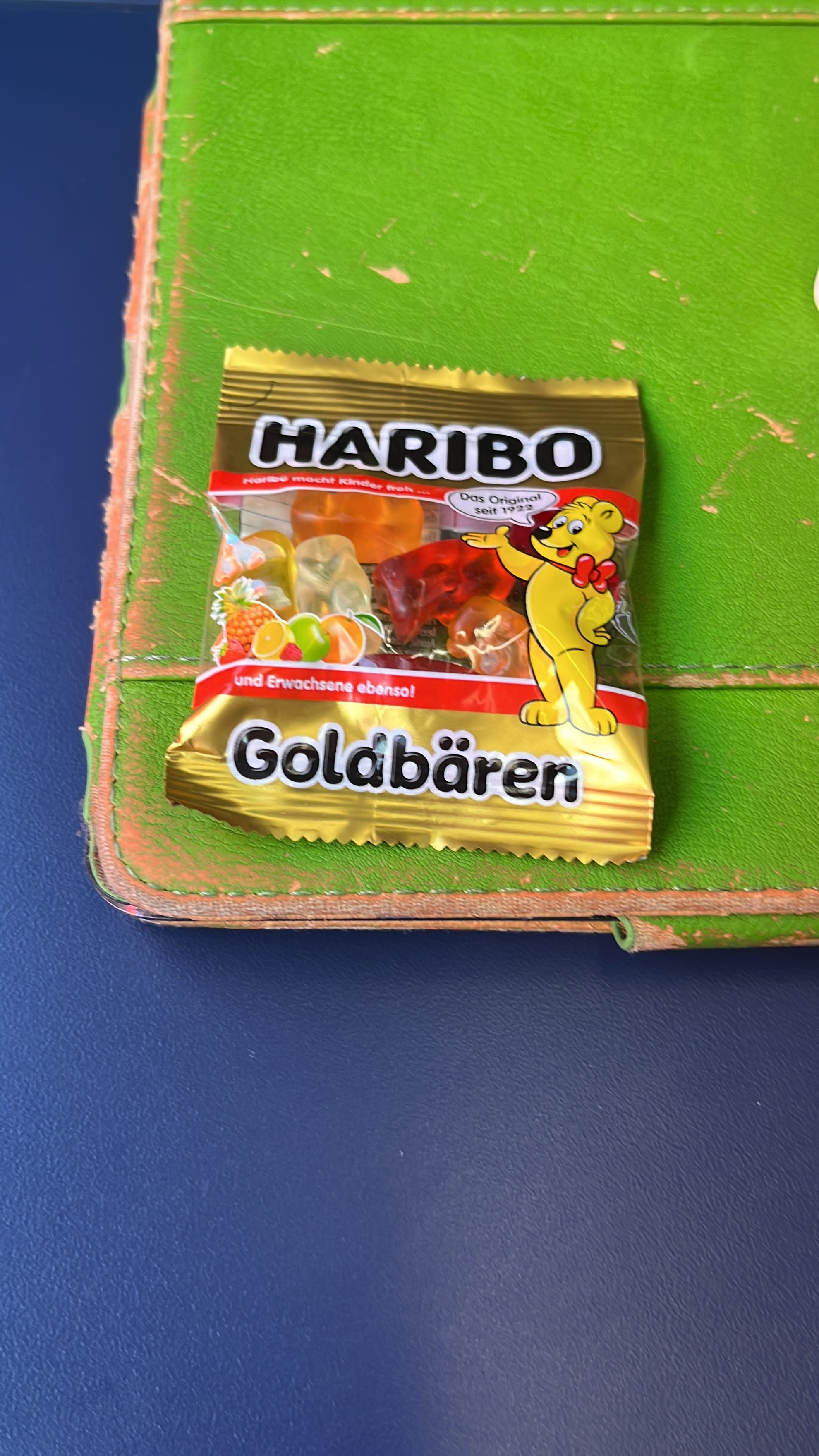
Valencia Airport is nice enough, with a very civilised business class lounge, and Swiss supply passengers with some very nice chocolate - something I like even more than gummy bears.
I made my rather tight connection in Zürich, arrived safely in Vienna, and headed into the darkness. It was time to return to Bratislava…
Sunday, June 26, 2022
The big train ride, day 8 - in which some valuable lessons are learned…
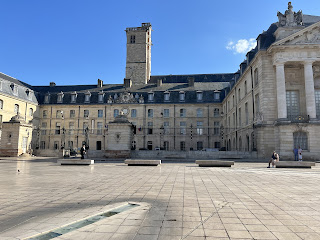
France was heating up, and I had a long train ride ahead of me. Which, as regular readers may recall, left me with a challenge. You see, I started walking ten thousand steps each day in 2016, and haven’t missed a day since. And so, to ensure that I didn’t fail, I had an early breakfast and took one of Dijon’s very efficient trams into the city centre to take advantage of the best of the day.

And that, I guess, was the flaw in my schedule - albeit an intentional one. But Dijon is certainly somewhere I’d like to bring Ros to sooner rather than later.
But I did have a train to catch, and a connection to make…
France is, of course, famous for its high speed trains. They are undoubtedly impressive, sweeping across the country on dedicated lines but why do SNCF insist on charging for a mandatory seat reservation? And it’s not a minor amount either, with the cost of a first class seat reservation adding as much as €70 to the basic first class fare. And, if you have a connection, that means more than one seat reservation.
As I headed for Dijon Ville station, there was something nagging away at the back of my mind - what I was going to do the next day. For, whilst everything had been neatly planned up until now, the only fixed point after this journey was a Eurostar train in three days time. But the train to Lyon was on time, I had snacks to keep me going and a solution was bound to come up, right?
At Lyon, I had time to ponder my options before catching the train to Barcelona. SNCF and the Spanish national rail company, RENFE, now operate four high speed trains each day crossing the border. Other than that though, your only real options are either via Port-Bou on the Mediterranean coast, or via Latour de Carol in the Pyrenees. Neither is quick, or convenient, and it leads me to wonder why more fast trains don’t exist. I’d been lucky to get a reservation on this leg, which should have been a warning.
There were no seats available the next day travelling back the way I was coming, and no availability on trains to San Sebastián, either directly or via Madrid, and so I was forced to do something unplanned.
The journey to Barcelona is one to enjoy, with some gorgeous scenery as the train passes through Nimes and Montpellier, along the Mediterranean shore and into Catalonia. We were held up at Perpignan due to a passenger being taken ill and, by the time we arrived in Barcelona, it was already dark.
I did have a plan though, requiring a seat reservation on a morning train out of Tarragona, and as RENFE only do seat reservations for Interrail passengers in person, I headed for the ticket office to make the necessary arrangements. This turned out to be easier said than done, and it required some rather frantic negotiations with their customer service team before I was directed back to the ticket office.
Once I’d queued for a little while, a friendly gentleman remarked that “that hombre” had appeared, sold me a seat reservation and indicated his mild surprise that, with such a Hispanic surname, I spoke no Spanish. But I had what I needed. The Great Escape was on!
Sunday, June 19, 2022
The big train ride, day 7 - across the continent to the home of condiment
The idea of sleeper trains is a romantic one and it is easy to forget that, not so long ago, they were headed the way of the dinosaur. Deutsche Bahn were so convinced of this that they decided to axe all of their sleeper trains. Fortunately, their Austrian neighbours saw an opportunity and bought all of the available rolling stock.
The result was a network of routes based from Vienna that allow you to go to sleep in one city and wake up, hours later, a long way away and for no more than the cost of a cheap hotel room. Even if you want a compartment to yourself, and I’m quite keen on that, the cost is still reasonable.
And other people want to get in on the act, with private companies raising funds to fill the gaps that ÖBB (Austrian State Railways) can’t easily service.
My destination was Milan Porta Garibaldi, thirteen or so hours from Vienna, including a two hour break in Villach where the two halves of the train, the other for Rome, were divided and new locomotives connected.
We arrived at three minutes early, leaving me enough time to get to the imposing Milano Centrale to catch a cross-border train to Bellinzona. These are operated by a collaboration between the Swiss canton of Ticino and Italian Lombardy, thus the trains are efficient and rather stylish.
At Bellinzona, the time efficient route to Zürich is via the Gotthard Base Tunnel. Efficient but dull, so I took the slow train, via Airolo and the old Gotthard Pass route and stared out of the window at the glorious Alpine scenery. A dash for a connecting ICE train at Zürich and I was in Basel ahead of schedule to catch an SNCF regional service to Mulhouse Ville.
My final destination for the day was Dijon (cue a series of mustard jokes). My hotel was attached to the Toison D’Or shopping mall, which gave me the opportunity to buy that new Fitbit I needed. It’s very nice and a bit more stylish and advanced than the old one.
A quick dinner later, it was time for some sleep - I had another early start to come…
The big train ride, day 6 - a somewhat battered traveller detours in search of profit…
Morning, and time to assess the damage. The knees were somewhat beaten up, with cuts and scrapes the record of the previous day’s mishap. But they were working, so it was time to get on with the show. And I had a plan…
Before leaving Suffolk, I had rummaged through our “random currency box” and discovered that we had 81,000 Hungarian forints. And given that my only fixed point for the day was to catch a train from Vienna at 7.23 p.m., it was time to get inventive.
There is a train service that runs every hour from Bratislava-Petrzalka station to Parndorf in Austria, from where you can get to Györ in Hungary. I needed a new Fitbit as I’d scratched the face of the one I was wearing, and the strap was damaged - neither by the fall, fortunately - and 81,000 forint would probably cover the cost of a replacement. And there was a conveniently located laundromat near Györ-Gyarvaros station…
And, sure enough, the laundromat was rather clever - you can pay by debit card, and the machine adds the laundry detergent itself, thus simplifying matters greatly. Better still, because the machines are industrial, a load of laundry can be washed and dried in about an hour, incredibly useful when you’ve got a train to catch. So, if you’re ever in Hungary and need to get some laundry done, the Bubbles chain comes highly recommended. The machine instructions are in English too, which is a bonus, and there’s an app so that you can book in advance.
Next, to the nearby shopping mall to look for a new Fitbit. The local branch of Media Markt, a Europe-wide consumer electronics store, didn’t have what I looking for and, as it turned out, the forint bank notes were out of circulation. So, I went to a bank to change them.
Unhelpfully, the bank weren’t obliged to do so, as I was nine months too late. Instead, I was directed towards a bank in the centre of Györ which, I was assured, could help. The catch was that they were about to close for the day. And then I had an idea.
Post Offices are run by the state in most places, and Hungary is no exception, so I headed for the main Post Office and, lo and behold, for a very reasonable 3% fee, I was able to walk out with 78,000 forints which I soon converted into €195. Time for a dash to Vienna for that 7.23 train…
Luckily, I’d left myself a time cushion, as we were held up at Hegyeshalom for reasons that never actually became clear. But I did get to Vienna in time for the connection I couldn’t miss.
I found my cabin, made myself comfortable and we were off. The cabin attendant had brought me a nice glass of Sekt, which was drunk as we headed south-west…
Saturday, June 18, 2022
The big train ride, day 5 - in which things go a bit wrong…
It was another glorious day in the Tatras, and I was up relatively early in order to grab breakfast and explore. The sky was full of swallows as, it turned out, they were staying at my hotel too, with nesting sites in the eaves and fledglings to feed.
As part of my package, I was able to get free cablecar rides, so, after breakfast, I headed to the nearby station for the ride up to Hrebienok.
The return journey was rather more treacherous - it’s funny, isn’t it, how descents seem to be like that? - and my skill at picking the right rocks to step onto failed me at an awkward moment. I crashed to the ground, landing hard on both knees and rather taking the wind out of me for a moment. Whilst I was hurt, I wasn’t broken and, getting up a little gingerly, I made it somewhat more slowly back to the proper path and limped back to the cablecar.
Lunch and a beer tends to cure many things, and it was time to set off for a new destination, so there wasn’t time to feel sorry for myself.
I was supposed to return to Poprad-Tatry for my next train but instead I returned to Strbske Pleso for a connecting train to Strba. The train to Strba is a narrow gauge electric cog railway, descending sharply into the valley below, where my reserved train would pick up about fifteen minutes after Poprad-Tatry.
My timing was good, as heavy rain promptly swept over the Tatras from the Polish side, washing out the rest of the afternoon. And I made it to Bratislava in time to do some laundry.
I had booked my hotel in Bratislava based on the premise that it had a guest laundry, thus allowing me to have enough clean clothes to make it through to the end of the trip. The news, on arrival, that no such guest laundry existed, was a bit of a blow to morale. But that was a problem for a new day, and I needed to take the weight off of my aching knees…
The big train ride, day 4 - Stary, Stary night…
Time for a change of scenery and a confession of sorts…
Ostrava not, frankly, having an awful lot to detain the curious traveler in search of entertainment, it was time to set off for one of the high points of the trip, Slovakia’s Tatras. Why Slovakia, I hear you ask? Well, the scenery is apparently spectacular, the air is clean and fresh and, as for the trains…
The Slovak scenery was rather attractive, and it gave for an easy journey to relax. And, whilst the connection at Poprad-Tatry was an unrelaxing, and unsignposted, seven minutes, I just about made it.
Now, for the confession. I may have mentioned that I am not a train spotter. Whilst I stand by that, I find unusual trains interesting and what the Tatras have is narrow gauge electric railways. And yes, this one was a bit like a tram, but it was certainly different.
And, apparently, the Queen and Prince Philip had visited the hotel more than a decade ago, something the hotel was rather proud of. I wonder why they were in Slovakia?
Once I’d dropped off my luggage in the room, I took a train to Strbske Pleso, a nearby ski resort with a lake to boat on or promenade around. There’s also a top notch Kempinski hotel, serving the winter sports set.
Back in Stary Smokovec, beer was drunk in moderation and a club sandwich eaten. I tend to think that a club sandwich is a good test of a hotel kitchen, as it’s quite simple as a concept yet easy to do badly. Fortunately, this was a pretty good club sandwich…
Sunday, June 12, 2022
The big train ride, day 3 - riding the Ostravan to an evening of light opera in Moravia…
After another astonishingly good night’s sleep, it was time to leave Germany, as I had plans. I hadn’t actually done anything about them but I did have some.
The EuroCity train from Berlin to Prague conveniently stops in Dresden, before heading up the Elbe valley. It has been a popular route for some time, no more so than during the Thirty Years War, when the locals had the misfortune to be on the main route between Saxony and Bohemia. As a result, various armies rampaged through the towns, leaving death, destruction and plague behind them. The “misery of Pirna” rather sums up the catastrophic effect of the Swedish siege of the town in 1639.
It’s a pretty run, with the Elbe on your left as you make your way to Prague. At the Czech border, the river becomes the Labe, and remains a major artery. The train, courtesy of Czech Railways, was comfortable and efficient, with a trolley service serving half-litre cans of Pilsner Urquell for €2. I limited myself to one with lunch…
The connection at Prague was as scheduled, formed by a Slovak Railways service heading for Zilina. I wasn’t going that far, not yet anyway, but whilst the Ostravan was a bit delayed by engineering work, I made it to the furthest corner of the Czech Republic without much drama.
Ostrava is the third city of the Czech Republic, to which one might respond, “so what?”. It isn’t exactly bustling, even on a Saturday night, but I did have plans. And, whilst the local composer is Janacêk, the local opera company were performing an opera by Bedrich Smetana, “The Two Widows”.
I bought myself a ticket online, a front row seat in the Gallery - priced at 500Kč, a very reasonable £17 for the best seats in the house. And whilst my Czech is wholly non-existent, the fact that it was being subtitled in English was an unexpected bonus. Why that should be is anyone’s guess, but a confused tourist should never refuse such a courtesy.
“Dve Vdovy” is a fairly light-hearted tale, based on a one-act farce written by Mauritius-born novelist and playwright Jean Pierre Félicien Mallefille. Nobody dies, over-dramatically or otherwise, and there is a happy ending, which is nice. Occasionally, performers would appear offstage, and the acting was more than respectable, something that I value in opera.
All in all, a perfectly charming evening and, if you’re ever in Ostrava, do see if there is a performance on at the theatre. If nothing else, you’ll enjoy the theatre building itself, and the quality of the performance will be high.
I walked back to my hotel through a surprisingly deserted city centre. If the locals don’t come out on a Saturday night, where are they? Admittedly, this may have something to do with the curious fact that restaurant kitchens appear to close at 9 p.m. But I had a song in my heart and joy in my soul. Life was alright…
Saturday, June 11, 2022
The big train ride, day 2 - I like gummy bears but, on the whole, I’d rather be in Dresden…
So, the great adventure was under way, and I awoke with a sense of purpose in anticipation of… well, to be honest, I wasn’t really sure. I knew that I had a train to catch at 11.30, and I had plans to find pork and beer at the other end but, apart from that, it was all a bit “free form”.
All in all, it was very nice but, whilst I was tempted by the possibility of a tram ride to Heidelberg, I had that train.
The 17.00 wasn’t anywhere near as full, despite the cancellation of the 16.31 ICE train, and we rolled across Saxony in a leisurely manner until we reached my destination, Dresden.
And, as intended, pork was eaten and beer drunk, before I turned it for the night. I had an earlier start the next day…
Friday, June 10, 2022
The big train ride, day 1 - the longest journey starts with a single community bus ride…
I enjoy travel, as regular readers will testify. And it is as much the actual journey as the destination sometimes. It’s not that being somewhere isn’t enjoyable, but the process of travelling from A to B should bring some joy.
A month ago, it was Europe Day and, to celebrate this and the fiftieth anniversary of the introduction of the Interrail ticket, there was a short lived offer of half-price Interrail tickets. So, I bought myself a one-month first class Interrail ticket, usage any time in the next year.
Which brings me to a train somewhere in Hesse…
I left Creeting St Peter yesterday morning, dragging a pleasingly small suitcase on wheels and with a small rucksack on my back, using our Connecting Communities demand responsive transport to get me to Stowmarket station in time for the 9.32 train to Liverpool Street. I’d activated my pass and was curious to see how it would work.
The idea is that you select your train using the handy app that Interrail offer and, once you know that you’ve boarding it, you mark the train by sliding a little ‘button’ to the right. This ensures that the train company get their share of revenue from the ticket. If asked by a ticket inspector - they all seem to be called train managers these days - you show the QR code for your pass and all is well. They are theoretically supposed to check that you’ve entered the train on your pass, a throwback to the time when they were in paper form, but nobody seems to be too bothered about that.
The first problem was as Liverpool Street, where the QR code didn’t trigger the barriers, but there was someone on duty so they let me out with merely a perfunctory glance at the QR code, so no harm done.
I’d cautiously left more than enough time to get to St Pancras but it was a nice day, and my 10,000 steps don’t walk themselves, so, rather than take the Elizabeth Line to Farringdon and then ThamesLink to St Pancras, I walked through the Barbican Estate to Farringdon, where my ticket again failed to trigger the barrier. And, again, I was admitted to the platforms. I do find myself wondering what QR codes I could show and still be let in…
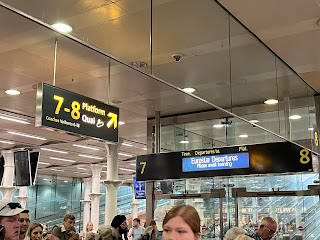
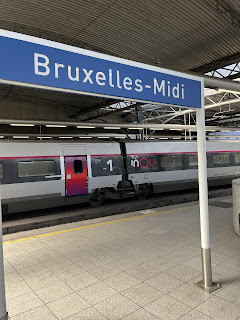
I had a tight connection in Brussels, fifteen minutes for a Deutsche Bahn ICE train to Frankfurt Airport and an on time arrival was good news. The bad news was that all of the shortcuts from Eurostar to the main station were closed, with a full complement of passengers attempting to make it past a narrow gap.I did make it to platform 5 though, although there was no sign of a train. Now there are certain expectations of German trains, the primary one being that they run on time. Given my final destination, it wasn’t a crisis, but for the two young Americans attempting to get to Kiel via five connections, it was looking a bit grim. I hope that they made it…
We were twenty minutes late into Frankfurt Airport, which meant a later train to my final stop for the day, Mannheim. And, again, the train to Basel was late, by about twenty minutes. So much for German efficiency, it seems… On the other hand, the hotel couldn’t have been much more convenient for the station and, having checked in and dropped off my luggage, it was time for a brief explore and a bite to eat.
Mannheim is not an obvious tourist destination, although it is convenient for Heidelberg, which most certainly is one. It is quite prosperous looking though, with a main shopping street full of big names from the retail sector, and the Innenstadt is very walkable. The main feature is the Wasserturm, an enormous water tower which stands at the eastern end of town.
Sleep was calling to me though, and I was soon back in the hotel, where I fell into a deep sleep, ready for another day…
Thursday, May 19, 2022
A genteel demonstration in the county town
Tuesday, May 17, 2022
Creeting St Peter - my reign of terror is at a close

Monday, April 25, 2022
Welcome to #allthestations… Liechtenstein…

I needed a drink after that climb and, most conveniently, at the bottom of the hill was a converted old American yellow school bus, serving burgers and local beer. I didn’t hesitate…
Vaduz has one of those slightly absurd land trains. But it was free, and I was intrigued to see what treats it might include. There was a lot of alpine music, and quite a lot of history, but little to lead you to believe that Vaduz is the sort of place that excites much. If you’ve got forty-five minutes to kill, it’s no worse than walking, but I wouldn’t suggest building your day of touristic activity around it.
I needed dinner and, for all of Vaduz’s charm, it isn’t price conscious. Ros had mentioned that she’d rather liked Feldkirch, across the Austrian border. And I just had time to get to Switzerland to catch the train… The somewhat occasional Buchs to Feldkirch service supplies Liechtenstein with its only scheduled train service and so I can now authoritatively claim that I have ridden the entire Liechtenstein rail network.
And Feldkirch did seem quite nice, at least what I got to see of it. The schnitzel was certainly worth the journey, although I deeply suspect that serving bad schnitzel is a criminal offence in Austria…
That left me with the task of getting back to my hotel, which is where the tri-national route 11 bus comes in. This leaves Feldkirch and runs the full length of Liechtenstein, via Schaan, Vaduz and Balzers, before ending its journey in Sargans, over the border in Switzerland, where you can connect to trains further into the country. And it’s a pretty ride too…
I got an early night, for I had an early start the next morning…
Friday, April 22, 2022
In which I learn that I’ve been pronouncing Vaduz incorrectly all these years…
It was a relatively gentle start, which was welcome after I’d arrived in Zurich just in time to catch the last shuttle to my hotel the previous evening. And it’s funny, isn’t it, how after a period travelling anywhere new, your confidence over what, prior to the pandemic, had been a relatively straightforward journey, is slightly, if not shaken, then not quite what it had been. Arriving at an airport after 10.30 in the evening felt a bit “edge of the seat”, even if I would have thought nothing of it a few years ago.
But everything had worked, and the adventure was underway.
Yes, I’d never been to Liechtenstein before, which comes almost as much of a surprise to me as it does to anyone else. But the mountains were snow-capped, and Vaduz seemed quiet and unhurried. My hotel was another new experience, a self check-in one - part of a small Swiss chain - but it all seemed to work and I found myself with time to explore.
It turned out that the National Treasure was self check-in too, as you placed the coin in a slot machine at the entrance which triggered the door to get inside, thus saving on the cost of a member of staff. And the National Treasure is a bit quirky, with everything from a Fabergé egg to one hand painted by one of the Princesses. But it’s quite impressive, all things considered. And the State Museum isn’t bad either, offering a potted history of what is a very small country. For example, I learned that, whilst Liechtenstein became a free nation in 1719, its rulers only took up permanent residence in 1938, after Anschluss. And, given what it is known for now, it was considered a bit rural and poverty-stricken until fairly recently.
I headed back to the relative warmth of Vaduz, before heading to Schaan, Liechtenstein’s transport hub, for a gentle stroll. For, not only does Schaan have a bus station, but also one of the country’s very few railway stations, immaculately kept and in an unusual shade of pink. There aren’t many trains, but neither the Swiss mainline station at Buchs, nor the Austrian mainline station at Feldkirch, are very far away.
I needed dinner though, so back to Vaduz for food and an early night. And now that I was paying attention, I realised what was puzzling me about the announcements. Vaduz is pronounced with an extra ‘t’ before the ‘z’, which I’d not appreciated. Now, I live in Suffolk, where we like to include letters that aren’t pronounced, so being somewhere where letters are pronounced but not written was a twist. I wonder what else I’ve been missing all these years…